Safety first: This is general money education, not personalised financial advice. Please read our financial disclaimer before you start.
Key takeaways
- Eight steps in about 2 hours 30 minutes covers the basics: numbers, bills, caps, savings and a weekly check-in (our timing estimate).
- Use last month's actual spending, not your hopes, as the starting point.
- Three caps (housing and bills, food, and everything else) are easier to keep than 20 small categories.
- Move savings on payday, even if it is $10 or $25 at first.
- Pick one 15 minute weekly check-in. A budget you look at weekly beats a polished one you never open.
In this post13 sections
- Why a One Evening New Year Budget Plan Works
- The Evening Plan at a Glance
- Step 1: Gather Your Numbers (20 minutes)
- Step 2: Total Your Real Monthly Income (10 minutes)
- Step 3: Sort Spending Into Three Buckets (30 minutes)
- Step 4: Audit Subscriptions and Bills (25 minutes)
- Step 5: Put Annual Bills on a Calendar (15 minutes)
- Step 6: Set Three Monthly Caps and a Savings Amount (20 minutes)
- Step 7: Automate Savings and Bill Dates (15 minutes)
- Step 8: Choose Your Weekly Check-In (15 minutes)
- What to Do If the Numbers Do Not Add Up
- Keep It Going Through February
- FAQ
Quick note: product links go to Amazon search results or our own shop, and we may earn a small commission if you buy, at no extra cost to you. Dollar amounts are labelled examples, not advice about your money, and prices change by store and week. This is general information, not financial advice.
Why a One Evening New Year Budget Plan Works
Most January budgets fail at the same point: the plan is too big. A spreadsheet with 25 categories and a daily tracking habit is hard to keep after week two. A short plan that fits one evening gets you a number, a cap and a check-in, which is enough to start. You can add detail in February.

If you want a slower route, our 30 day money reset spreads the same work over a month, and the no spend January rules add a spending pause. This article is the fast version.
The Evening Plan at a Glance
| Step | What you do | Time |
|---|---|---|
| 1 | Gather bank and card statements for the last 2 to 3 months | 20 minutes |
| 2 | Total your real monthly income | 10 minutes |
| 3 | Sort spending into fixed bills, food and everything else | 30 minutes |
| 4 | Audit subscriptions and bills for cuts | 25 minutes |
| 5 | Put annual bills on a calendar | 15 minutes |
| 6 | Set three monthly caps and pick a savings amount | 20 minutes |
| 7 | Automate savings and bill dates | 15 minutes |
| 8 | Choose a weekly check-in and write it down | 15 minutes |
| Total | 150 minutes (2 hours 30 minutes) |
Step 1: Gather Your Numbers (20 minutes)
Download or open statements for the last 2 to 3 months from every checking account and credit card. A paper pile or open browser tabs both work.

Step 2: Total Your Real Monthly Income (10 minutes)
Write down what lands in your account each month after tax, from every source. If your pay changes, use the lowest month from the last three. Budgeting from the low month avoids shortfalls.
Step 3: Sort Spending Into Three Buckets (30 minutes)
Skip the long category list. Sort every transaction into one of three buckets.
| Bucket | What goes in it | Example items |
|---|---|---|
| Housing and bills | Costs that are due regardless | Rent or mortgage, utilities, phone, insurance, minimum debt payments, transport to work |
| Food | Groceries and eating out together | Groceries, takeout, coffee, school lunches |
| Everything else | Spending you can change | Shopping, subscriptions, hobbies, gifts, fun |
Add up each bucket per month and compare the total to your income from step 2. If you spend more than you earn, step 4 and step 6 are where the money comes back. For a longer category guide, see our budget categories list. If you like a ready-made split, the 50/30/20 rule is a common starting point.
Step 4: Audit Subscriptions and Bills (25 minutes)

Quick audit checklist
Savings from this step are your own: they depend on your bills. We do not promise a number, but even cancelling two $10 subscriptions frees $20 a month, or $240 a year (our arithmetic).
Step 5: Put Annual Bills on a Calendar (15 minutes)

Annual and quarterly costs cause most budget surprises: car registration, insurance, school fees, holiday gifts. Write each on the calendar, then divide by 12 to get a monthly amount. For example, a $600 yearly cost is $50 a month. This is the idea behind sinking funds, and a Christmas sinking fund started in January makes next December far calmer.
Step 6: Set Three Monthly Caps and a Savings Amount (20 minutes)
Now turn your buckets into limits. Take the income from step 2, subtract the first bucket, and split what is left between food, everything else and savings. Here is an example with made-up numbers.
| Line | Monthly amount | Share of income |
|---|---|---|
| Housing and bills | $1,760 | 55% |
| Food | $480 | 15% |
| Everything else | $480 | 15% |
| Savings and debt extra | $480 | 15% |
| Total | $3,200 | 100% |
Your split will differ. The point is to have one number per bucket and a savings line that is paid first. If your bills take more than half, start with a small savings amount and raise it when a bill ends.

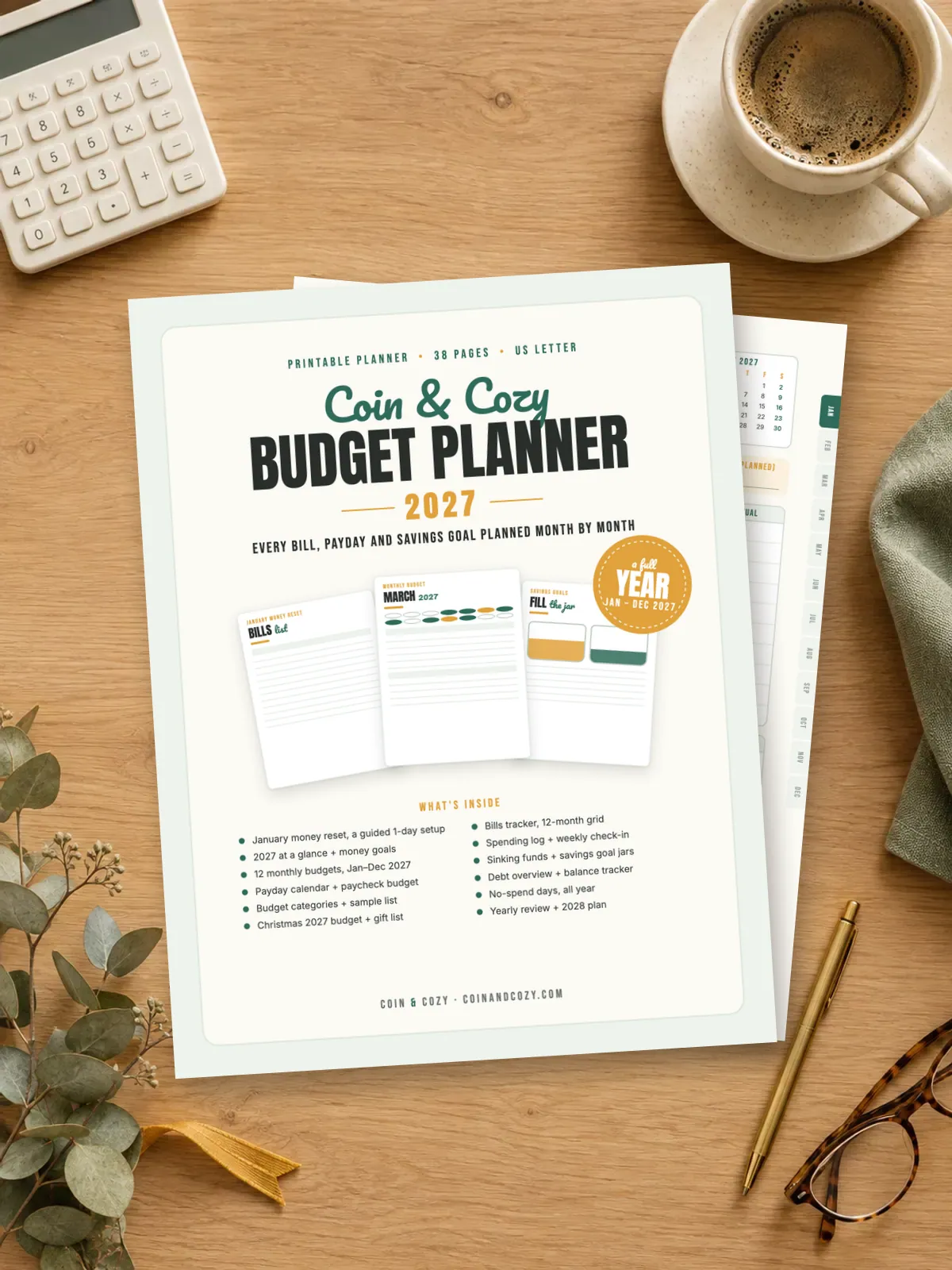
The shop's Cozy Budget Planner 2027 has monthly pages for exactly this: income, three caps, bills by date and a weekly check-in box.
Step 7: Automate Savings and Bill Dates (15 minutes)

-
Step 1: Set a transfer for payday
Create an automatic transfer from checking to savings on the day you are paid. Start at $10 or $25 a week if you need to.
-
Step 2: Match bill dates to pay dates
Ask providers to move due dates close to payday where you can. Fewer late fees, fewer surprises.
-
Step 3: Name the savings account
Give it a purpose such as Emergency Buffer. Our starter emergency fund guide shows realistic first targets.
Step 8: Choose Your Weekly Check-In (15 minutes)

Pick a time, such as Sunday morning for 15 minutes. At each check-in, do three things.
15 minute weekly check-in
Write the check-in time in your calendar now, before you close the planner. If you prefer a binder, our budget binder ideas show the pages worth printing, and the shop's Cozy Money Binder packages them.
What to Do If the Numbers Do Not Add Up
If your bills and food already use all your income, do not skip the plan. Pick one of three moves: lower one bill with a phone call, add a short-term income source, or reduce the Everything else bucket to a bare minimum for 60 days. Our low income budget guide and one paycheck ahead plan cover this case.

Keep It Going Through February
In the first week of February, do one 30 minute review. Compare real spending with your three caps, adjust any cap that was off by a lot, and add one more detail such as splitting groceries from eating out. Gradual detail beats a flawless-looking January.
For a savings habit that fits a small budget, try a 100 envelope or 52 week challenge alongside the plan, or the shop's Savings Challenge Bundle 2027.
Frequently asked questions
How long does it take to make a new year budget plan?
About 2 hours 30 minutes in our eight step estimate, if you have access to statements. A first pass with only income and three caps can take under an hour.
What should I do first when starting a budget in January?
Gather two to three months of statements and total your income. Everything else (caps, savings, bills) depends on those two numbers.
How many categories should a beginner budget have?
Three is enough to start: housing and bills, food, and everything else. Add detail after a month of checking in.
How much should I save each month?
There is no single right number. Start with an amount you can keep, such as $10 to $25 a week, and raise it when a bill ends. This is general information, not financial advice.
What if I miss a weekly check-in?
Do a short one the next day and keep the same time next week. The habit matters more than an unbroken streak.
Save it for later
Pin this to your Budgeting Basics board so it's there when you need it.
Save to Pinterest