This post contains affiliate links. As an Amazon Associate we earn from qualifying purchases, at no extra cost to you. Read our disclosure.
Safety first: This is general money education, not personalised financial advice. Please read our financial disclaimer before you start.
Key takeaways
- Start with $100, then $500, then $1,000, instead of six months of expenses.
- Find the first dollars with one week of tracking and 2 or 3 small swaps.
- Keep the fund in a separate account and automate a small transfer on payday.
- Send half of any windfall to the fund until it reaches $1,000.
- Write the rules for using it, and restart the transfer after you spend it.
In this post9 sections
- How to Build an Emergency Fund on a Low Income: Start Smaller Than You Think
- What You Need Before You Start
- How to Build an Emergency Fund on a Low Income in 6 Steps
- How Long Each Weekly Amount Takes
- Small Swaps That Find $5 to $15 a Week
- Emergency Fund Mistakes on a Low Income
- What to Do When You Have to Use It
- Where the Planner Pages Fit
- FAQ
| Question | Short answer |
|---|---|
| First goal | $100, then $500, then $1,000 |
| Where the first dollars come from | One week of tracking plus 2 or 3 small swaps |
| Where to keep it | A separate savings account, not your checking |
| How to pay it | A small automatic transfer on every payday |
| What to send it | Tax refunds, bonuses, birthday money, selling things you no longer use |
| When to use it | Only for the rules you wrote down, then rebuild |
How to Build an Emergency Fund on a Low Income: Start Smaller Than You Think
Most advice says to save three to six months of expenses. On a tight income that number can feel like a reason not to start. A starter emergency fund is a different goal: a small cushion you can finish, so the next flat tire or urgent care bill does not land on a credit card. The Federal Reserve's report on household well-being, released May 28, 2025, found that 63 percent of adults said they would cover a $400 emergency expense using cash or its equivalent. That means many households are one surprise away from borrowing, and a small fund changes that.
This guide is about the first $500 to $1,000, built in tiny weekly amounts. If you want the full target for your bills, read how much an emergency fund should be. If money is tight right now, stay here.
What You Need Before You Start
Starter fund setup list
How to Build an Emergency Fund on a Low Income in 6 Steps
-
Step 1: Pick a first goal small enough to finish
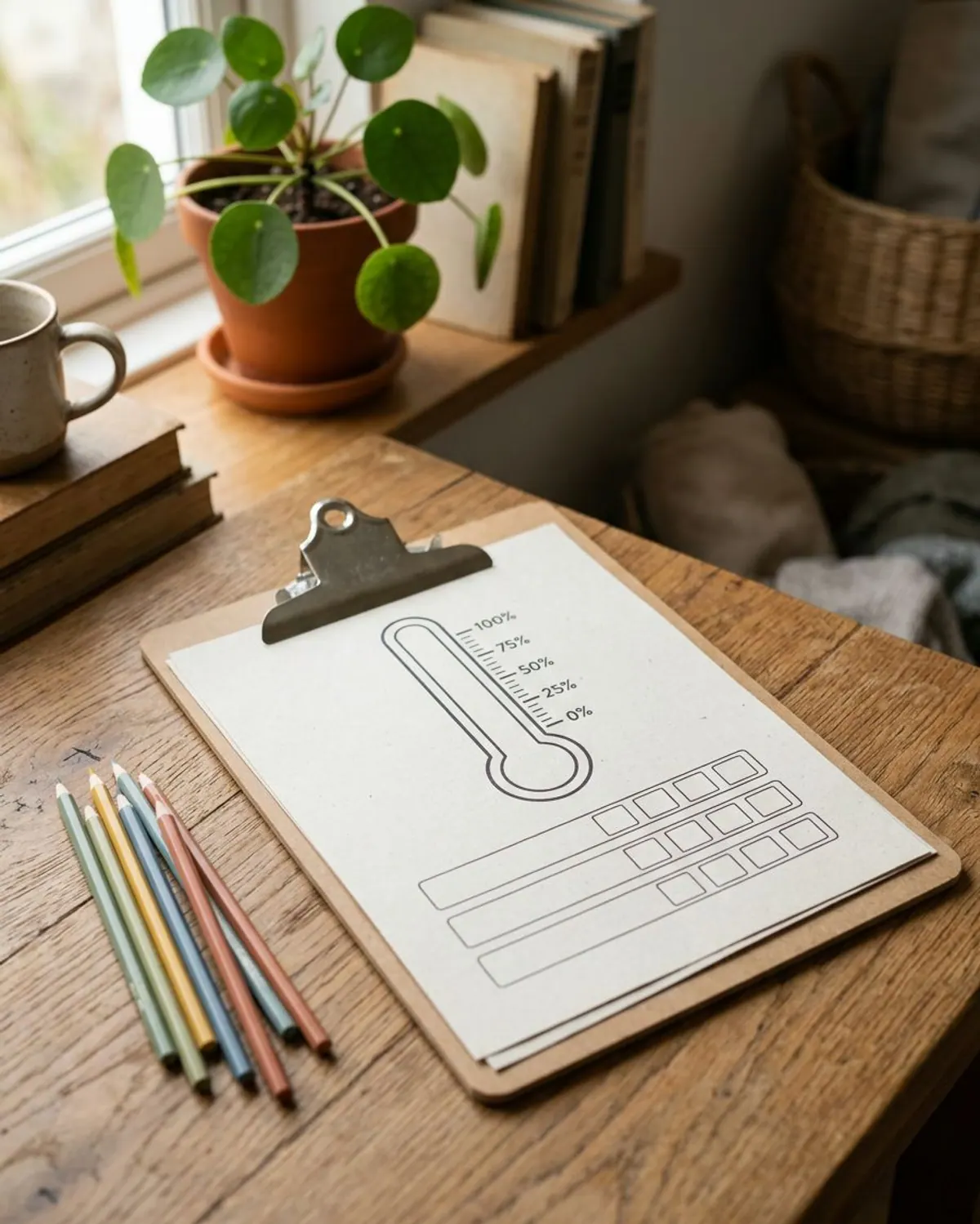
Skip the six-month target for now. Set $100 as goal one, $500 as goal two and $1,000 as goal three. A goal you can reach in a few weeks keeps you going; a goal that takes years gets quietly dropped. Write the three numbers on your tracker and color in each one as you pass it.
-
Step 2: Find the first dollars with one week of tracking
For 7 days, write down every purchase, even the $3 ones. At the end, circle the 2 or 3 that you would not miss. You are not cutting your life down; you are finding $5 to $15 a week that was leaking. The budget planner for beginners shows how to turn that list into a monthly plan.
-
Step 3: Give the fund its own home
Money in your checking account gets spent. Open a separate savings account, preferably at a different bank or one without a debit card, so moving the money takes a deliberate step. If an account is not possible yet, keep a labeled envelope at home and move it to savings once you reach $100. Check that any account is insured and has no monthly fee before you put money in.
-
Step 4: Automate a small amount on payday
Set a transfer that fires the day you are paid. $10 a week is a real start, and $5 a week still beats waiting until you have extra. If your income swings from week to week, use a percentage instead, like 2 to 5 percent of each deposit. If you are paid every two weeks, the biweekly budget guide shows how to place the transfer on each check.
-
Step 5: Send windfalls to the fund
Most low-income households have a few lumps of cash a year: a tax refund, a work bonus, a birthday check, money from selling something you no longer use. Decide ahead of time that half of any windfall goes to the fund until you hit $1,000. Half keeps it feeling like a treat, and the other half still counts.
-
Step 6: Write the rules for using it, then rebuild
Decide now what counts: a car repair you need to get to work, an urgent medical or vet bill, a lost-income gap, a broken appliance you cannot do without. Sales, trips and predictable costs do not count; give those their own sinking funds. When you do use the fund, write the date and amount on the tracker and restart the weekly transfer the same payday. Using it is the fund doing its job, not a failure.





How Long Each Weekly Amount Takes
The math is simple division, and seeing it helps you choose an amount you will keep up. These are examples, not predictions: your timeline depends on your real income and bills, and interest is left out.
| Saved each week | $100 | $500 | $1,000 |
|---|---|---|---|
| $5 | 20 weeks | 100 weeks | 200 weeks |
| $10 | 10 weeks | 50 weeks | 100 weeks |
| $15 | 7 weeks | 34 weeks | 67 weeks |
| $25 | 4 weeks | 20 weeks | 40 weeks |
| $40 | 3 weeks | 13 weeks | 25 weeks |
Small Swaps That Find $5 to $15 a Week
You do not need a big budget overhaul. Pick two or three of these, and move the saved amount to the fund the same day so it does not disappear.

| Swap | What to do with it |
|---|---|
| Make coffee at home two mornings a week | Move the price of one café coffee to the fund |
| Bring lunch one extra workday | Move what you would have spent that day |
| Check subscriptions you forgot | Cancel one, then move its monthly price over weekly |
| Use a grocery list and skip the second trip | Move one impulse purchase to the fund |
| Sell one item you no longer use | Send the whole sale to the fund |
If your budget has no room at all, the low-income savings challenges are built for $1 and $5 starts. A bigger shift, like staying one paycheck ahead, comes after the starter fund.
Emergency Fund Mistakes on a Low Income
Do this
- Start with $100 and a tracker
- Move money on payday, before you can spend it
- Keep the fund separate from checking
- Send half of every windfall to it
- Restart the transfer right after you use the fund
Skip this
- Waiting until you have a lot extra
- Aiming for six months on day one
- Keeping it in the account with your debit card
- Counting a planned bill as an emergency
- Quitting the weekly transfer after one withdrawal
What to Do When You Have to Use It
Spend the money, then look at your rules card. If the cost matched the rules, you did what the fund is for. Write the date and amount on the tracker, and restart the weekly transfer the next payday, even if it is only $5. If the fund was not enough, pay the bill in the order that protects housing, utilities and transport first, and ask the biller about a payment plan before using a credit card.

A starter fund does not have to be big to work. It only has to be there before the surprise is.
Where the Planner Pages Fit
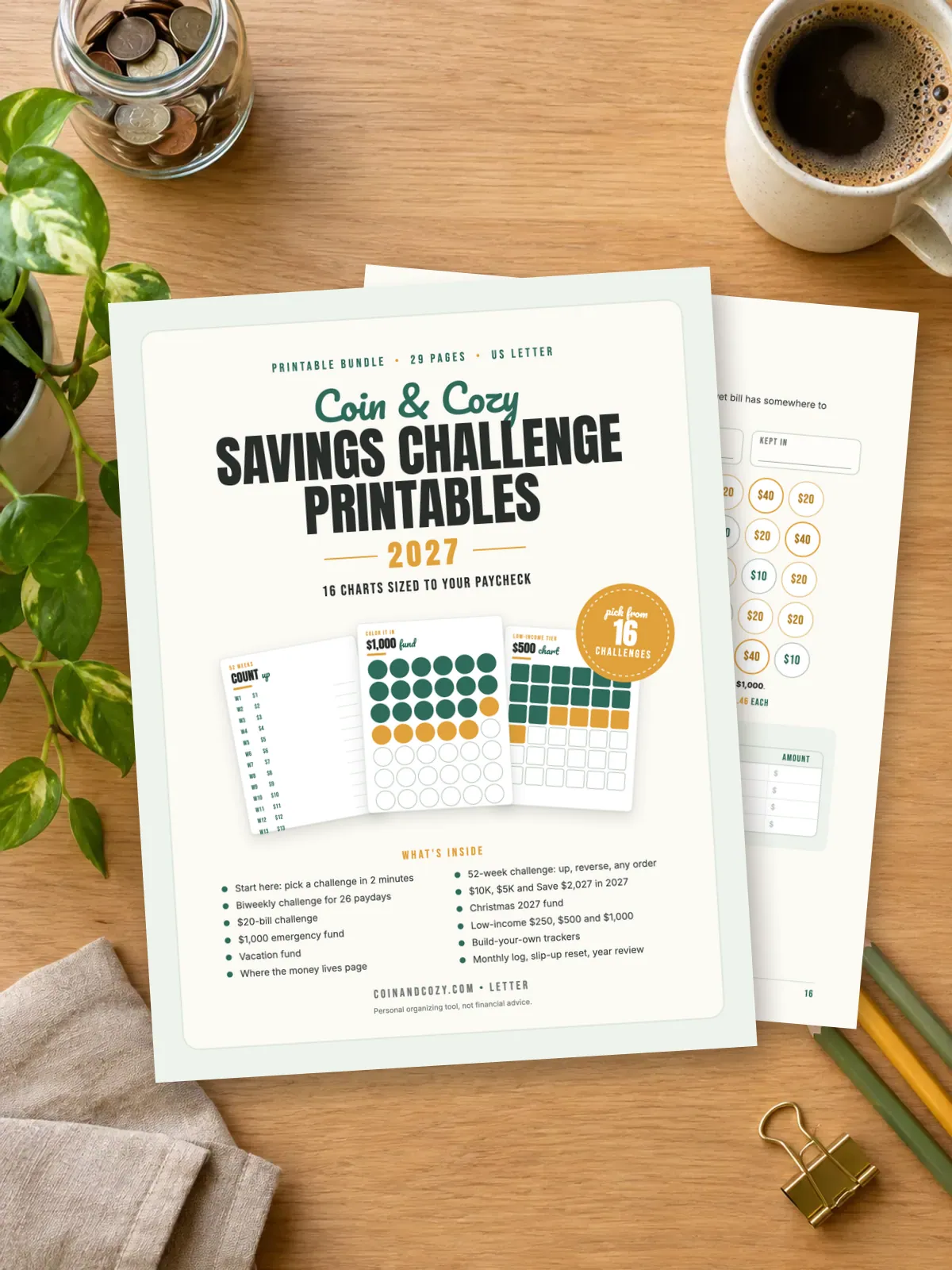
If you like seeing the plan in one place, the Savings Challenge Printables 2027 include a $1,000 emergency fund chart, $500 and $250 charts with small boxes, and a weekly table from $5 to $50. The paycheck chooser page helps you find an amount that fits. All of it is a personal organizing tool, not financial advice.
Supplies for tracking your starter fund
-
Pocket savings tracker notebook
Typically $6 to $12
A small place to log every deposit and withdrawal.
Check price on Amazon for Pocket savings tracker notebook -
Set of colored pencils
Typically $5 to $12
For coloring in each goal on the thermometer tracker.
Check price on Amazon for Set of colored pencils -
Labeled cash envelopes
Typically $6 to $12
A home for the fund until you open a savings account.
Check price on Amazon for Labeled cash envelopes
Frequently asked questions
How do I build an emergency fund on a low income?
Set a small first goal of $100, find $5 to $15 a week by tracking one week of spending, keep the money in a separate savings account, automate a transfer on payday and send half of any windfall to it. Raise the goal to $500, then $1,000. These are example numbers, not financial advice.
How much should I save for an emergency fund on a low income?
Start with $100, then $500, then $1,000. Once the starter fund is in place, work toward one month of must-pay bills. The right number depends on your own bills and income.
Is $500 enough for an emergency fund?
It covers many small surprises, like a tire, a phone repair or a vet visit, but not a job loss. Treat $500 as step two of a staircase, not the finish line.
How can I save $1,000 in an emergency fund with a low income?
At $25 a week it takes about 40 weeks; at $10 a week, about 100 weeks. Adding half of each tax refund or bonus shortens that a lot. These are simple division examples.
Where should I keep an emergency fund?
A separate, insured savings account you can reach within a day or two. Avoid keeping it in your everyday checking account, where it is easy to spend.
What counts as an emergency?
Costs you cannot avoid and did not plan for: urgent car repairs needed for work, medical or vet bills, lost income, or a broken appliance you need. Planned bills and sales do not count.
Save it for later
Pin this to your Budgeting Basics board so it's there when you need it.
Save to Pinterest