This post contains affiliate links. As an Amazon Associate we earn from qualifying purchases, at no extra cost to you. Read our disclosure.
Safety first: This is general money education, not personalised financial advice. Please read our financial disclaimer before you start.
Key takeaways
- Start with your minimum monthly cost, the bills that must be paid to keep housing, power, food and transport.
- Pay essentials in order: housing, utilities, food, transport, health, then minimum debt payments.
- Pick a method that fits tight money; the 50/30/20 rule may not, so adjust it.
- Put $5 to $15 a week in a small buffer before anything else you can control.
- Check 211, Benefits.gov, SNAP and LIHEAP before you assume there is no help.
In this post6 sections
| Question | Short answer |
|---|---|
| Where to start | Your minimum monthly cost: housing, utilities, food, transport, health |
| Which method | Zero-based or cash envelopes; adjust the percentages to your real rent |
| First savings goal | A small buffer, $5 to $15 a week |
| Where to find money | Subscriptions, bill calls, grocery plan, assistance programs |
| How often to review | 15 minutes every payday and once a month |
How to Budget on a Low Income: Start With Your Floor
Most budget advice assumes you have room to move. On a tight income, the first job is different: make sure the essentials are covered every month, then spend what is left on purpose. Experian advises putting housing, food, utilities, health care and transportation at the top of the list when money is short, and that is the order used below.
If you are the only earner in your home, our single mom budget guide walks through the same idea with one-income examples. If you are paid every two weeks, the biweekly budget guide shows how to split each check.
Low Income Budget in 7 Steps
-
Step 1: Find your minimum monthly cost
Write down take-home pay (what lands in your account after taxes). Then list only what must be paid to keep your housing, utilities, food, phone, transport to work, health costs and minimum debt payments. That total is your floor. Use the last three months of statements, not guesses.
-
Step 2: Pay essentials in order
When money is short, the order matters: housing first, then utilities, then food, then transport, then health, then minimum payments on debt. Write the order at the top of your budget page so the decision is already made when a bill comes in early. If you cannot cover everything, call the biller before the due date; many will set up a payment plan.
-
Step 3: Pick a method that fits
The 50/30/20 rule assumes needs take half your pay, which is not true in many places. Stash notes that a 60/30/10 split may be more realistic on a low income. A zero-based budget, where income minus every planned expense equals zero, or cash envelopes for groceries and fun money, often works better. Read the zero-based budget guide or how to start the cash envelope system to choose.
-
Step 4: Give every dollar a job
Use the sample budget below as a template. Assign every dollar of take-home pay to a line before the month starts, including a small buffer and a small amount for fun. Fun money is not a luxury; it keeps a plan from falling apart in week three.
-
Step 5: Trim and check for help
Look for subscriptions you do not use, call providers to ask for a lower rate and plan groceries around a list. Then check assistance: call or search 211, search Benefits.gov for programs you may qualify for, look at LIHEAP for help with energy bills and ask your state about SNAP and Medicaid. Eligibility depends on your household and state, so apply instead of assuming.
-
Step 6: Build a tiny buffer first
Even $5 to $15 a week starts a cushion for a flat tire or a copay. Aim for $100, then $500. The emergency fund on a low income guide has a weeks-to-goal table. If you carry card debt, keep making minimums while you build the buffer so a surprise does not go back on the card.
-
Step 7: Review every payday and raise the gap
The gap is income minus expenses. You can widen it by lowering a bill, or by adding income: asking for hours, a small side job or selling things you no longer use. Review for 15 minutes on payday, move any extra to the buffer and adjust one number if it did not work. Our money saving challenges for low income budgets give you low-pressure ways to save.







A Sample Low Income Budget: $2,400 a Month
This is an example for a household taking home $2,400 a month. Your rent, region and family size will change every line, so use it as a shape, not a target.
| Line | Amount | Notes |
|---|---|---|
| Housing (rent or mortgage) | $850 | Paid first |
| Utilities | $150 | Power, water, trash |
| Groceries | $400 | Plan around a list |
| Transport | $250 | Gas, pass or car payment share |
| Phone and internet | $90 | Lowest plan you can use |
| Insurance and health | $100 | Renters, car or copays |
| Minimum debt payments | $120 | Never skip these |
| Household and personal basics | $60 | Soap, cleaning, toiletries |
| Essentials total | $2,020 | 84% of take-home |
| Starter buffer | $60 | About $15 a week |
| Sinking funds | $80 | Car repairs, birthdays, school costs |
| Fun money | $50 | So the plan survives |
| Flex | $190 | Spend only if a line runs over; otherwise move it to savings |
| Grand total | $2,400 | Every dollar has a job |
Check the math: $850 + $150 + $400 + $250 + $90 + $100 + $120 + $60 = $2,020. Add $60 + $80 + $50 + $190 and you reach $2,400. Essentials take 84 percent of this example, which is why a 50/30/20 split does not fit.


If Your Income Changes Every Month
If your hours or pay change, budget off your lowest recent month, and treat anything above it as extra for the buffer. List essentials first, and in a high month pay the next month's bills early. A weekly check is easier than a monthly one when pay is uneven.
Low income budget checklist

Tools That Help (Paper or App)
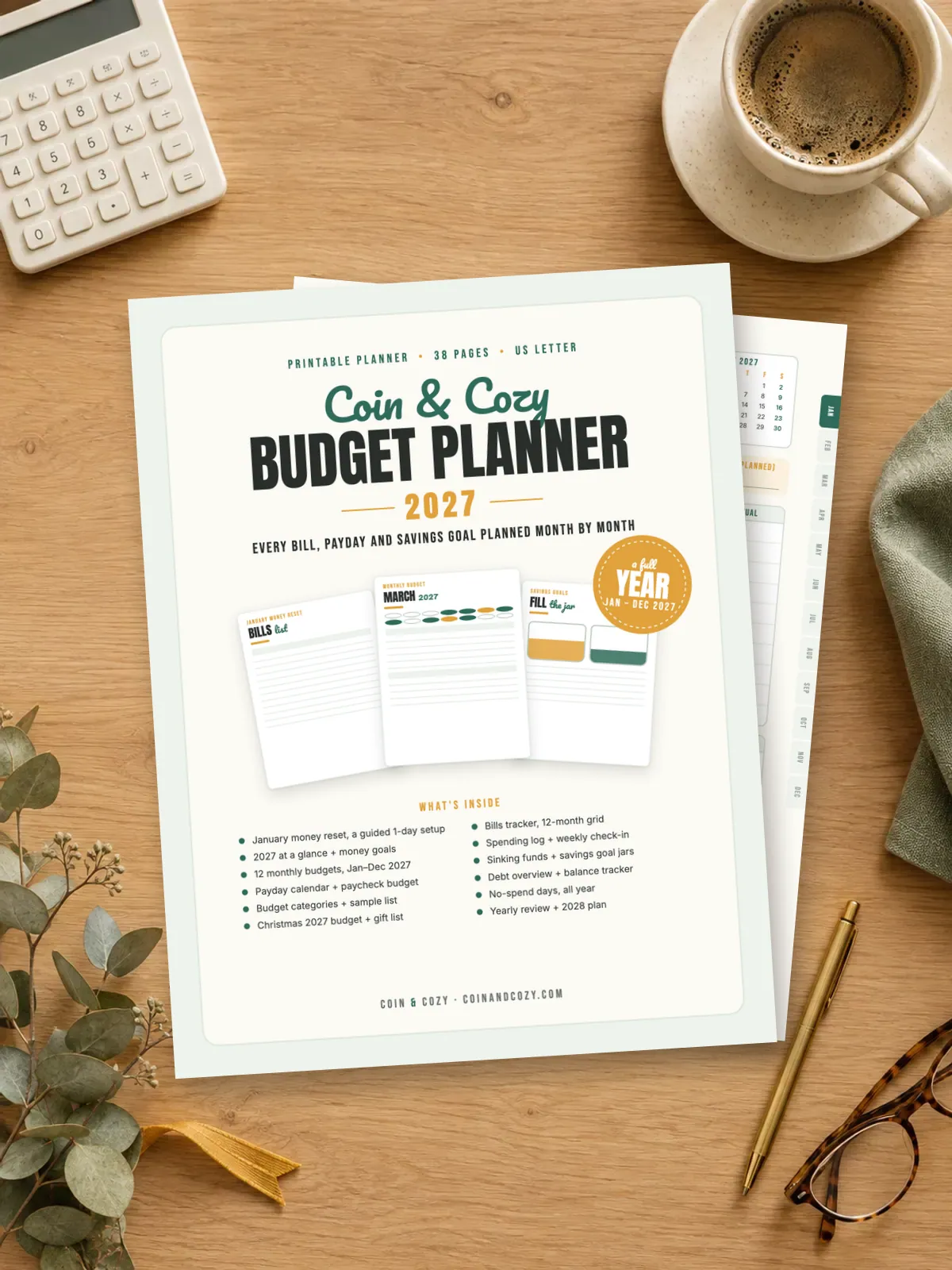
A free app or a paper planner can keep this visible. Our best budgeting apps guide compares free and paid options, and the Cozy Budget Planner 2027 has monthly pages, a payday calendar and a sinking funds page. A printable is a personal organizing tool, not financial advice.
Supplies for a paper low income budget
-
Undated monthly budget planner
Typically $10 to $20
A paper home for the sample budget and each payday.
Check price on Amazon for Undated monthly budget planner -
Basic solar calculator
Typically $5 to $12
Checks the math without opening your phone.
Check price on Amazon for Basic solar calculator -
Labeled cash envelopes
Typically $6 to $12
For groceries and fun money categories.
Check price on Amazon for Labeled cash envelopes -
Pocket accordion file
Typically $6 to $14
Keeps bills and statements in payday order.
Check price on Amazon for Pocket accordion file
This guide is for general information and is not financial advice. The budget is an example and your numbers will be different. For help with debt or benefits in your own situation, talk to a nonprofit credit counselor or your local benefits office.
Frequently asked questions
How do you budget on a low income?
Find your minimum monthly cost, pay essentials in order (housing, utilities, food, transport, health, minimum debt payments), give every remaining dollar a job, start a buffer of $5 to $15 a week and check assistance programs. Review on every payday.
Does the 50/30/20 rule work on a low income?
Often not, because rent, food and utilities can take more than 50 percent of pay. A split like 60/30/10 or a zero-based budget with your real numbers usually fits better. In our $2,400 example, essentials take 84 percent.
How can I save money on a low income?
Start with a buffer of $5 to $15 a week, cancel unused subscriptions, call providers to lower bills, plan groceries around a list and send half of any windfall to savings.
Where can I find help paying bills?
Call or search 211, search Benefits.gov, look at LIHEAP for energy bills and ask your state about SNAP and Medicaid. Programs and eligibility vary by household and state.
What if my income changes every month?
Budget from your lowest recent month, treat anything above it as extra for savings and review weekly instead of monthly.
Save it for later
Pin this to your Budgeting Basics board so it's there when you need it.
Save to Pinterest