Safety first: This is general money education, not personalised financial advice. Please read our financial disclaimer before you start.
Key takeaways
- 8 weekly deposits of $37.50, $75, $112.50 or $150 reach a $300, $600, $900 or $1,200 Christmas goal (our arithmetic).
- In a 2025 AICPA and Harris Poll survey, 47% of U.S. adults expected to go into debt for holiday gifts, travel or both, and 79% of those planning to spend said they would use a credit card.
- 52% of those planning to use a card did not expect to pay the balance in full when the bill arrived, so 'put it on the card' often becomes January debt.
- Write the goal first, then cut the gift list to fit it. Never the other way around.
- If debt is already coming, stop adding to it and pay more than the minimum on the highest-rate card first.
In this post9 sections
- Why a Debt Free Christmas Starts in the First Week of November
- Step 1: Pick a Christmas Goal You Can Pay in Cash
- Step 2: Split the Goal Into Lines Before You Shop
- Step 3: Trim the List Until It Fits
- Step 4: Find the Extra Cash Without Borrowing
- Step 5: Use Cash or a Debit Card, and Check the Total After Every Trip
- If Holiday Debt Is Already Coming
- A Simple Week by Week Check
- FAQ
Quick note: product links go to Amazon search results or our own shop, and we may earn a small commission if you buy, at no extra cost to you. Dollar amounts are labelled examples, not advice about your money, and prices change by store and week. This is general information, not financial advice.
Why a Debt Free Christmas Starts in the First Week of November
The Christmas money problem is rarely one big purchase. It is a dozen small ones, each easy to put on a card, and a bill that lands after the holiday. The AICPA surveyed 2,084 U.S. adults with The Harris Poll from October 28 to 30 in 2025: 47% expected holiday debt, and 79% of people planning gift or travel spending expected to use a credit card (Journal of Accountancy).
The same survey found that 52% of those planning to use a card did not expect to pay it in full when the statement arrived, and 17% expected holiday debt to take more than six months to pay off. Those are 2025 numbers, but the pattern is easy to see in any year: the plan matters more than the willpower.

Step 1: Pick a Christmas Goal You Can Pay in Cash
Look at what you can set aside from now until December 20. Count only money you have or will be paid, not money you hope for. If you need a starting point, our Christmas budget calculator and the 2026 Christmas budget numbers article show how others split it.
| Christmas goal | Weekly deposit (8 weeks) | Every two weeks (4 deposits) | What it usually covers (example) |
|---|---|---|---|
| $300 | $37.50 | $75 | Two kids, a name draw for adults and a simple meal |
| $600 | $75 | $150 | Kids' gifts, adult gifts, stockings and a family meal |
| $900 | $112.50 | $225 | The above plus teacher gifts, cards, wrap and some travel |
| $1,200 | $150 | $300 | The above plus hosting, a bigger meal and a buffer |
Step 2: Split the Goal Into Lines Before You Shop
A goal alone does not stop overspending. Lines do. Here is one example split of a $600 goal, which you can scale up or down.
| Line | Cap | Share |
|---|---|---|
| Kids' gifts | $220 | 37% |
| Adult gifts | $90 | 15% |
| Stockings | $60 | 10% |
| Christmas meal | $120 | 20% |
| Cards, wrap and decor | $50 | 8% |
| Teacher and neighbor gifts | $30 | 5% |
| Buffer | $30 | 5% |
| Total | $600 | 100% |
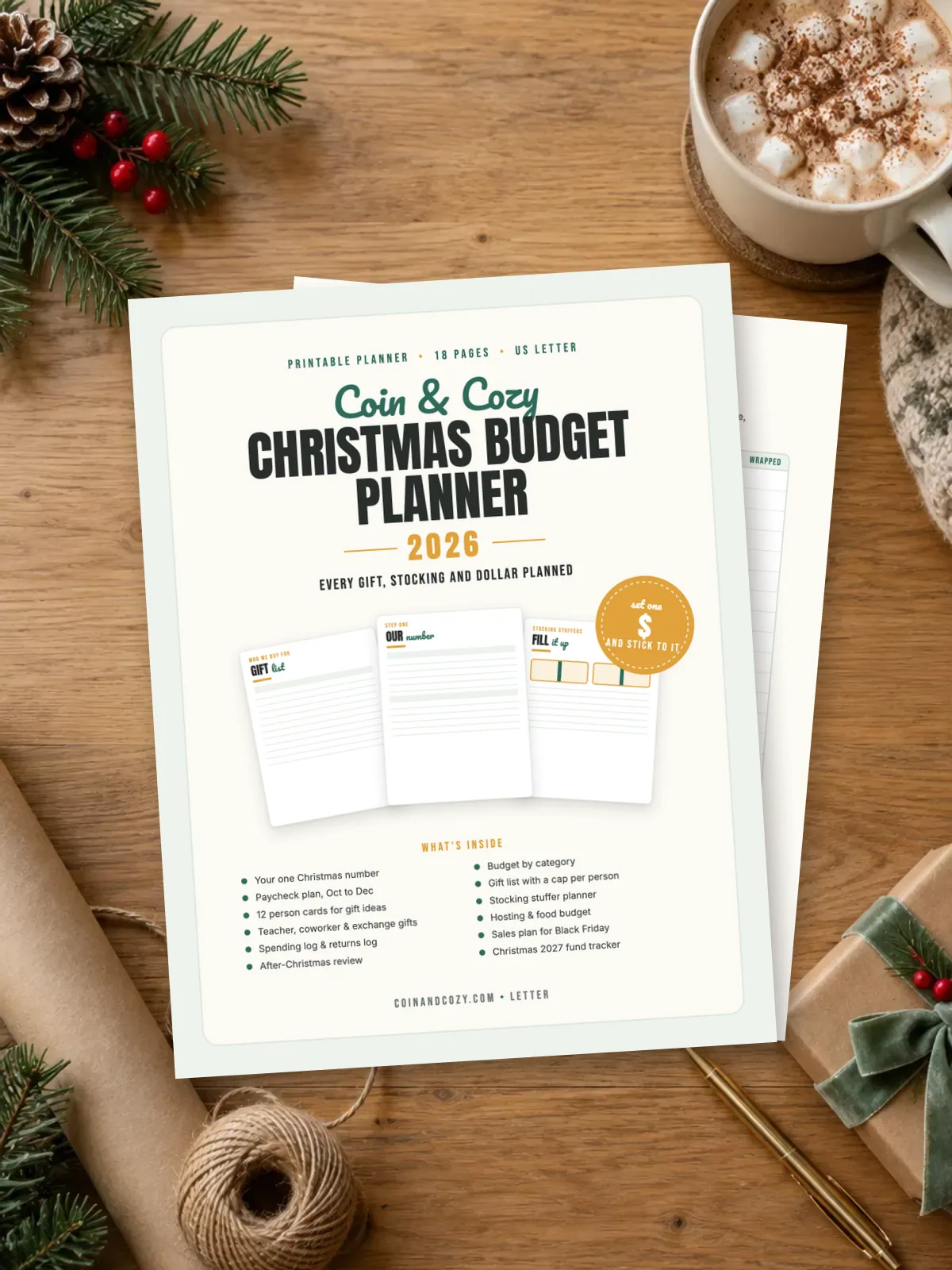
The shop's Christmas Budget Planner has these lines already set up, with a paycheck plan, a gift list with a cap beside each name and a spending log. If you would rather use a notebook, three columns (planned, spent, left) do the same job.

Step 3: Trim the List Until It Fits
If your gift list adds up to more than your goal, trim the list, not the plan. These moves cut the most without anyone noticing.
-
Step 1: Draw names for adults
One name per adult with a $15 to $25 cap replaces a dozen gifts with one good one. Add a family gift swap if you host.
-
Step 2: Set a number per child, then stop
Choose a total for each child and write it on the list. Count stockings inside the total, not on top of it.
-
Step 3: Build the meal from the pantry first
Check what you already have, then shop for the gaps once. Our Christmas dinner on a budget article has menu ideas under a set total.
-
Step 4: Put a 24 hour rule on anything not on the list
Add it to a note, wait a day, and buy it only if a line has room. Most impulse gifts quietly disappear.
-
Step 5: Lower the goal instead of borrowing
If the list still costs more than the cash you will have by December 20, lower the goal and the caps. A smaller plan paid in full beats a bigger one on a card.


Step 4: Find the Extra Cash Without Borrowing
If the weekly deposit is more than your budget can bear, there are three honest ways to find room. Pick one or two, not all three.
Ways to raise your Christmas cash

A short no-spend stretch also frees up weekly cash. Our no spend November rules and no spend December activities list give you structure.
Step 5: Use Cash or a Debit Card, and Check the Total After Every Trip
Paying with cash or a debit card makes the limit visible. Put each line's money in an envelope or a labelled savings pocket, and write the balance on the front after each purchase. If you use a card for points or protection, only do it when the matching cash is already set aside to pay the statement in full.

If Holiday Debt Is Already Coming
If you already put gifts on a card, do not add to it. List the balance, the rate and the minimum, then decide a monthly payment above the minimum. As a simple example that ignores interest: a $900 holiday balance paid at $150 a month takes 6 months, while at $300 a month it takes 3 months. Real interest makes it longer, so check your card's rate.
Our credit card debt payoff plan walks through ranking cards and choosing a method, the debt payoff tracker guide compares snowball and avalanche, and the debt payoff coloring pages make progress visible. The shop's debt payoff tracker printables are a printed version of that idea.

A Simple Week by Week Check
| Weeks | What to do |
|---|---|
| Week 1 (Nov 1) | Pick the goal, write the lines, set up the first deposit |
| Weeks 2 to 3 | Finish the gift list with caps; start a sell box |
| Week 4 (Nov 27 to 30) | Black Friday: only buy list items, at or under your target price. See our Black Friday budget plan |
| Weeks 5 to 6 | Buy gifts in cash, check the log, adjust the buffer |
| Week 7 | Plan and shop for the meal once |
| Week 8 (Dec 20) | Wrap, count what is left, move any buffer to January |
If you want a bigger long-term fix, a Christmas sinking fund started in January makes next year's weekly amounts much smaller.
Frequently asked questions
How do I have a debt free Christmas with little time left?
Pick a goal you can pay from the next 8 weeks of pay, divide it into weekly deposits, and cut the gift list to fit. A $600 goal needs $75 a week in our example.
How much should I save per week for Christmas?
Divide your goal by the weeks left. With 8 weeks, $300 is $37.50 a week, $600 is $75, $900 is $112.50 and $1,200 is $150. These are examples, not advice about your money.
Is it ever okay to use a credit card for Christmas?
Some people use a card for protection or rewards when the matching cash is already set aside to pay the statement in full. If that is not true for you, use cash or debit.
What if I already have holiday debt?
Stop adding to it, list the balance and rate, and pay more than the minimum. Our credit card debt payoff plan shows how to choose between methods.
How do I stop overspending on Christmas gifts?
Write a cap beside every name before you shop, count stockings inside it, and wait 24 hours before buying anything that is not on the list.
Save it for later
Pin this to your Budgeting Basics board so it's there when you need it.
Save to Pinterest