This post contains affiliate links. As an Amazon Associate we earn from qualifying purchases, at no extra cost to you. Read our disclosure.
Safety first: This is general money education, not personalised financial advice. Please read our financial disclaimer before you start.
Key takeaways
- Your Christmas number is money you have plus money you'll be paid before Christmas, not what other people spend.
- Split it before you shop: an example starting point is 60% gifts, 20% food, 10% decor and wrap, 10% buffer.
- Set caps per child and per person, then check that they add up to your gift line.
- Plan by payday so the last purchases land before December 20.
- If the number feels small, close the gap with the 8 no-credit ideas below, not a card.
In this post11 sections
- Christmas Budget Calculator: Enter What You Have
- What the Result Shows
- How Much to Spend on Christmas: Why Money You Have Beats the Average
- What Is a Good Christmas Budget? Three Example Households
- How Much to Spend on Christmas per Child (Fair Between Kids)
- Gifts for Everyone Else (Example Caps)
- The Payday Plan Before December 20
- 8 Ways to Close the Gap Without Credit
- Print It: The Christmas Budget Planner
- Start the Christmas 2027 Fund in January
- FAQ
Christmas Budget Calculator: Enter What You Have
Free calculator
Your Christmas number
Fill in what you have. The total updates as you type. Nothing you enter leaves this page.
Your Christmas number $0
| Category | Share | Amount |
|---|---|---|
| Gifts and stockings | 60% | $0 |
| Food and hosting | 20% | $0 |
| Decor, cards and wrap | 10% | $0 |
| Buffer for the things you forget | 10% | $0 |
The split above is an example to start from, not advice. Change the percentages to fit your family. Only count money you already have or will be paid before Christmas, not credit.
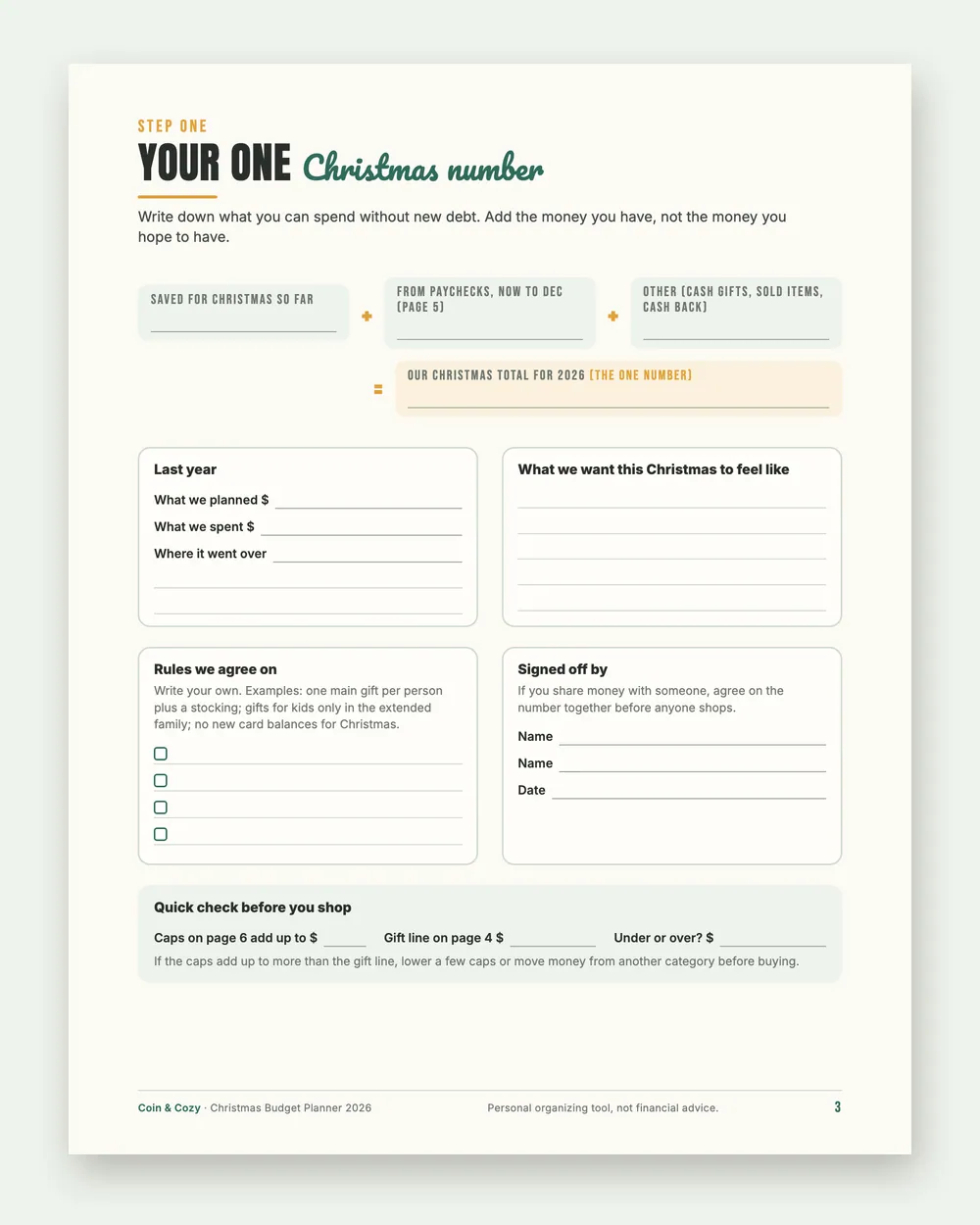
Want this on paper, with the caps, stockings and receipts all in one place? The Cozy Christmas Budget & Gift Planner ($6, 18 printable pages) starts with this same one-number page, then gives you a paycheck plan with this year's key dates, a 22-person gift list with caps, 12 person cards, a stocking planner for 8 stockings, a hosting budget and a returns log.
What the Result Shows
Your Christmas number is saved money plus each payday's set-aside times the paydays left before December 20, plus other money like gift cards or a bonus. The table splits it into four lines, and the gift cap is the gift line divided by the people you buy for, stockings included. Change the split percentages if hosting matters more to you than gifts; the calculator warns you if they don't add up to 100%.
How Much to Spend on Christmas: Why Money You Have Beats the Average
You'll see a lot of headlines about what the "average" family spends. That number tells you nothing about your rent, your paychecks or your January. The only Christmas budget that works is built from money you already have or will be paid before the holidays. Anything above that becomes a bill in the new year.

What Is a Good Christmas Budget? Three Example Households
Here's the calculator run for three made-up households, using the default split. These are example numbers, not financial advice.
| Household | Saved | Per payday x paydays left | Other money | Christmas number |
|---|---|---|---|---|
| A: one parent, 2 kids, paid every 2 weeks | $150 | $60 x 4 = $240 | $50 gift card | $440 |
| B: two parents, 3 kids, paid twice a month | $300 | $100 x 4 = $400 | $100 bonus | $800 |
| C: two adults hosting family, paid weekly | $200 | $40 x 9 = $360 | $0 | $560 |
| Household | Gifts and stockings | Food and hosting | Decor, cards, wrap | Buffer |
|---|---|---|---|---|
| A (60/20/10/10) | $264 | $88 | $44 | $44 |
| B (60/20/10/10) | $480 | $160 | $80 | $80 |
| C, hosting (45/35/10/10) | $252 | $196 | $56 | $56 |

How Much to Spend on Christmas per Child (Fair Between Kids)
The calculator's gift cap divides evenly. Most families then shift it: kids get a bigger share, adults a smaller one. Keep each child's cap the same, and count the stocking inside that cap so one child's stocking doesn't quietly outgrow another's.
| Household | Gift line | Per child (gift + stocking) | Left for everyone else |
|---|---|---|---|
| A, 2 kids | $264 | $80 ($65 + $15) | $104 |
| B, 3 kids | $480 | $100 ($80 + $20) | $180 |

For ideas that fit a cap, see our budget-friendly Christmas gifts for kids.
Gifts for Everyone Else (Example Caps)
| Person | Example cap |
|---|---|
| Partner | $30 to $60 |
| Parents and siblings | $15 to $25 each, or one family gift |
| Teachers and coaches | $5 to $10 |
| Coworkers and gift exchanges | $10 to $15 |
| Neighbors | A $5 homemade treat |
Add up the caps before you buy anything. If they're more than the gift line, lower a few caps now, not at the register. Our cheap gifts for friends and coworkers list stays under $10.
The Payday Plan Before December 20
Write every payday between now and December 20, and what you'll set aside from each one. Then match purchases to paydays: gifts that need shipping first, before mid-December shipping cutoffs; Black Friday (November 27) and Cyber Monday (November 30) only for things already on your list; food and hosting last, in the final week. If your last payday is December 18 or 19, plan that check for groceries, not gifts.
| Payday | Set aside | What it pays for |
|---|---|---|
| Oct 30 | $60 | Kids' main gifts (ordered early) |
| Nov 13 | $60 | Stockings and teacher gifts |
| Nov 27 | $60 | Gifts for everyone else, from the list only |
| Dec 11 | $60 | Food, wrap and the buffer |

8 Ways to Close the Gap Without Credit
-
Step 1: Lower the caps before shopping
One main gift plus a stocking per child is plenty. Cutting $10 from six caps frees $60.
-
Step 2: Draw names for the adults
A gift exchange with one $20 cap replaces five or six separate gifts.
-
Step 3: Sell three things you don't use
Outgrown toys, kids' clothes and books sell well before the holidays.
-
Step 4: Pause one subscription until January
Move that monthly amount into the Christmas fund instead.
-
Step 5: Make the "everyone else" gifts
Baked treats or a small homemade gift for neighbors and coworkers keeps those caps at a few dollars.
-
Step 6: Shop your house for wrap and decor
Kraft paper, twine and greenery cost little. For more decor ideas on a small budget, Linen & Lamp's cozy Christmas decor ideas, most under $20 is a good start.
-
Step 7: Use what's already yours
Gift cards in the drawer, cash-back balances and store credit from returns all count as other money in the calculator.
-
Step 8: Run a short no-spend stretch
Two no-spend weeks in November can add a payday's worth to the fund. The free savings challenge pack below includes a no-spend tracker and the 100 envelope challenge charts.


Print It: The Christmas Budget Planner
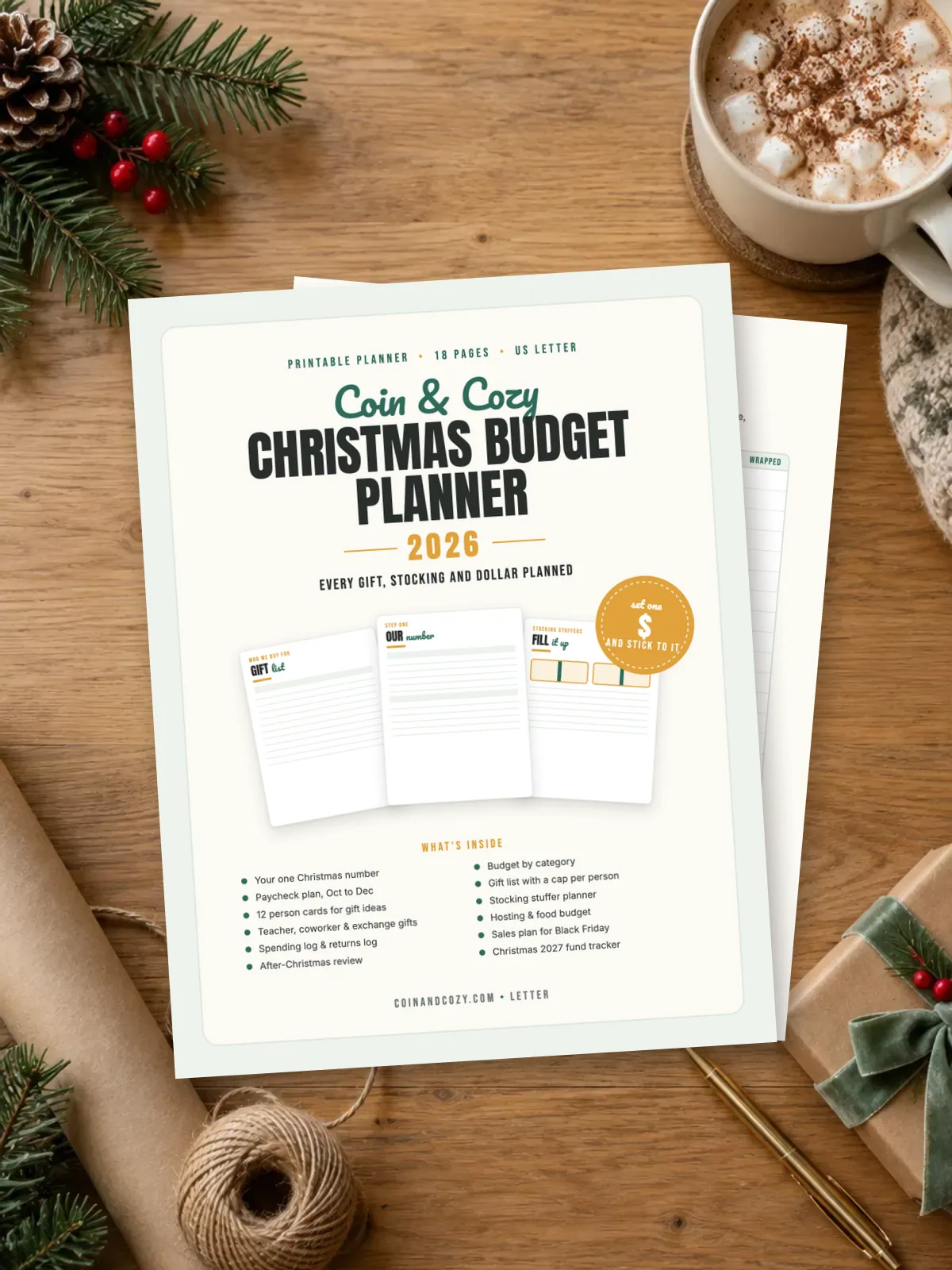
A calculator gives you the number; paper keeps you to it. The Cozy Christmas Budget & Gift Planner has your one Christmas number page, a budget by category with a buffer line, a gift list with caps, the stocking planner, teacher and coworker gifts, a spending and returns log, and a 2027 fund tracker. It prints on US Letter or A4, with a low-ink version.
Prefer a free version? Our Christmas budget planner and gift tracker template walks through a simple printable layout, and Christmas on a budget has 30 low-cost ideas for gifts, decor and traditions.
Helpful, not required
-
Holiday planner notebook
Typically $8 to $15
Keeps lists and receipts together through December.
Check price on Amazon for Holiday planner notebook -
Cash budget envelopes
Typically $8 to $16
One envelope each for gifts, food and decor.
Check price on Amazon for Cash budget envelopes -
Receipt organizer
Typically $8 to $15
Makes returns and exchanges in January easy.
Check price on Amazon for Receipt organizer
Start the Christmas 2027 Fund in January
The easiest Christmas budget is the one you start eleven months early. Divide next year's number by your paydays in 2027 and set that aside each time. $440 over 26 biweekly paydays is about $17 a paycheck.

If you'd like the whole money system for 2027 in one place, the Cozy Money Binder brings the budget planner, the savings challenge charts and the Christmas planner together for $14.
Frequently asked questions
What percentage of income should I spend on Christmas?
There's no single right percentage. Start from money you've saved and can set aside before Christmas, then check that January's bills are still covered. The calculator above does that math.
Should I use a credit card for Christmas?
The calculator only counts money you have or will be paid before Christmas. Anything borrowed becomes a January bill, so it's left out of the plan on purpose.
What about buy now, pay later for Christmas gifts?
Buy now, pay later spreads the cost into paychecks you'll need in January and February. It isn't part of this plan; lower caps or close the gap with the no-credit ideas above.
How much should I spend per child at Christmas?
Pick an amount from your gift line, keep it the same for each child and count the stocking inside it. Household A in our example uses $80 per child; household B uses $100.
Is this Christmas budget calculator free?
Yes. It runs in your browser, doesn't need an email and doesn't store what you type.
Save it for later
Pin this to your Frugal Living Tips board so it's there when you need it.
Save to Pinterest