This post contains affiliate links. As an Amazon Associate we earn from qualifying purchases, at no extra cost to you. Read our disclosure.
Safety first: This is general money education, not personalised financial advice. Please read our financial disclaimer before you start.
Key takeaways
- Deloitte (Oct 2026): the average US household plans $1,654 for the holidays, up 4% from $1,595 in 2025; $988 of it is retail goods and $666 is activities and experiences.
- Gallup (Oct 2025): adults plan $1,007 on gifts; under-$50K households plan $651 and $100K-plus households $1,479.
- NRF (2025 survey): $890.49 per person, with $627.93 on gifts and $262.56 on food, decor and cards.
- Per person and per household are different numbers; gifts-only and whole-season are different again. Compare like with like.
- The $900 family-of-four example below comes from a paycheck plan, not from an average, and it is marked as an example.
In this post8 sections
- What the Surveys Say a Christmas Budget for a Family Looks Like
- Christmas Spending by Income: What Families Really Plan
- What Counts in a Christmas Budget (It Is Not Just Gifts)
- A Good Christmas Budget for a Family of Four: $900 Worked Example
- Percent-of-Income Rules of Thumb (and Why They Disagree)
- How to Trim the Example Budget by $200 Without Anyone Noticing
- Your Own Number: The Calculator and the Planner
- FAQ
Quick note: product links go to Amazon search results or our own shop, and we may earn a small commission if you buy, at no extra cost to you. Survey figures are quoted from the named source and year; we have not rounded them.
What the Surveys Say a Christmas Budget for a Family Looks Like
Three national surveys ask Americans what they plan to spend. They do not agree, because each one measures something different: Deloitte counts the whole season per household, Gallup counts gifts per household, and NRF counts gifts plus holiday items per person.
| Figure | Amount | Source and year | What it means for a family (example) |
|---|---|---|---|
| Average household holiday spend, whole season | $1,654 | Deloitte 2026 Holiday Retail Survey (Oct 2026) | Gifts, food, decor, travel and outings for one household; up 4% from $1,595 in 2025 |
| Of which retail goods (gifts and holiday items) | $988 | Deloitte 2026 | Up 10% on 2025; this is the part a gift list controls |
| Of which holiday activities and experiences | $666 | Deloitte 2026 | Dinners out, travel, events; down 4% on 2025 |
| Planned holiday gift spending per household | $1,007 | Gallup poll, Oct 1 to 16, 2025 | Gifts only; 37% plan $1,000 or more, 31% plan under $500 |
| Holiday spending per person | $890.49 | NRF 2025 holiday survey | $627.93 gifts plus $262.56 on food, decor, cards and flowers, per adult shopper |
| Nov to Dec retail sales forecast | $1.013 trillion | NRF forecast, Oct 15, 2026 | Up 4.2% on 2025; shows stores expect shoppers to spend more, not that you should |
Sources: Deloitte, Holiday Spending Set to Increase, Oct 15, 2026 (4,000 adults surveyed Aug 26 to Sep 10, 2026); Gallup, Holiday Shoppers Plan to Spend Briskly, Oct 28, 2025 (1,000 adults, Oct 1 to 16, 2025); NRF, 2026 holiday forecast, Oct 15, 2026 and the NRF 2025 holiday consumer survey. Gallup had not published a 2026 reading when this was written; we will update the row when it does.
So what is the average family spending? If you take Deloitte's household number as the whole season and Gallup's as the gift share, a typical household is spending roughly $1,000 on gifts and another $600 or so on everything else. A family with two kids and a long gift list sits above that; a family that trades names and skips travel sits well below.
Christmas Spending by Income: What Families Really Plan
The averages hide a wide spread. Both Deloitte and Gallup break spending down by household income, and the gap between the bottom and top bands is more than four to one.
| Household income | Deloitte 2026 (whole season) | Gallup Oct 2025 (gifts only) |
|---|---|---|
| Under $50,000 | $693 | $651 (down from $776 in 2024) |
| Middle income (Gallup label) | not published | $847 (down from $902 in 2024) |
| $100,000 and up | not published | $1,479 (up from $1,403 in 2024) |
| $200,000 and up | $3,607 | not published |
Two things stand out. Lower-income households cut their plans between 2024 and 2025 in Gallup's data while higher-income households raised theirs, and Deloitte's under-$50K figure ($693) is less than half its overall average ($1,654). If your household is in the under-$50K band, a Christmas budget around $650 to $700 is not "cheap"; it is what most families like yours plan.

What Counts in a Christmas Budget (It Is Not Just Gifts)
Deloitte's split is the useful one here: $988 of the $1,654 is retail goods, and $666 is activities. NRF's per-person number says the same thing from the other side: $262.56 of each person's $890.49 goes to food, decor, cards and flowers, not gifts. A family budget that only lists gifts is usually short by a third.
Lines a family Christmas budget needs

A Good Christmas Budget for a Family of Four: $900 Worked Example
Here is how we would build a Christmas number for a two-adult, two-kid household paid every two weeks. Start from money, not from the gift list: $100 set aside from each of six paychecks between early October and mid December is $600, plus $300 already in a holiday fund, which gives a $900 Christmas. Example numbers, not financial advice.
| Line | Example amount | Share | Notes |
|---|---|---|---|
| Two kids' gifts, $160 each including stockings | $320 | 36% | Same cap per child; stocking inside the cap |
| Partner gifts, $60 each | $120 | 13% | Agree the cap together in November |
| Extended family, teachers and one gift exchange | $110 | 12% | Draw names for adults; one $20 exchange gift |
| Food and baking | $170 | 19% | Big meal plus extra groceries for two weeks |
| Decor, wrapping, cards and shipping | $80 | 9% | Reuse the tree; buy paper and tags only |
| Buffer | $100 | 11% | Unspent buffer rolls into January |
| Total | $900 | 100% | $600 from paychecks plus $300 saved |
Compare that with the surveys and the example sits near the Deloitte under-$50K figure and a little above Gallup's $651 for the same band, with gifts at $550 of the $900. It is below every overall average, and that is fine: the averages include households spending $3,000 and more.

Percent-of-Income Rules of Thumb (and Why They Disagree)
You will see rules like "spend 1% of your income on Christmas." Clearpoint, a nonprofit credit counseling agency, caps its holiday budget planner at 1.5% of annual household income for the whole season (Clearpoint, accessed October 2026). Other planners quote 1% to 2%, and some gift-only rules run higher, which is why the numbers online never match.
| Annual take-home pay | 1% | 1.5% | 2% |
|---|---|---|---|
| $40,000 | $400 | $600 | $800 |
| $55,000 | $550 | $825 | $1,100 |
| $70,000 | $700 | $1,050 | $1,400 |
| $90,000 | $900 | $1,350 | $1,800 |
Use the percent as a sanity check, not a target. A family taking home $55,000 that follows the 1.5% rule lands at $825, close to the $900 example above. A family at $40,000 would be at $600, and the paycheck method would probably give the same answer because there is less to set aside.

How to Trim the Example Budget by $200 Without Anyone Noticing
If $900 is more than your paychecks allow, the cuts that nobody at the table notices come from the small-gift and decor lines, not from the kids' caps. Swap the adult gift list for one $20 exchange using our white elephant gift ideas under $20: that line drops from $110 to about $60.
Keep teacher and coworker gifts under $10 with the cheap Christmas gifts for coworkers list, fill stockings from the stocking stuffers under $5 list so each child's $25 stocking becomes $15, and bake instead of buying the office treats. Those four moves take roughly $200 out of the example and leave the kids' main gifts untouched. More cuts are in 27 ways to save money on Christmas gifts.
Average is a range, not a target. Your Christmas number is the money you have before December 20.
Your Own Number: The Calculator and the Planner
The surveys tell you what other families plan; your own number comes from your paychecks. The Christmas budget calculator adds what you have saved to what you can set aside each payday and splits it into gifts, food, decor and a buffer. The full step-by-step plan, from the number to the January reset, is in our Christmas on a budget guide.
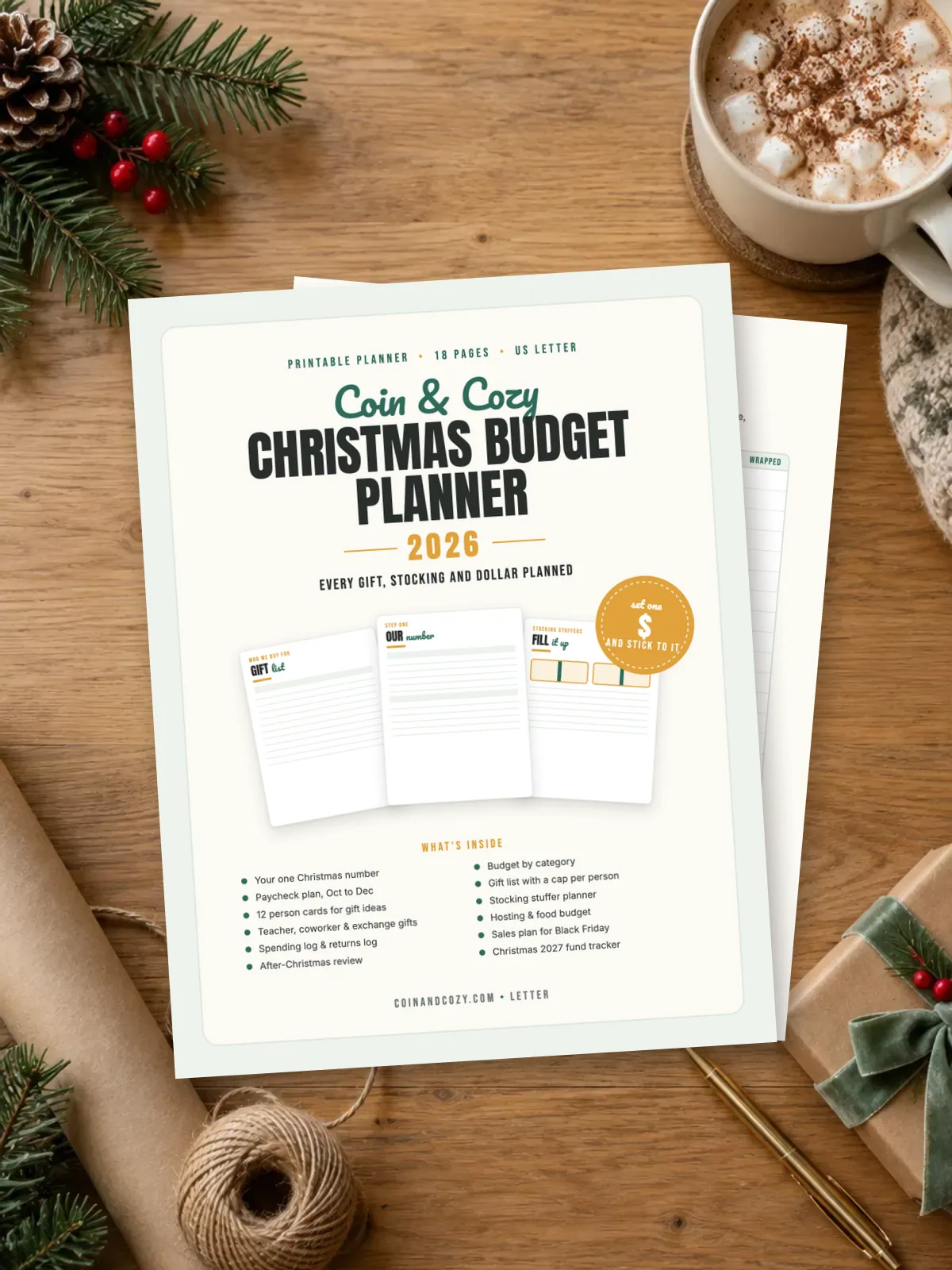
If you want it on paper, the Christmas Budget Planner 2026 ($6, 18 pages) starts with the one-number page, then a paycheck plan with this year's dates (Black Friday is November 27 and Cyber Monday November 30), gift caps for 22 people, 8 stocking lists and two gift exchange boxes. It is also inside the Budget Binder Printables bundle with the 2027 budget planner and the savings charts.
Two cheap tools for a cash Christmas
-
Cash envelope wallet with 12 tabbed envelopes
Typically $10 to $18
One envelope per budget line; when the gifts envelope is empty, gifts are done.
Check price on Amazon for Cash envelope wallet with 12 tabbed envelopes -
Kraft gift tags with twine, 100 pack
Typically $5 to $9
Covers every gift on a 22-person list for the price of two store-bought cards.
Check price on Amazon for Kraft gift tags with twine, 100 pack
Frequently asked questions
What is a good Christmas budget for a family?
One built from money you will have before December 20, not from an average. For an anchor, Deloitte's 2026 survey puts the average household at $1,654 for the whole season and under-$50K households at $693; Gallup's 2025 poll puts gift spending at $1,007 per adult. Our family-of-four example lands at $900. Example numbers, not financial advice.
What is the average amount a family spends on Christmas?
Deloitte's 2026 Holiday Retail Survey says $1,654 per household for the season, with $988 on retail goods and $666 on activities. Gallup (Oct 2025) says $1,007 on gifts per adult, and NRF's 2025 survey says $890.49 per person including $627.93 on gifts.
What percentage of income should I spend on Christmas?
There is no official rule. Clearpoint's holiday planner caps the season at 1.5% of annual household income; other planners say 1% to 2%. At $55,000 take-home, 1.5% is $825. Treat the percent as a sanity check and build the real number from your paychecks.
How much should you spend on each kid for Christmas?
The surveys do not report a per-child figure. Our example gives each child the same cap, $160 including a $25 stocking, inside a $900 family budget. The cap matters less than keeping it equal between kids and counting the stocking inside it.
When do most families finish their Christmas budget?
Earlier than you might think. Deloitte's 2026 survey found 28% of shoppers expect their holiday budgets to be spent by the end of October, and 55% of retail holiday spending is planned online. Setting your number in October keeps November sales from setting it for you.
Save it for later
Pin this to your Frugal Living Tips board so it's there when you need it.
Save to Pinterest