Safety first: This is general money education, not personalised financial advice. Please read our financial disclaimer before you start.
Key takeaways
- List every card's balance, APR, minimum and due date in one place.
- Pay every minimum, then send all extra money to one card at a time.
- Highest APR first usually saves the most; smallest balance first gives quicker wins.
- A balance transfer fee of 3% to 5% can still save money, but only if you can clear it in the promo period.
- Roll each paid-off card's payment into the next one, and track balances monthly.
In this post13 sections
- What You'll Need
- Step 1: List Every Card (Balance, APR, Minimum, Due Date)
- Step 2: Stop New Charges Without Cutting Up the Cards
- Step 3: Find Your Extra Payment
- Step 4: Pick the Order (Highest APR or Smallest Balance)
- Step 5: Try to Lower the Interest
- Step 6: Automate and Roll Payments Forward
- Step 7: Track Every Month
- Worked Example: $7,000 Across 3 Cards
- Credit Card Payoff Mistakes to Avoid
- Variations: Couples, One Card or Uneven Pay
- When to Get Help: Nonprofit Credit Counseling
- FAQ
What You'll Need
Gather these before you start (about 30 minutes)
Grab our free debt payoff worksheets (PDF) if you want a ready-made page for the list in Step 1 and the monthly tracker in Step 7.
Step 1: List Every Card (Balance, APR, Minimum, Due Date)
Write down every card, even the store card with $80 on it. For each one, note four things: the balance, the interest rate (APR), the minimum payment and the due date. Your statement shows all four. This list is your credit card debt payoff plan in its first form.

| Card | Balance | APR | Minimum | Due |
|---|---|---|---|---|
| Card A | $1,200 | 27% | $35 | 3rd |
| Card B | $3,500 | 22% | $90 | 15th |
| Card C | $2,300 | 18% | $60 | 22nd |
| Total | $7,000 | $185 |
Seeing the total in one place can sting. That's normal, and it's also the moment you start controlling it.
Step 2: Stop New Charges Without Cutting Up the Cards
A payoff plan only works if the balances stop growing. Take the cards out of your wallet and remove them from shopping apps and browser autofill. You don't have to close the accounts; closing old cards can lower your available credit, which can affect your credit score.

Step 3: Find Your Extra Payment
Minimum payments mostly cover interest, so the real progress comes from anything extra. Look at last month's spending and find a realistic amount: trimmed takeout, a paused subscription, a lower phone plan. In our example, the household finds $215 extra, so it pays $400 a month in total instead of $185.

A written budget makes this easier. Our zero based budget guide shows how to give that extra payment its own line so it doesn't get spent.
Step 4: Pick the Order (Highest APR or Smallest Balance)
Pay the minimum on every card, then send all the extra to one card at a time. You have two common choices for which card goes first:

| Method | Order in the example | Debt-free in | Interest paid |
|---|---|---|---|
| Highest APR first (avalanche) | A, then B, then C | about 21 months | about $1,380 |
| Smallest balance first (snowball) | A, then C, then B | about 22 months | about $1,450 |
The highest-rate order usually costs less. The smallest-balance order gives quicker wins, which keeps some people going. Either one beats paying minimums. For the full comparison, see our debt snowball vs avalanche guide.
Step 5: Try to Lower the Interest
Lower interest means more of every payment goes to the balance. Two ways to try:
Call the card issuer. It costs nothing to ask. A short script:

Hi, I've been a customer since [year] and I'm working on paying my balance off. Is there any way to lower my interest rate, or a hardship program I'd qualify for?
They may say no. If they say yes, ask whether it's permanent or temporary, and whether it affects your account in any way. Write down the date and the name of the person you spoke with.
Consider a balance transfer, with the math done first. A 0% introductory card can pause interest, but most charge a transfer fee, commonly 3% to 5% of the amount moved. You usually can't transfer between two cards from the same bank, and approval isn't guaranteed. The CFPB credit card guides explain how fees and promotional rates work.

| 3% fee | 5% fee | |
|---|---|---|
| Fee added | $105 | $175 |
| New balance | $3,605 | $3,675 |
| Monthly payment to clear in a 15-month 0% period | about $241 | $245 |
| Interest Card B would charge in month one at 22% | about $64 | about $64 |
The rule of thumb: divide the new balance by the number of promo months. If you can't pay that each month, the leftover balance will start charging the card's regular rate when the promo ends. And a transfer only helps if Step 2 holds; new charges on the old card undo it.
Step 6: Automate and Roll Payments Forward
Set autopay for at least the minimum on every card so you never miss a due date or pay a late fee. Then schedule the extra payment to the focus card right after payday.

When the first card hits $0, don't spend its payment. Roll it into the next card. In the example, Card A is gone in about 6 months; its whole payment then joins Card B's, which speeds things up.

Step 7: Track Every Month
Once a month, write each balance on your tracker and color in a box. It takes five minutes and makes the progress visible on months when it feels slow.

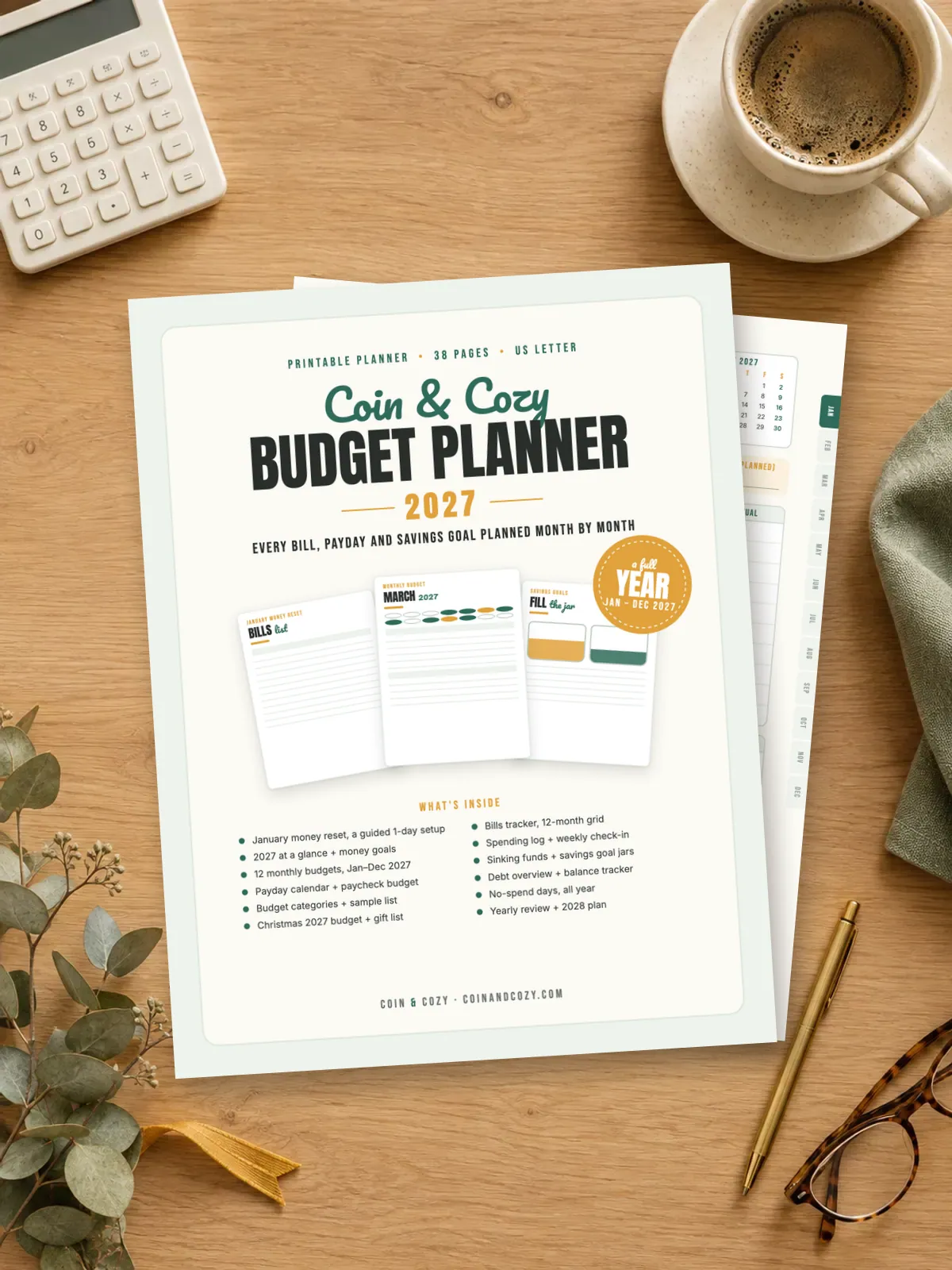
If you want a longer-term home for this, the Cozy Budget Planner 2027 has a debt overview page with a snowball and avalanche explainer plus debt balance trackers next to each monthly budget.
Worked Example: $7,000 Across 3 Cards
Here's how the example plays out using the highest-APR order at $400 a month, with every number an illustration rather than a promise. Real results depend on your rates, fees and whether minimums change.
| Card | Paid off around | What happens next |
|---|---|---|
| Card A ($1,200, 27%) | Month 6 | Its payment rolls into Card B |
| Card B ($3,500, 22%) | Month 17 | Its payment rolls into Card C |
| Card C ($2,300, 18%) | Month 21 | Debt-free |
For contrast: if the household kept paying only the same $185 in minimums, the debt would take more than 5 years and about $4,900 in interest. The extra $215 a month cuts that to under 2 years and about $1,380.
Want to see each card shrink instead of just reading the number? The Debt Payoff Coloring Kit ($6) has a credit card tracker for every month, color-in payoff charts for $1,000 up to $25,000 and a creditor call log. It tracks your payments and does not promise a payoff date.
Credit Card Payoff Mistakes to Avoid

Do this
- Pay every minimum on time, every month
- Keep a small starter emergency fund so surprises don't go on a card
- Read the fine print before a balance transfer
- Roll each paid-off payment into the next card
Skip this
- Closing your oldest cards right away
- Moving debt to a 0% card and charging the old one again
- Skipping savings completely, then using the card for a car repair
- Spreading extra money thinly across every card
A small cushion matters. Our guide to how much an emergency fund should be explains the starter step many people build before they push hard on debt.
Variations: Couples, One Card or Uneven Pay
Couples: list both people's cards on one page, agree on the order together and pick one monthly money date to update the tracker.
Only one card: skip the ordering step and put every extra dollar on it; a single balance transfer may be simpler to judge.
Uneven pay: set the plan around your lowest month's extra payment, then send anything above that in good months as a bonus payment.
Paid every two weeks? Our biweekly budget guide shows which paycheck can carry the extra payment and how to use the 2027 third-paycheck months.
When to Get Help: Nonprofit Credit Counseling
If the minimums alone are more than you can pay, or the balances keep rising, talk to a nonprofit credit counselor. The NFCC lists member agencies that offer budget reviews and, when it fits, a debt management plan that can combine payments and lower rates. Be wary of companies that charge large upfront fees or promise to make debt disappear.

Once you're paid off, keep the momentum: send that same monthly payment to savings. This article is general information, not financial advice.

For a step-by-step page to fill in as you go, our debt snowball worksheet guide walks through each line.
Frequently asked questions
How do I make a plan to pay off credit card debt?
List every card with its balance, APR, minimum and due date, stop new charges, find an extra monthly payment, choose an order (highest APR or smallest balance), and roll each paid-off payment into the next card.
Should I pay off the highest interest card or the smallest balance first?
Highest interest first usually costs less overall. Smallest balance first gives faster wins, which helps some people stick with it. Both work if you keep paying extra.
Is a balance transfer a good idea?
It can be, if the transfer fee (often 3% to 5%) costs less than the interest you'd pay and you can clear the balance before the promo ends. Approval isn't guaranteed, and it's general information, not financial advice.
Can I ask my credit card company for a lower interest rate?
Yes. Call the number on the back of the card, explain you're paying the balance down and ask about a lower rate or hardship program. They may say no, but asking is free.
When should I talk to a credit counselor?
If you can't cover the minimum payments or balances keep growing, a nonprofit credit counselor, such as an NFCC member agency, can review your budget and options like a debt management plan.
Save it for later
Pin this to your Debt Payoff board so it's there when you need it.
Save to Pinterest