This post contains affiliate links. As an Amazon Associate we earn from qualifying purchases, at no extra cost to you. Read our disclosure.
Safety first: This is general money education, not personalised financial advice. Please read our financial disclaimer before you start.
Key takeaways
- List every debt, smallest balance first, with its balance, rate and minimum.
- Pay minimums on all of them and put every extra dollar on row 1.
- When a debt hits $0, roll its whole payment onto the next row the same month.
- In our example, $50 extra plus the rollover cleared $11,300 in 30 months instead of about 54.
- Example numbers only; this is not financial advice.
In this post10 sections
- Debt Snowball Worksheet: What Goes in Each Column
- Step 1: List Every Debt and Order It Smallest First
- Step 2: Find Your Snowball Amount, Even If It's $50
- Step 3: Fill In Month 1 and the Rollover
- Debt Snowball on Bi-Weekly Pay: Which Check Carries the Extra
- When a Minimum Changes or a Bill Surprises You
- Debt Snowball Mistakes That Slow You Down
- Debt Snowball Worksheet Printable Free
- Track the Year in the Cozy Budget Planner 2027
- FAQ
Debt Snowball Worksheet: What Goes in Each Column
A debt snowball worksheet is one page with a row for every debt and seven columns. Here's what each one is for, so the steps below make sense the first time you fill it in.
Download the free debt snowball worksheet (PDF, 3 pages). No sign-up needed. Page 1 has the seven columns below, page 2 is the avalanche version, and page 3 tracks your balances for 12 months.
| Column | What to write | Where to find it |
|---|---|---|
| Order | 1 for the smallest balance, 2 for the next, and so on | You decide this in Step 1 |
| Debt | A short name: store card, medical bill, car loan | Your bills |
| Balance | What you owe today | Latest statement or app |
| Rate (APR) | The interest rate, for reference | Statement, near the balance |
| Minimum | The minimum monthly payment | Statement or loan agreement |
| Snowball payment | Minimum plus any extra or rolled-over money | You fill this in Step 3 |
| Paid off | The month the balance hits $0 | Filled in as you go |
The debt snowball method is simple: pay the minimum on everything, put every extra dollar on the smallest balance, and when that one is gone, roll its whole payment onto the next. The worksheet is just that idea written down so you can follow it each month.
The method was popularized by radio host Dave Ramsey, and you'll see his name on many free forms. You don't need any one brand's version; the columns above are all it takes.

Everything below uses one example household with made-up numbers, not anyone's real debt. The math is simplified: fixed minimums, monthly interest and no new charges. It's general education, not financial advice; see our financial disclaimer.
Step 1: List Every Debt and Order It Smallest First
Gather your latest statements or log in to each account. Write down every debt with its balance, rate and minimum, then sort the rows from the smallest balance to the largest.
Our example household has four debts after the holidays, totaling $11,300.
| Order | Debt | Balance | Rate (APR) | Minimum |
|---|---|---|---|---|
| 1 | Store card | $420 | 26.99% | $35 |
| 2 | Medical bill (payment plan) | $780 | 0% | $40 |
| 3 | Credit card | $2,300 | 22.99% | $69 |
| 4 | Car loan | $7,800 | 7.9% | $245 |
The rate isn't used to choose the order here, which is the whole point of the snowball. If you'd rather pay the highest rate first, that's the avalanche method, and our snowball vs avalanche debt payoff tracker compares the two with the same example.
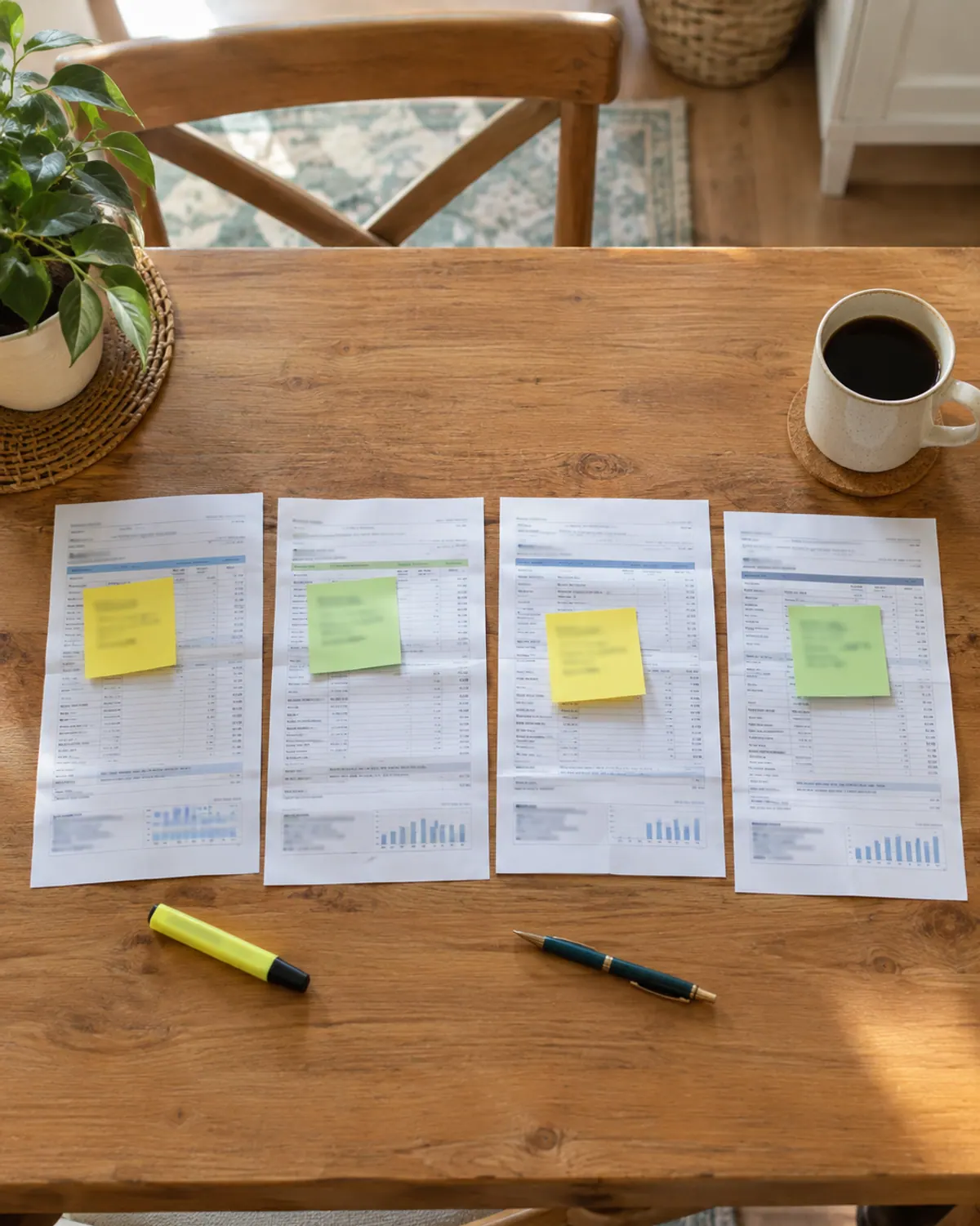
Before you add a debt, check the bill for errors. For medical bills especially, it's worth asking the provider about payment plans or financial assistance before it goes on the list.
Step 2: Find Your Snowball Amount, Even If It's $50
Add up all the minimums. In the example that's $35 + $40 + $69 + $245 = $389 a month.
Next, decide on one extra amount you can pay every month without borrowing it back. Our household finds $50, so the total debt payment is $439 a month. That $50 is the start of the snowball.

$50 might feel too small to matter. In this example it does a lot of work, because every finished debt adds its payment to the pile, as you'll see in Step 3.
One more thing before you start: a small cash cushion keeps the snowball from stalling the first time the car needs tires. Many people save a few hundred dollars first, and our free savings challenge pack has a 50-envelope chart that reaches $1,275.
Step 3: Fill In Month 1 and the Rollover
In Month 1, every debt gets its minimum and the smallest debt also gets the $50. So the store card gets $85 and the others get their minimums.
When a debt hits $0, cross out its row and write the month in the Paid off column. Then add its whole payment to the next row's snowball payment. That's the rollover.
| Order | Debt | Balance | Minimum | Snowball payment | Paid off |
|---|---|---|---|---|---|
| 1 | Store card | $420 | $35 | $85 ($35 + $50 extra) | Month 6 |
| 2 | Medical bill | $780 | $40 | $125 ($40 + $85), from Month 7 | Month 10 |
| 3 | Credit card | $2,300 | $69 | $194 ($69 + $125), from Month 11 | Month 22 |
| 4 | Car loan | $7,800 | $245 | $439 ($245 + $194), from Month 23 | Month 30 |
The months where a debt finishes are a little messy, and the worksheet should show that. In Month 6, the store card only needs $25.41 to reach $0, so the other $59.59 goes to the medical bill that month.
| Month | Store card | Medical bill | Credit card | Car loan |
|---|---|---|---|---|
| 1 | $85, left $344.45 | $40, left $740 | $69, left $2,275.06 | $245, left $7,606.35 |
| 5 | $85, left $24.85 | $40, left $580 | $69, left $2,170.45 | $245, left $6,818.92 |
| 6 | $25.41, paid off | $99.59, left $480.41 | $69, left $2,143.03 | $245, left $6,618.81 |
| 7 | done | $125, left $355.41 | $69, left $2,115.09 | $245, left $6,417.38 |
| 10 | done | $105.41, paid off | $88.59, left $2,008.42 | $245, left $5,805.11 |
| 11 | done | done | $194, left $1,852.90 | $245, left $5,598.33 |
| 22 | done | done | $126.39, paid off | $312.61, left $3,164.26 |
| 23 | done | done | done | $439, left $2,746.09 |
| 30 | done | done | done | $179.80, paid off |

In this example the household is debt free in Month 30, with about $1,611 in total interest. Paying only the minimums, with no extra and no rollover, the last debt would take about 54 months and cost about $2,458 in interest. Same bills, same $389 in minimums; the $50 and the rollover make the difference.
Your numbers will differ, since real minimums and interest change month to month. Type in the real balance from each statement when you update the sheet.
Debt Snowball on Bi-Weekly Pay: Which Check Carries the Extra
Most bills are monthly, but many paychecks come every two weeks. There are two simple ways to fit the worksheet to that.
Split it. Send $25 of the extra from each paycheck. Each check covers the bills due before the next one, plus half the snowball.
Use the first check of the month. Pay the whole snowball payment from the check that lands before the target debt's due date. Write that payday next to the row so you remember.

Twice a year, most bi-weekly schedules have a month with a third paycheck. Since your monthly bills are already covered by the first two, that third check is a strong candidate for an extra snowball payment. Our bi weekly savings challenges explain how to count your paydays for the year.
When a Minimum Changes or a Bill Surprises You
Credit card minimums often get smaller as the balance drops. If yours does, keep paying the original amount and write it in the Minimum column. The difference keeps working for you instead of slipping back into the budget.
If a surprise bill hits, pause the extra, keep every minimum paid, and cover the surprise from your cushion. Restart the extra the next month. One missed extra payment moves the finish line by about a month, not back to the start.

If you're behind on payments or a debt goes to collections, the snowball may not be the first move. The CFPB's guide to reducing debt and nonprofit credit counseling through the NFCC can help you review your options for free or a low fee.
Debt Snowball Mistakes That Slow You Down
Skipping the rollover. When a debt is paid off, its payment has to move to the next row. If it drifts back into everyday spending, the snowball stops growing.
Leaving a debt off the list. A forgotten store card or a buy-now-pay-later plan still has a due date. Every debt goes on the worksheet, even the small ones.
Adding new charges. Paying a card down while still using it for groceries keeps the balance flat. Many people put the card away and switch to cash envelopes or a debit card while the snowball runs.
Letting the extra shrink. Write the extra at the top of the worksheet and treat it like a bill.
No cushion. Without a few hundred dollars set aside, the first car repair goes back on a card.
Debt snowball worksheet checklist
Debt Snowball Worksheet Printable Free
Here's a blank debt snowball worksheet you can print from this page. Fill in one row per debt, smallest balance first, and keep it where you pay bills.
| Order | Debt | Balance | Rate (APR) | Minimum | Snowball payment | Paid off |
|---|---|---|---|---|---|---|
| 1 | ||||||
| 2 | ||||||
| 3 | ||||||
| 4 | ||||||
| 5 | ||||||
| 6 |
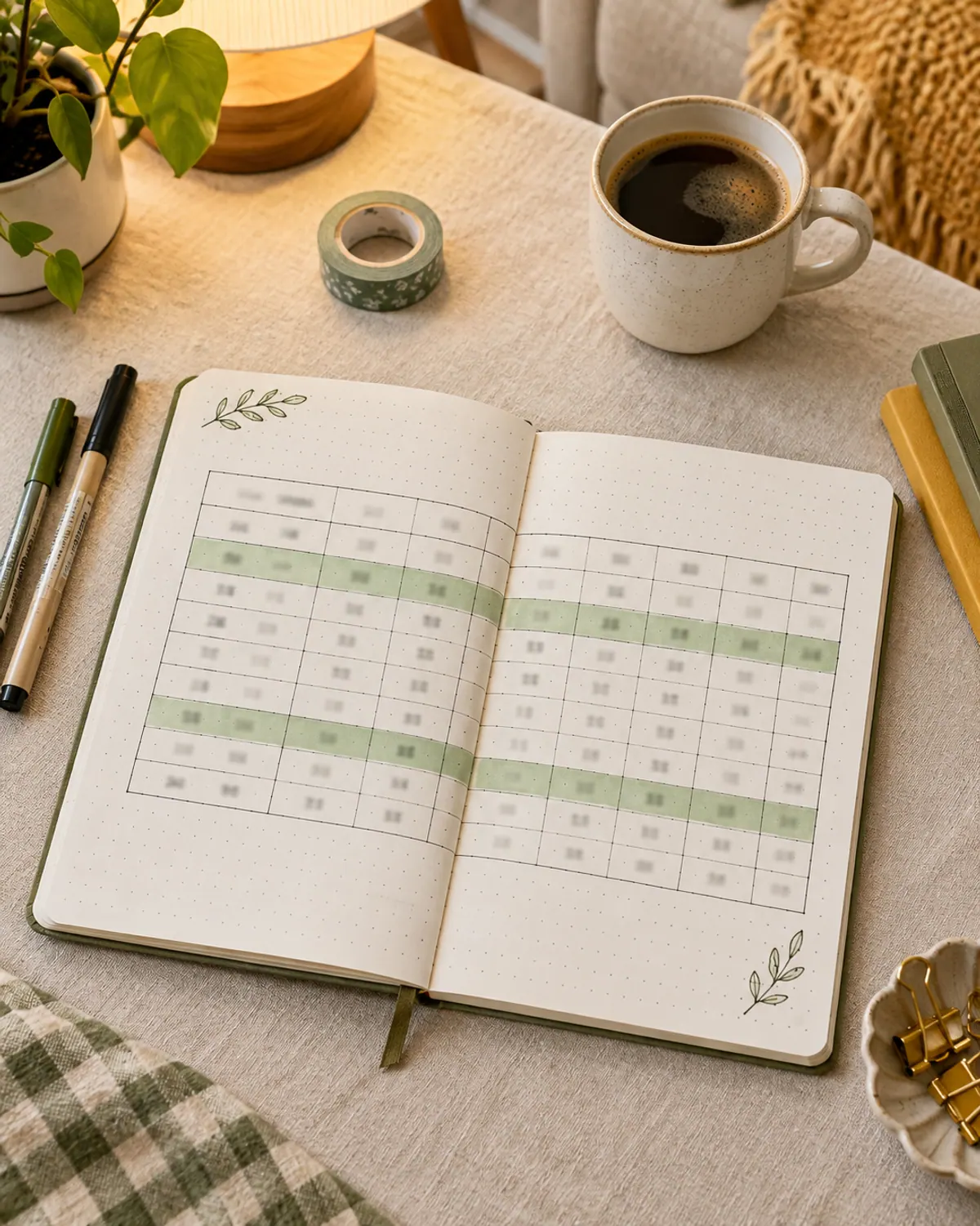
Prefer a bullet journal? Draw the same seven columns across a two-page spread and leave a strip at the bottom for the monthly log. Coloring a row in when it's paid off gives you the same little win.
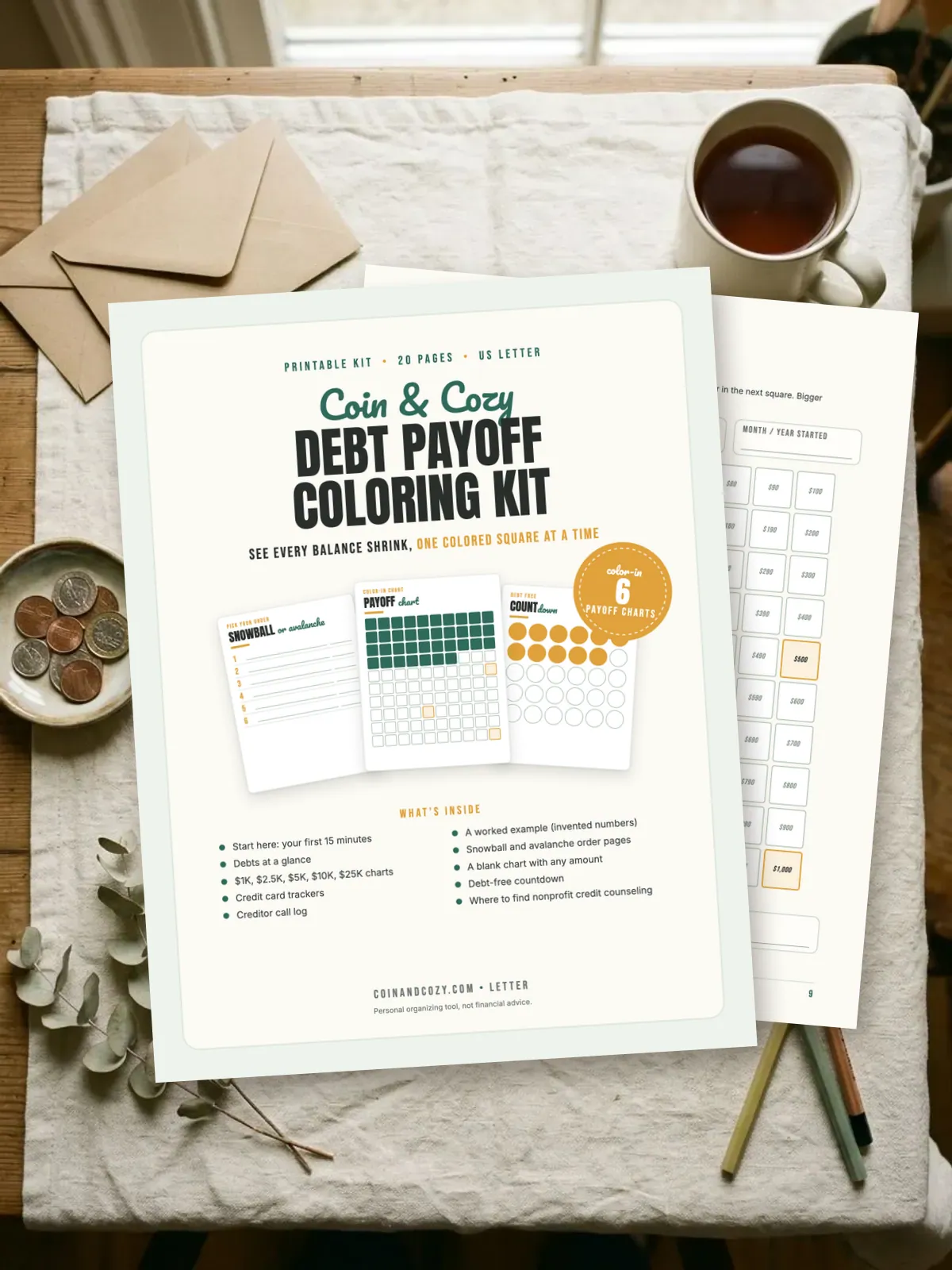
Once the worksheet is filled in, some people like to color the progress too. The Debt Payoff Coloring Kit ($6) has color-in payoff charts, a snowball and an avalanche order page, and a first-15-minutes page for getting started.
Simple supplies for a debt snowball worksheet
-
A5 budget binder or planner
Typically $8 to $30
Keeps the worksheet, statements and monthly log in one place.
Check price on Amazon for A5 budget binder or planner -
Pastel highlighter set
Typically $4 to $17
For shading each row when a debt is paid off.
Check price on Amazon for Pastel highlighter set -
Paper cash envelope pack
Typically $8 to $22
Helpful if you switch to cash for groceries while the card is paid down.
Check price on Amazon for Paper cash envelope pack -
Label maker
Typically $9 to $40
Optional, for labeling a bill folder by due date.
Check price on Amazon for Label maker
Track the Year in the Cozy Budget Planner 2027
A worksheet shows the plan. Keeping it going for 30 months is easier when the debt pages sit next to your monthly budget.
The Cozy Budget Planner 2027 includes a debt overview with plain explanations of the snowball and avalanche methods, a debt balance tracker, 12 dated monthly budget pages, a payday calendar and a biweekly paycheck budget. It's a printable planner for US Letter.

Start tonight with Step 1: four rows, smallest first, and one extra amount at the top. The worksheet does the deciding after that.
Frequently asked questions
How do you fill out a debt snowball worksheet?
List every debt with its balance, interest rate and minimum, sort them smallest balance first, then write each row's snowball payment. Row 1 gets its minimum plus your extra. When a debt is paid off, write the month and add its payment to the next row.
What is the debt snowball method?
It's a payoff plan where you pay the minimum on every debt and put all extra money on the smallest balance. Once that's gone, its payment rolls onto the next smallest, so the payment grows like a snowball.
Is there a free printable debt snowball worksheet?
Yes. The blank worksheet on this page prints from your browser, with columns for order, debt, balance, rate, minimum, snowball payment and paid-off month.
How do you do the debt snowball when paid bi-weekly?
Either split the extra across both paychecks or pay the whole snowball payment from the check that lands before the target debt's due date. Months with a third paycheck are a good time for an extra payment.
Can you start the debt snowball with only $50 extra?
Yes. In our example, $50 a month plus the rollover paid off $11,300 of debt in 30 months, compared with about 54 months on minimums alone. Your results depend on your own balances and rates.
Save it for later
Pin this to your Debt Payoff board so it's there when you need it.
Save to Pinterest