Safety first: This is general money education, not personalised financial advice. Please read our financial disclaimer before you start.
Key takeaways
- Snowball: pay minimums on everything, then put every extra dollar on the smallest balance.
- Avalanche: pay minimums on everything, then put every extra dollar on the highest interest rate.
- In our example, avalanche saved about $146 in interest and one month, while snowball cleared the first debt 10 months sooner.
- A tracker needs four things: a debt list, a payoff order, a monthly log and a visual you can color in.
- Numbers here are examples only, and this is not financial advice.
In this post8 sections
- Debt Snowball vs Avalanche: The Short Answer
- The Debt Snowball Method, With One Worked Example
- The Debt Avalanche Method, With the Same Example
- How to Set Up a Debt Payoff Tracker on Paper
- How to Set Up a Debt Payoff Tracker in Google Sheets or Excel
- Credit Cards, Car Loans, Medical Bills and Mortgages: What to Include
- Bonus: Find Your Extra Monthly Amount First
- FAQ
Debt Snowball vs Avalanche: The Short Answer
Both methods start the same way. You list every debt, pay the minimum on all of them, and add any extra money to one target debt. When that debt is gone, its payment rolls onto the next one.
The only difference is the order. The snowball targets the smallest balance first, and the avalanche (sometimes called the highest-interest method) targets the highest interest rate first.
The Consumer Financial Protection Bureau explains that the highest-interest approach can save money over time but may feel slow, while the snowball gives quicker wins but can cost more in interest. In its guide to reducing debt, the CFPB doesn't name a winner and suggests choosing the strategy that fits your situation.
Want the tracker on paper? Download the free debt payoff worksheets (PDF, 3 pages). No sign-up needed. You get a snowball worksheet, an avalanche worksheet and a 12-month tracker, all on US Letter.

The Debt Snowball Method, With One Worked Example
To keep things simple, both examples use the same three debts and the same $550 a month total payment. That's $350 in minimums plus $200 extra. These are example numbers only, not anyone's real debt.
| Debt | Balance | Interest rate (APR) | Minimum payment |
|---|---|---|---|
| Medical bill on a payment plan | $900 | 0% | $50 |
| Credit card | $3,500 | 24% | $100 |
| Car loan | $6,000 | 7% | $200 |
With the snowball, the order is smallest balance first: medical bill, then credit card, then car loan. The extra $200 goes to the $900 medical bill, so it gets $250 a month.
-
Step 1: Months 1 to 4: the medical bill
The medical bill drops from $900 to $650, $400, $150 and then $0 in month 4. That first win comes fast.
-
Step 2: Months 4 to 15: the credit card
The $250 that went to the medical bill rolls onto the credit card, so it now gets $350 a month. In this example, the card is paid off in month 15.
-
Step 3: Months 15 to 22: the car loan
Now the whole $550 goes to the car loan. It's paid off in month 22, and total interest paid across all three debts comes to about $1,152.

The Debt Avalanche Method, With the Same Example
With the avalanche, the order is highest interest rate first: credit card (24%), then car loan (7%), then medical bill (0%). The extra $200 goes to the credit card, so it gets $300 a month from the start.
-
Step 1: Months 1 to 14: the credit card
The 24% card gets the extra money first. In this example it's paid off in month 14, one month earlier than with the snowball.
-
Step 2: Months 14 to 18: the medical bill finishes on its own
The card's payment rolls onto the car loan. Meanwhile the medical bill, still getting its $50 minimum, finishes in month 18.
-
Step 3: Months 18 to 21: the car loan
The full $550 now goes to the car loan, which is paid off in month 21. Total interest comes to about $1,006.

| Snowball | Avalanche | |
|---|---|---|
| Pays first | Smallest balance (medical bill) | Highest rate (credit card) |
| First debt paid off | Month 4 | Month 14 |
| Debt free | Month 22 | Month 21 |
| Total interest | about $1,152 | about $1,006 |
| Best for | People who need quick wins to keep going | People who want the lowest total cost |
In this example the avalanche saved about $146 and one month. The snowball cleared a whole debt 10 months sooner. Your own numbers could show a bigger or smaller gap, so run your real balances before deciding.
Quick quiz
Which debt payoff method fits you better?
Try the snowball. Quick wins can keep you going, and a method you finish beats one you abandon.
Try the avalanche. Targeting the highest rate first usually means less total interest.
Either works. When rates are similar, the interest difference is often small, so pick the order you'll enjoy.
How to Set Up a Debt Payoff Tracker on Paper
The free debt payoff worksheets already have these columns, so you can skip the ruling and print page 3 for the monthly balances.
A paper tracker in a notebook or bullet journal is easy to start tonight. All you need is a pen, a ruler and your latest statements.
-
Step 1: Gather your statements
Log in to each account or pull the latest bills. Write down the balance, interest rate (APR), minimum payment and due date for every debt.
-
Step 2: Make your debt list page
Draw a table with columns for debt name, balance, APR, minimum and due date. Then number each debt in your payoff order: smallest balance first for snowball, highest rate first for avalanche.
-
Step 3: Add a monthly log
On the next page, make a row for each month and a column for each debt. Every month, write what you paid and the new balance from your statement.
-
Step 4: Draw a visual tracker
Draw one bar, jar or thermometer per debt and split it into 10 or 20 sections. Color in a section every time you pay down that share of the balance.
-
Step 5: Set a monthly check-in
Pick one day a month, like the day after payday, to update every page. It takes about 15 minutes with a cup of tea.


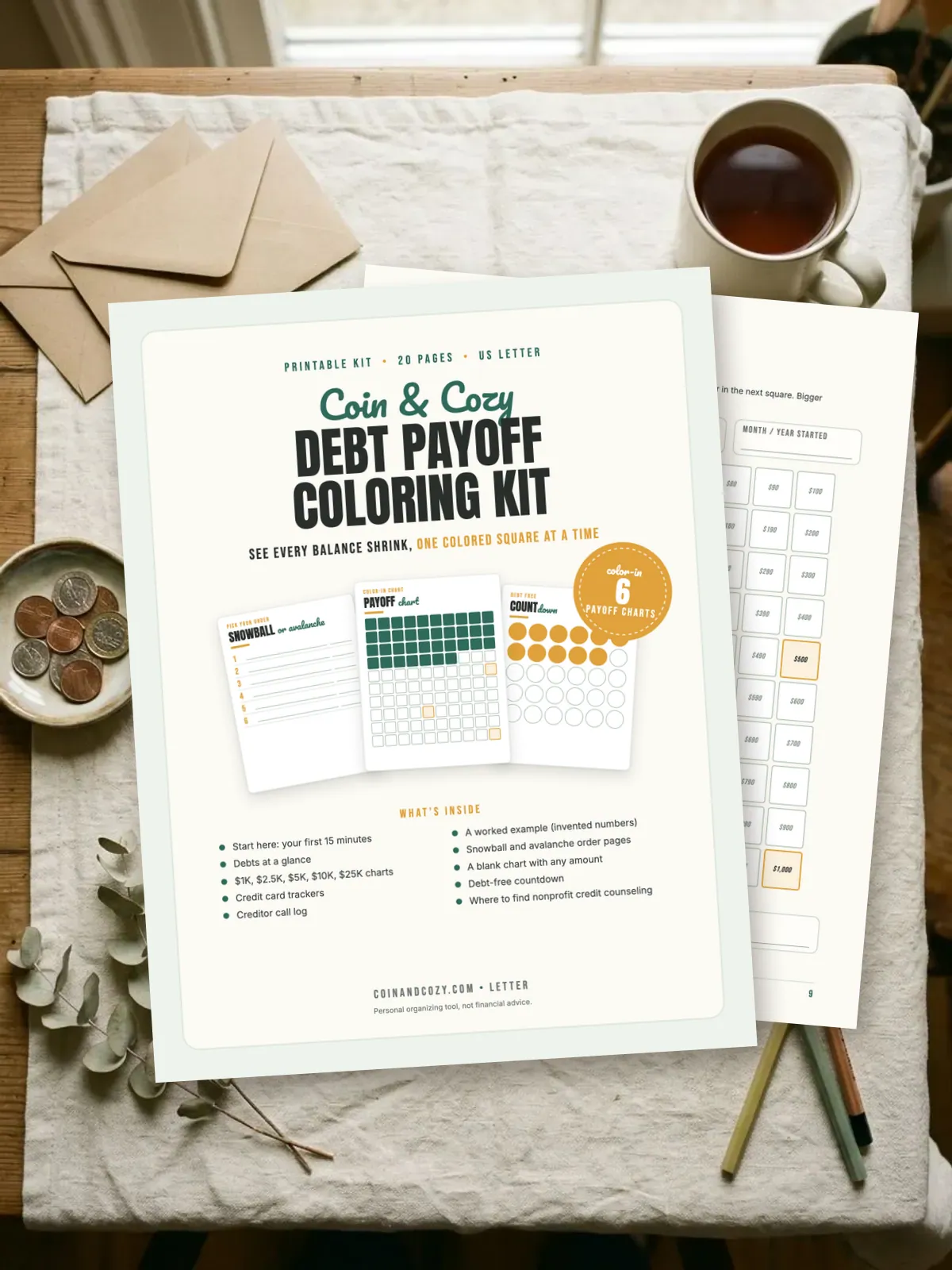
If you want a paper tracker you can color in, the Debt Payoff Coloring Kit ($6) explains both methods neutrally, lets you pick the order, and gives every payment chunk a square on a payoff chart.
How to Set Up a Debt Payoff Tracker in Google Sheets or Excel
A spreadsheet does the math for you and works on your phone. Google Sheets is free with a Google account, and the same layout works in Excel.

Tab 1, Debt list. Put one debt per row with columns for name, balance, APR, minimum and payoff order. Sort by balance for snowball or by APR for avalanche.
Tab 2, Monthly log. Use the layout below, with one row per month and two columns per debt. Here are the first five months of the snowball example.
| Month | Medical paid | Medical balance | Card paid | Card balance | Car paid | Car balance |
|---|---|---|---|---|---|---|
| 1 | $250 | $650 | $100 | $3,470.00 | $200 | $5,835.00 |
| 2 | $250 | $400 | $100 | $3,439.40 | $200 | $5,669.04 |
| 3 | $250 | $150 | $100 | $3,408.19 | $200 | $5,502.11 |
| 4 | $150 | $0 | $200 | $3,276.35 | $200 | $5,334.20 |
| 5 | $0 | paid off | $350 | $2,991.88 | $200 | $5,165.32 |
To estimate a new balance, use: old balance + (old balance × APR ÷ 12) − payment. In Sheets that looks like =C2+(C2*0.24/12)-D3 for a 24% card. Real statements will differ a little, so type in the actual balance each month when you can.
Tab 3, Progress. Add a simple bar chart of total debt by month. Watching the line drop is the spreadsheet version of coloring in a thermometer.
Debt payoff tracker setup checklist
Credit Cards, Car Loans, Medical Bills and Mortgages: What to Include
Credit cards usually belong at the top of an avalanche list because their rates are often the highest. Write down the current APR from your statement, since card rates can change.
Car loans and student loans go on the list too. If you make extra payments, ask the lender or servicer to apply them to the principal of the loan you're targeting.
Medical bills may be on a no-interest payment plan. Before you add one, check the bill for errors and ask the provider about payment plans or financial assistance.

Mortgages are often left off a snowball or avalanche list because they're large, long and usually lower-rate. Many people finish their other debts first, then decide what to do next.
If you're behind on payments or worried about collections, the CFPB and nonprofit credit counselors can help you understand your options. This guide is general education, not financial advice.
Bonus: Find Your Extra Monthly Amount First
Most debt trackers skip the step that matters most: where the extra money comes from. Even $50 a month added to the target debt shortens the timeline.

Start with a monthly budget built from scratch and look for one line to trim. A no-spend January or a cheaper $50 a week grocery list can free up your first extra payment.
The holidays are where many January balances start. Planning Thanksgiving dinner on a budget, a per-kid cap for Christmas gifts for kids and stocking stuffers under $5 can keep new debt off the tracker.
What we like
- Snowball: fast first win, fewer bills sooner
- Snowball: easy to follow without a calculator
- Avalanche: usually less total interest
- Avalanche: often a slightly shorter timeline
Keep in mind
- Snowball: can cost more in interest
- Snowball: high-rate debt may wait a long time
- Avalanche: first payoff can take many months
- Avalanche: easier to lose motivation in the middle
Want everything in one place? The Cozy Budget Planner 2027 includes a debt overview with plain snowball and avalanche explanations and a debt balance tracker, next to your monthly budget pages. All numbers in this guide are examples, and nothing here is financial advice.
Frequently asked questions
Is the debt snowball or avalanche better?
Neither is better for everyone. The avalanche usually costs less in interest, and the snowball gives faster wins that help many people stay motivated. The CFPB suggests choosing the strategy that fits your situation.
What should a debt payoff tracker include?
List each debt with its balance, interest rate, minimum payment and due date, your payoff order, a monthly log of payments and new balances, and a visual like a bar or thermometer you can color in.
Can I use Google Sheets as a debt payoff tracker?
Yes. Make one tab for your debt list, one for a monthly log with a paid and balance column for each debt, and one for a progress chart. The same layout works in Excel.
Should I include my mortgage in the debt snowball?
Many people leave the mortgage off because it's large, long and usually lower-rate, and focus on cards, car loans and other debts first. Your situation may differ, so this isn't financial advice.
How much extra should I pay toward debt each month?
Any amount helps. Even $50 a month on top of minimums shortens the timeline. Build a monthly budget first so the extra amount is money you can count on.

Save it for later
Pin this to your Debt Payoff board so it's there when you need it.
Save to Pinterest