This post contains affiliate links. As an Amazon Associate we earn from qualifying purchases, at no extra cost to you. Read our disclosure.
Safety first: This is general money education, not personalised financial advice. Please read our financial disclaimer before you start.
Key takeaways
- Between January 1 and December 1, 2027 there are 48 weekly paydays, 24 biweekly paydays and 11 monthly paydays, so a $600 Christmas is $12.50 a week, $25 every two weeks or $55 a month.
- Set the Christmas number first (gifts, food, travel, extras), then divide by your paydays; do not start from what a chart tells you to save.
- Keep the fund somewhere you will not spend it in July: a cash envelope, a labeled bank bucket or a separate savings account that is not linked to your debit card.
- Starting late still works: $600 from June is $47 a paycheck on biweekly pay, and $600 from September 8 is $50 a week for 12 weeks.
- Automate the transfer for payday morning; a Christmas sinking fund you have to remember is one you will skip in a tight month.
In this post11 sections
- Christmas Sinking Fund: The One Number to Save Each Payday (Answer First)
- Step 1: Set Your Christmas Number (Gifts, Food, Travel, Extras)
- Step 2: Count Your Paydays From January to December 1 (Weekly, Biweekly, Monthly for 2027)
- Step 3: Pick Your Plan: Monthly, Biweekly or 52 Week Christmas Savings Challenge
- Step 4: Where to Keep the Christmas Fund (Envelope, Bucket or Separate Account)
- Step 5: Automate It on Payday and Stop Thinking About It
- Example: $600 by December 1 on Biweekly Pay
- Starting Late? The 6 Month, 12 Week and 10 Week Versions
- Christmas Sinking Fund Mistakes (Spending It in July)
- Christmas Savings Plan Printable: Free Tracker or the 2027 Bundle
- FAQ
Christmas Sinking Fund: The One Number to Save Each Payday (Answer First)
Here is the whole christmas savings plan in one table. Pick the Christmas budget that matches your household, find your pay schedule, and that is the amount to move on every payday from the first one in January to the last one before December 1, 2027. The counts assume a Friday payday; if yours falls on another weekday the totals shift by one at most.
| Christmas budget | Weekly (48 paydays) | Biweekly (24 paydays) | Twice a month (22 paydays) | Monthly (11 paydays) |
|---|---|---|---|---|
| $300 | $6.25 | $12.50 | $14 | $28 |
| $500 | $10.50 | $21 | $23 | $46 |
| $600 | $12.50 | $25 | $28 | $55 |
| $1,000 | $21 | $42 | $46 | $91 |
| $1,500 | $31.25 | $62.50 | $69 | $137 |
| $2,000 | $42 | $84 | $91 | $182 |

If you have read our sinking funds guide, you already know the rule: yearly cost divided by paydays. Christmas is just the sinking fund with the hardest deadline, which is why it gets its own plan. The numbers above are examples to plan from, not financial advice; your Christmas number and your pay schedule decide the real figure.
Step 1: Set Your Christmas Number (Gifts, Food, Travel, Extras)
Before you touch a chart, write down what Christmas actually costs your household. Most people only count gifts and then wonder why the fund runs out on December 20. Use four lines: gifts (by person, with a cap), food and hosting, travel or gas, and extras (wrapping, cards, teacher gifts, the tree, one new decoration).
If you kept receipts or bank statements from last December, add them up and use that as the starting number; it is more honest than a goal you hope to hit. If you did not, the Christmas budget calculator walks through each line with example amounts and lands on a total in about three minutes. For most of our readers that total sits somewhere between $300 and $1,000, which is why the table above starts there.

Step 2: Count Your Paydays From January to December 1 (Weekly, Biweekly, Monthly for 2027)
January 1, 2027 is a Friday, which makes 2027 easy to count. From January 1 through November 26 there are 48 Fridays, so weekly earners get 48 paydays before December 1. Biweekly earners get 24 whichever Friday their cycle starts on (January 1 or January 8), with the last check landing November 19 or November 26. Monthly earners paid on the 1st get 11 paydays, January through November, and people paid on the 1st and 15th get 22.
Count your own calendar if your payday is not a Friday or if your employer pays a day early around holidays. The biweekly savings challenge guide has a section on 24, 26 or 27 paychecks that explains why the count matters so much for a plan with a fixed finish line. The key point is that the Christmas fund ends on December 1, not December 31, so you lose two biweekly paychecks compared with a full-year plan.

Step 3: Pick Your Plan: Monthly, Biweekly or 52 Week Christmas Savings Challenge
There are three common ways to run a christmas savings plan, and the only real difference is how often you move money and how it feels. A flat amount per payday is the easiest to automate. A climbing chart (save $1 the first week, $2 the second, and so on) is more fun to color in but gets heavy in November, which is exactly when you have the least spare cash. Here is how the three stack up for a roughly $600 Christmas.
| Chart | How it works | Total by December 1 | Best for |
|---|---|---|---|
| Monthly $55 chart | Move $55 on the 1st of each month, January to November | $605 over 11 months | People paid once a month or on salary |
| Biweekly $25 chart | Move $25 every other Friday, 24 paydays | $600 over 24 paychecks | Most hourly and biweekly earners; easiest to automate |
| 48 week Christmas challenge | Save $1 in week 1, $2 in week 2, up to $48 in the last week before December 1 (or flip it and start at $48) | $1,176 over 48 weeks | Anyone who likes a chart to color and has room for bigger deposits later |
| Twice a month $28 chart | Move $28 on the 1st and 15th, 22 paydays | $616 over 22 paydays | Semimonthly salary earners |
The classic 52 week challenge finishes at $1,378 on the last week of December, which is too late for Christmas shopping; that is why the Christmas version stops at week 48. If you want the climbing chart but worry about November, flip it so the biggest deposits ($48, $47, $46) happen in January when the January money reset has you motivated, and the deposits shrink to a few dollars by Thanksgiving.

Step 4: Where to Keep the Christmas Fund (Envelope, Bucket or Separate Account)
The best home for a christmas sinking fund is the one you will not raid. If you budget with cash, a labeled envelope in a binder works, and our cash stuffing guide covers how to keep it safe. If you bank online, most savings accounts let you create named buckets or goals; call it Christmas 2027 and give it a target so the progress bar does the motivating.
For people who have spent the Christmas fund before, a separate high-yield savings account at a different bank, with no debit card and no instant transfer to checking, is the strongest option. Transfers that take two days are a feature here. Whatever you choose, keep the Christmas fund out of your main checking account, where it will look like spending money by March.

The Christmas fund does not need to earn much. It needs to still be there on December 1.
Step 5: Automate It on Payday and Stop Thinking About It
Set up a recurring transfer for the morning of payday, before the money has a chance to feel like yours. Most banks let you schedule a transfer to repeat every two weeks or monthly; match it to the payday count from step 2 and set an end date in late November. If you save in cash, pull the Christmas amount at the same ATM trip as your grocery cash and put it straight in the envelope.
Then write the amount into your paycheck budget as a bill, not as leftover savings. The payday calendar and biweekly paycheck pages in the Cozy Budget Planner 2027 have a line for exactly this, and the Christmas 2027 budget page at the back is where the fund gets spent in December. If you use a free sheet instead, add a row called Christmas fund under fixed bills.

Example: $600 by December 1 on Biweekly Pay
Here is how the biweekly $25 chart plays out for someone paid every other Friday starting January 1, 2027. Dates shift by one week if your cycle starts January 8, and the last deposit lands November 26 instead.
-
Step 1: January 1: the first $25
Payday one. Move $25 into the Christmas bucket. Balance: $25. It feels small; it is supposed to.
-
Step 2: April 9: eight paychecks in
Balance: $200. This is the stretch where most people quit, because $200 does not feel like Christmas yet. Do not raise the amount; just keep going.
-
Step 3: July 2: the halfway mark
Fourteen paychecks, $350 saved. If a third-paycheck month or a tax refund shows up, you can add a one-time top-up here, but it is not required to finish.
-
Step 4: October 22: $550 and the shopping list
Twenty-two paychecks done. Start the gift list now and shop the early sales from the fund, not from checking.
-
Step 5: November 19: the last $25
Payday 24. Balance: $600, in cash, before Black Friday. Move it to checking in two or three chunks as you shop so it still feels like a budget.

Starting Late? The 6 Month, 12 Week and 10 Week Versions
You do not need a January start for a christmas savings plan to work; you just need a bigger number per payday. Count the paydays left before December 1 and divide again. Here are the three most common late starts for 2027, with example amounts rounded up.
| Start date | Paydays left (weekly / biweekly / monthly) | $300 Christmas | $600 Christmas | $1,000 Christmas |
|---|---|---|---|---|
| June 1 (6 months) | 26 / 13 / 6 | $12 / $24 / $50 | $24 / $47 / $100 | $39 / $77 / $167 |
| September 8 (12 weeks) | 12 / 6 / 3 | $25 / $50 / $100 | $50 / $100 / $200 | $84 / $167 / $334 |
| September 22 (10 weeks) | 10 / 5 / 2 | $30 / $60 / $150 | $60 / $120 / $300 | $100 / $200 / $500 |
If the late-start number is more than you can spare, lower the Christmas number rather than skipping paydays. A $300 Christmas fully paid in cash feels better than a $600 plan that ends with $350 saved and the rest on a card in January. The ways to save on Christmas gifts list is the place to shrink the gift line without anyone noticing.

Christmas Sinking Fund Mistakes (Spending It in July)
Most Christmas funds do not fail on the math. They fail on one of these.
Six ways a Christmas fund disappears before December
The fix for the July raid is a separate sinking fund for car repairs and emergencies, which is why we treat the Christmas fund as one envelope among several, not the household's only savings. And if the decor line keeps creeping, our sister site Linen & Lamp has a cozy Christmas decor on a budget list where most ideas are under $20.

Christmas Savings Plan Printable: Free Tracker or the 2027 Bundle
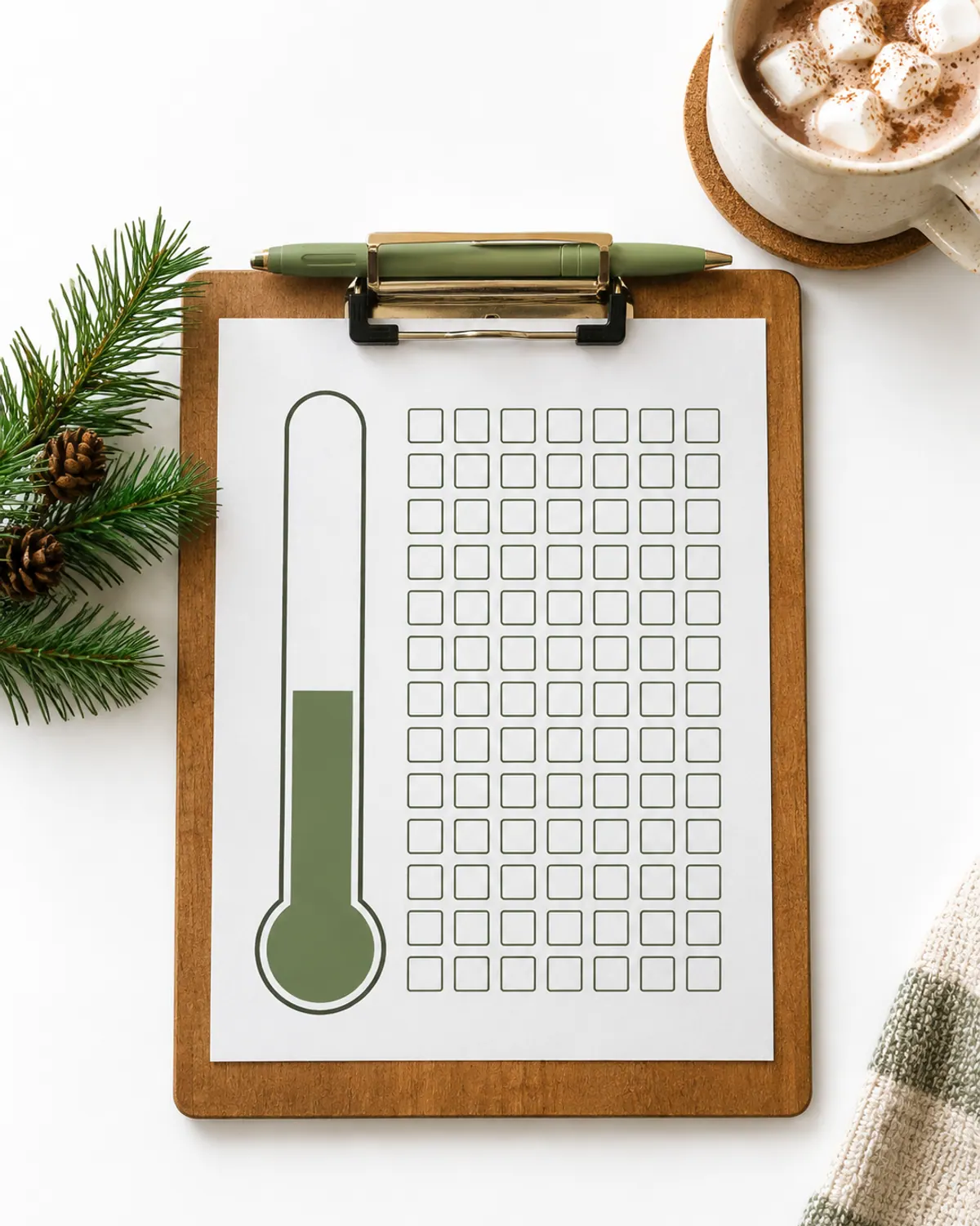
You can run this whole plan on a sheet of paper with 24 boxes. If you want something printed, the free biweekly savings challenge charts (PDF, 6 pages) have 26 paycheck rows per chart (use the first 24 for Christmas 2027) and a blank low-ink chart on page 6 for your own numbers; no sign-up needed. The 100 Envelope Savings Challenge pack adds a goal thermometer that works well on the fridge for a Christmas target.
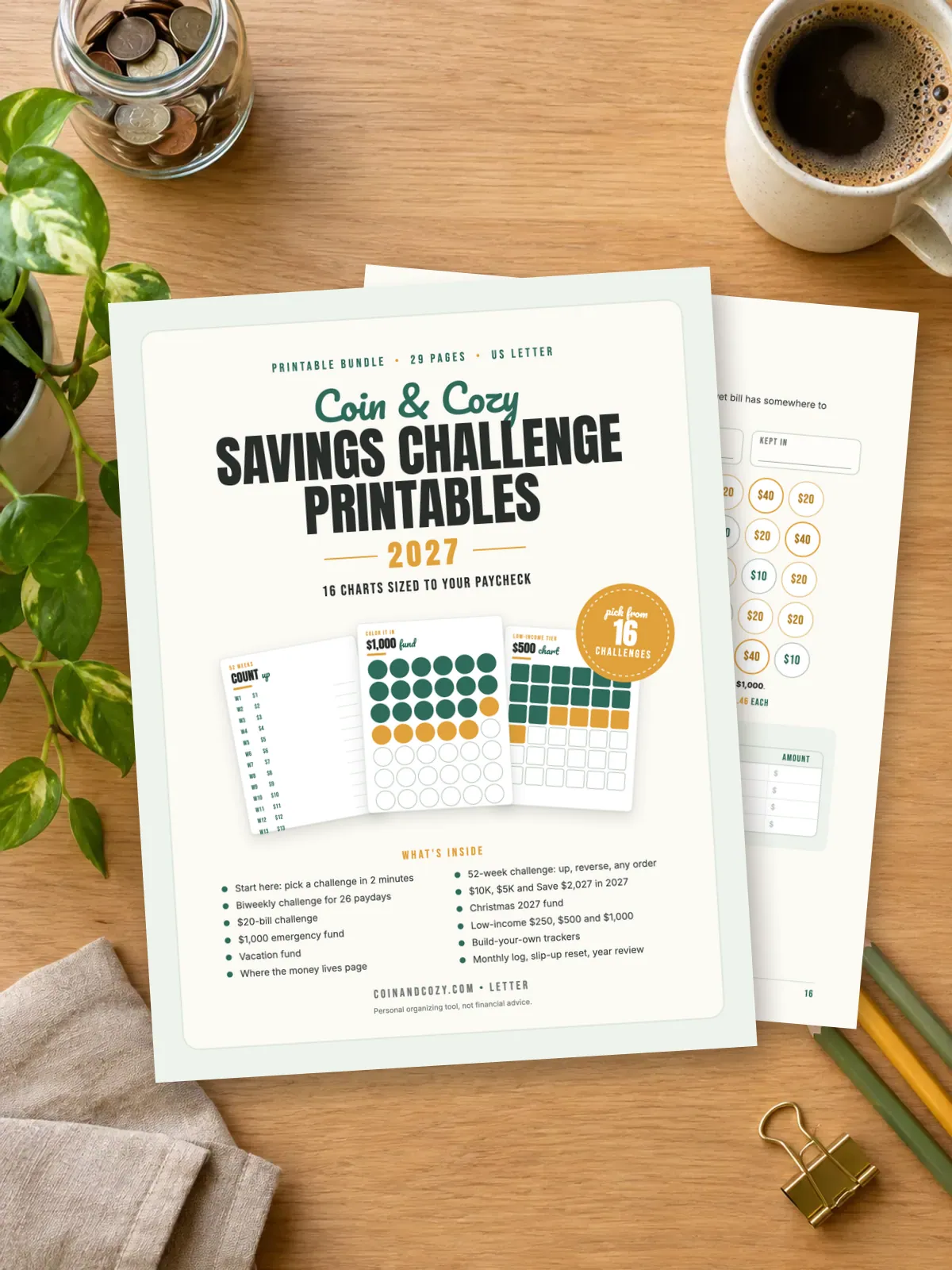
If you would rather have the dated version, the Savings Challenge Bundle 2027 includes a Christmas 2027 fund chart built for $600 with the 24 biweekly paydays already filled in, plus $250, $500 and $1,000 small-budget charts and a chooser page for picking the one that fits. It is $7 and prints on US Letter at home.
Helpful, not required
-
Cash envelope wallet for budgeting
Typically $10 to $25
Keeps the Christmas envelope with the rest of your cash categories so it is not loose in a drawer.
Check price on Amazon for Cash envelope wallet for budgeting -
A6 budget binder with inserts
Typically $8 to $20
Holds the Christmas fund, a tracker card and a few other sinking fund envelopes in one place.
Check price on Amazon for A6 budget binder with inserts -
Glass savings jar with lid
Typically $8 to $18
For households that like to see the fund grow on the counter.
Check price on Amazon for Glass savings jar with lid -
Label maker
Typically $20 to $40
Clear labels on envelopes and jars stop the Christmas fund from getting mixed up with grocery cash.
Check price on Amazon for Label maker
One number, every payday, from January to December 1. Pick the amount from the first table, decide where the fund lives, automate the transfer and then forget about it until the shopping list comes out. The example figures here are for planning and are not financial advice; your Christmas number is the one that matters.
Frequently asked questions
How much should I save each month for Christmas?
Divide your Christmas number by the months left before December 1. From January that is 11 months, so a $600 Christmas is $55 a month and a $1,000 Christmas is $91 a month. Count gifts, food, travel and extras in the number, not gifts alone. These are planning examples, not financial advice.
When should I start saving for Christmas?
The first payday in January gives you the smallest number per paycheck: 48 weekly, 24 biweekly or 11 monthly paydays before December 1, 2027. Starting in June roughly doubles the amount per payday, and a 12 week start from early September needs $50 a week for a $600 Christmas.
How do I start a Christmas sinking fund?
Set your Christmas number, count the paydays before December 1, divide, then open a separate place for the money (a cash envelope, a named bank bucket or a separate savings account) and schedule the transfer for payday morning. Track it on a grid with one box per payday.
How much does the average person spend on Christmas?
The National Retail Federation publishes a per-person holiday spending survey each fall, and the figure changes every year. We have not cited a number here because the 2026 release was not available when this was written. Your own December statements from last year are a better starting point than any national average anyway.
Can I do a Christmas savings challenge on a low income?
Yes. Lower the Christmas number rather than skipping paydays: a $300 Christmas is $6.25 a week or $12.50 every two weeks from January. Our low income savings challenges list has more small-dollar options that finish before the holidays.
Save it for later
Pin this to your Savings Challenges board so it's there when you need it.
Save to Pinterest