This post contains affiliate links. As an Amazon Associate we earn from qualifying purchases, at no extra cost to you. Read our disclosure.
Safety first: This is general money education, not personalised financial advice. Please read our financial disclaimer before you start.
Key takeaways
- Kakeibo was introduced in 1904 by Hani Motoko and uses four questions: money in, savings goal, spending and improvement.
- Answer two questions at the start of the month and two at the end.
- In our example, $2,400 take-home with a $240 savings goal leaves $2,160 to split into four categories.
- A 15 minute Sunday review is the heart of the habit.
- Kakeibo tracks spending; add one limit (an envelope or a cap) if you also want to control it.
In this post10 sections
- What a Kakeibo Budget Planner Is
- The Four Kakeibo Questions
- A Worked Example Month on $2,400
- How to Use a Kakeibo Budget Planner Step by Step
- Kakeibo Categories: What Goes Where
- Kakeibo vs Envelopes vs the 50/30/20 Rule
- Kakeibo Mistakes to Skip
- What to Buy (and What to Skip)
- Start Kakeibo in December for a Clean January
- FAQ
Quick note: product links go to Amazon search results or our own shop, and we may earn a small commission if you buy, at no extra cost to you. Dollar amounts are labelled examples, not advice about your money, and prices change by store and week. This is general information, not financial advice.
What a Kakeibo Budget Planner Is
Kakeibo (say kah-keh-boh) is a Japanese way to budget with a pen, a notebook and four questions. It was introduced in 1904 by Hani Motoko, who is described as Japan's first female journalist, to help women manage household money (Wikipedia). A kakeibo budget planner is simply any notebook or printable page where you answer those questions each month.
The method is less about hitting an exact number and more about noticing where your money goes. You write every purchase by hand, sort it into a category, and look at the totals once a week. That slow look is what changes habits, and it needs no app.

The Four Kakeibo Questions
Every guide to the method uses the same four questions, phrased a little differently (SoFi, Goodbudget). You answer the first two at the start of the month and the last two at the end.
| Question | When | What you write |
|---|---|---|
| 1. How much money do you have? | Start of month | Take-home pay plus any other money coming in |
| 2. How much do you want to save? | Start of month | One savings number, set before you spend |
| 3. How much did you spend? | End of month | Totals by category from your weekly entries |
| 4. How can you improve? | End of month | One sentence about one change for next month |
The fourth question is the one most templates skip. It turns the notebook from a record into a habit: you pick a single change, not a long list of resolutions.
A Worked Example Month on $2,400
Here is one example month so you can see the numbers move. These figures are our own arithmetic for a made-up household with $2,400 take-home pay, not real data and not advice.
Start of month. Question 1: $2,400 comes in. Question 2: save $240, which is 10%. That leaves $2,160 to spend, and the table below splits it into the four categories most kakeibo guides use (names vary a little by guide).
| Category | What goes in it | Planned amount |
|---|---|---|
| Needs | Rent, utilities, groceries, transport, insurance | $1,500 |
| Wants | Takeout, coffee out, streaming, hobbies | $360 |
| Culture | Books, classes, museum days, music | $160 |
| Extras | Surprises: repairs, gifts, a forgotten fee | $140 |
| Savings (set first) | Moved on payday | $240 |
| Total | $2,400 |
End of month. Question 3: you add up the weekly pages. Question 4: you decide what to change.
| Category | Planned | Actual | Difference |
|---|---|---|---|
| Needs | $1,500 | $1,512 | $12 over |
| Wants | $360 | $402 | $42 over |
| Culture | $160 | $95 | $65 under |
| Extras | $140 | $183 | $43 over |
| Savings | $240 | $208 | $32 short |
In this example the actual spending is $2,192, so $208 is left to save instead of $240. The answer to question 4 is short and specific: "Takeout went over by $42, so I will plan two takeout nights, not four." That one sentence is the whole improvement plan.
How to Use a Kakeibo Budget Planner Step by Step
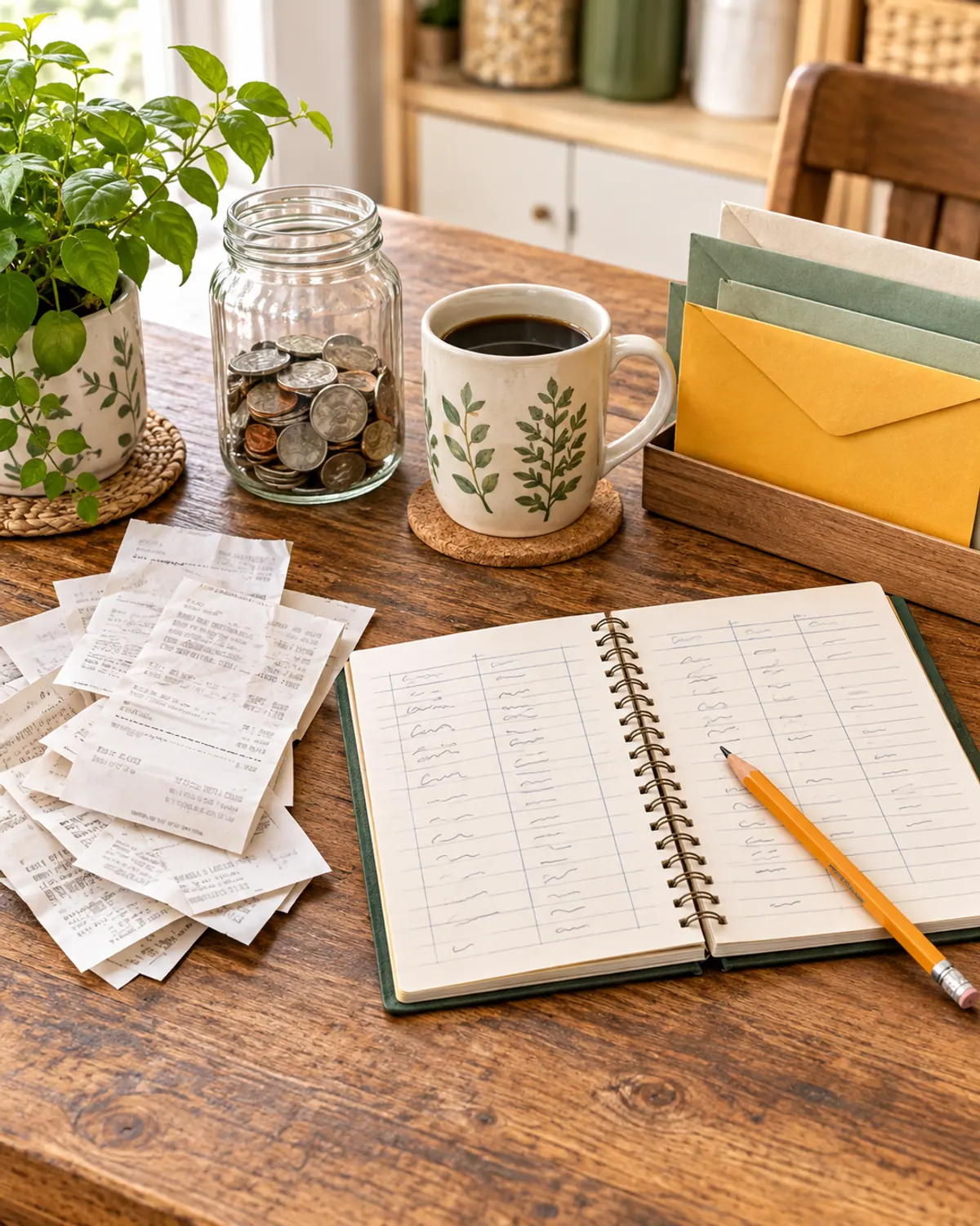
You need a notebook or a printed monthly page, a pen and about 15 minutes a week. Start on the first day of a month if you can, or on any payday.
-
Step 1: Write the month's two numbers
On the first page, write your income (question 1) and your savings goal (question 2). Subtract the savings goal to find what you can spend.
-
Step 2: Move the savings first
On payday, move the savings amount to a separate account or an envelope. Money that is already set aside is harder to spend by accident.
-
Step 3: Set four category totals
Split the rest into needs, wants, culture and extras, like the example table above. Do not aim for exact numbers in month one; a rough split is enough to start.
-
Step 4: Write each purchase by hand
Keep the notebook near your bag or on the kitchen counter. Write the date, the item and the amount, and tick the category. Writing slows you down just enough to notice the purchase.
-
Step 5: Do a 15 minute Sunday review
Once a week, add up each category and write the totals at the bottom of the page. Circle the one biggest line and write one sentence about it.
-
Step 6: Answer questions 3 and 4 at month end
Add the weekly totals, compare them with your plan and write one change for next month. Then turn the page and start again.

Kakeibo Categories: What Goes Where
Most guides use needs, wants, culture and extras, though the exact names differ by source. The hard part is the edge cases, so decide them once and write the rule on the first page.
| Purchase | Likely category | Why |
|---|---|---|
| Groceries | Needs | Food is a basic cost; takeout is a want |
| Coffee out | Wants | Nice, but you could make it at home |
| Library card fees or a used book | Culture | Learning and enjoying, not survival |
| Car repair | Needs or Extras | Needs if it is routine, Extras if it was a surprise |
| Birthday gift | Extras | Plan for it in advance and it moves into the plan |

Kakeibo vs Envelopes vs the 50/30/20 Rule
Kakeibo is a tracking method, not a spending limit. It pairs well with other plans, and it helps to know where each one fits. If you want rules for spending, see our guides to the cash envelope system and the 50/30/20 rule.
| Method | How it works | Best for | Effort |
|---|---|---|---|
| Kakeibo | Write every purchase, review weekly, answer four questions | People who want to understand their habits | Medium: 15 minutes a week plus quick daily notes |
| Cash envelopes | Cash is divided into labeled envelopes; spending stops when one is empty | People who overspend with cards | Medium: cash trips and envelope upkeep |
| 50/30/20 rule | Roughly half for needs, 30% wants, 20% savings and debt | Beginners who want a simple split | Low: one calculation |
| Zero-based budget | Every dollar gets a job before the month starts | People with irregular bills who like detail | Higher: a planning session each month |
A good first month: use kakeibo as a tracker, then pick one limit to add. If you are not sure, our zero-based budget template and budget planner for beginners show how to turn what you notice into a plan.
Kakeibo Mistakes to Skip
What we like
- Handwriting makes each purchase more noticeable
- A weekly review catches small leaks early
- One improvement sentence is easy to keep
- Works with a notebook, a printable or a binder
Keep in mind
- Skipping a week makes the next review harder
- Waiting until month end to enter receipts loses details
- Strict categories can frustrate; use a rough rule
- It tracks spending but does not set a limit by itself
The most common mistake is trying to log every coin from day one. Start with purchases over $5, or batch the small ones each Sunday, and tighten up in month two. Keep your receipts in one envelope so the Sunday review is quick.

What to Buy (and What to Skip)
You can start with a free notebook. If you want a tidier setup, these are small, low-cost items that make the weekly habit easier. Skip anything that costs more than a couple of coffees until you have done two full months.
Low-cost tools for a kakeibo month
-
A5 dotted notebook
Typically $8 to $16
Dots help you draw simple columns without a ruler.
Check price on Amazon for A5 dotted notebook -
Fine tip pens
Typically $6 to $12
A pen you like makes the weekly entry easier.
Check price on Amazon for Fine tip pens -
Small kraft envelopes
Typically $6 to $12
Holds receipts until Sunday.
Check price on Amazon for Small kraft envelopes -
Basic desk calculator
Typically $6 to $14
Totals your categories in seconds.
Check price on Amazon for Basic desk calculator
Start Kakeibo in December for a Clean January
Kakeibo is a good fit for a fresh start. Run it for December as a practice month, then use January 1 to set a real plan with what you learned. Our New Year budget plan is a one evening reset, and the spending tracker ideas article has layouts for your weekly page.
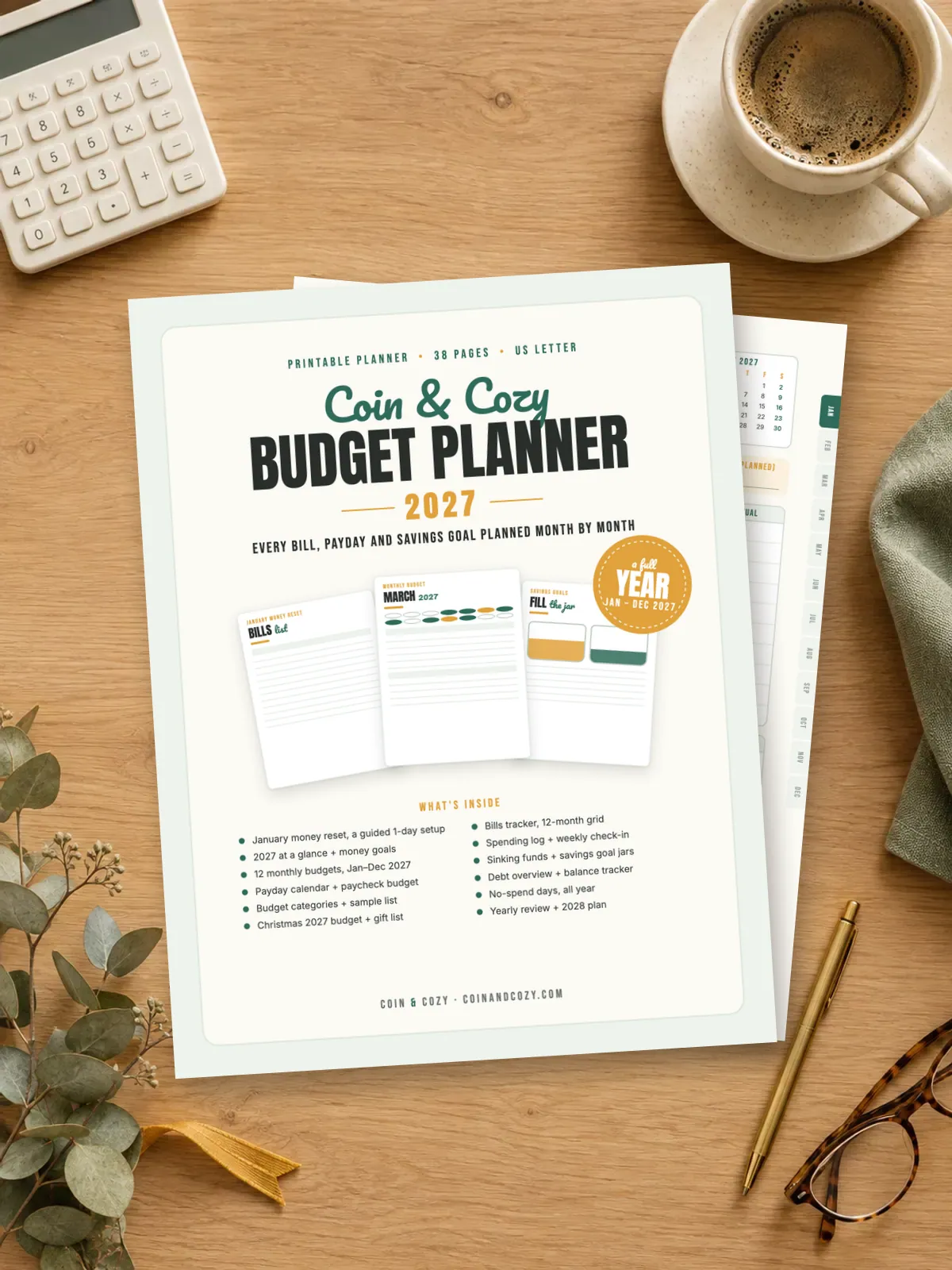
If you want your whole year in one place, the Cozy Budget Planner 2027 has room for monthly income, bills and savings goals, and the Cozy Money Binder adds savings and Christmas pages. You do not need either to try kakeibo; a notebook works fine.
Frequently asked questions
What is the kakeibo method?
Kakeibo is a Japanese budgeting method from 1904. You write your spending by hand, sort it into categories, and answer four questions each month about money in, savings, spending and improvement.
What are the four kakeibo questions?
How much money do you have, how much do you want to save, how much are you spending, and how can you improve. The first two are answered at the start of the month, the last two at the end.
What are the kakeibo categories?
Guides commonly use needs, wants, culture and extras, though names vary. You can use your own labels as long as you keep them the same every month.
Is kakeibo good for beginners?
Yes. It needs only a notebook and about 15 minutes a week. If you want a spending limit as well, add one envelope or one category cap after your first month.
Can I use kakeibo with an app?
You can. Some people write in the notebook and use an app for bank balances. The handwriting step is what makes the method different.
Is kakeibo financial advice?
No. It is a tracking habit. The numbers in this article are examples, not advice about your money.
Save it for later
Pin this to your Budgeting Basics board so it's there when you need it.
Save to Pinterest