This post contains affiliate links. As an Amazon Associate we earn from qualifying purchases, at no extra cost to you. Read our disclosure.
Safety first: This is general money education, not personalised financial advice. Please read our financial disclaimer before you start.
Key takeaways
- A specific financial goal has an amount, a deadline and a per-paycheck number.
- Per-paycheck math: goal ÷ paychecks until the deadline.
- Start with 3 goals: one 30-day, one 90-day, one year-long.
- Automate transfers on payday so goals happen before spending.
- Check progress at a 15-minute monthly money date.
In this post32 sections
- How to Make Financial Goals Specific (Amount, Date, Per-Paycheck Math)
- 30-Day Financial Goals (Quick Wins)
- 1. Track every dollar you spend for 30 days
- 2. Cancel or pause two subscriptions
- 3. Save a $100 mini cushion in 30 days
- 4. Write your first monthly budget
- 5. Do one no-spend week
- 6. Set up an automatic payday transfer
- 90-Day Financial Goals (Next 3 Months)
- 7. Build a $500 starter emergency fund
- 8. Pay off your smallest debt
- 9. Cut the grocery bill by $50 a month
- 10. Open three sinking funds
- 11. Check your free credit reports
- 12. Find $100 a month of extra income
- Financial Goals for the Year
- 13. Save one month of essential expenses
- 14. Pay for Christmas in cash
- 15. Finish a savings challenge
- 16. Pay off one credit card
- 17. Hold a monthly money date
- 18. Raise your savings by 1% every quarter
- 19. Build a car repair fund
- Long-Term Financial Goals to Start This Year
- 20. Get the full employer retirement match
- 21. Open a retirement account if you don't have one
- 22. Grow your emergency fund to 3 months
- 23. Set a debt-free date
- 24. Start a down payment fund
- 25. Check beneficiaries on your accounts
- Bonus: How to Keep Your Financial Goals Going Past February
- FAQ
How to Make Financial Goals Specific (Amount, Date, Per-Paycheck Math)
Vague goals like "save more" or "get better with money" are easy to forget by February. A goal you can finish has three parts: a dollar amount, a deadline and the amount per paycheck or per week.
The math is one line: goal amount ÷ number of paychecks (or weeks) until the deadline. A $500 goal over 6 biweekly paychecks is $83.33 a paycheck. That's a number you can schedule as an automatic transfer.

| Vague goal | Specific version | Per paycheck (biweekly) |
|---|---|---|
| Save more | $500 starter fund in 12 weeks | $83.33 |
| Pay off debt | $450 store card gone in 3 months | $75 |
| Do Christmas in cash | $600 saved by December | $23.08 (26 paychecks) |
| Save for a house | $10,000 down payment in 3 years | $128.21 (78 paychecks) |
Every number in this list is an example, not financial advice. Swap in your own amounts, keep the deadline, and do the division. Pick 3 to 5 goals to start, not all 25.
30-Day Financial Goals (Quick Wins)
Quick wins build the habit first. Each of these takes a month or less and costs nothing to start.
1Track every dollar you spend for 30 days

Write down every purchase, even the $3 coffee. You're not cutting anything yet, just looking. Most people find one or two categories that are much bigger than they guessed.
- Keep a small notebook in your bag or use your phone's notes app, then total each category on day 30.
2Cancel or pause two subscriptions

Look at your last two bank statements for repeat charges. Example: $15 + $11 = $26 a month, or $312 a year, back in your budget.
- Before canceling, check whether a pause option exists so you can come back later at the same price.
3Save a $100 mini cushion in 30 days

A tiny cushion stops a flat tire from going on a card. Example: $25 a week for 4 weeks = $100. Keep it in a separate savings account or an envelope.
- Name the account or envelope "Oops fund" so it's harder to spend on takeout.
4Write your first monthly budget
Give every dollar of next month's pay a job before the month starts. Our free monthly budget template walks you through it in about 30 minutes.
- Use last month's real spending from goal 1, not a guess.
5Do one no-spend week

Seven days of buying only essentials: groceries you planned, gas, bills and medicine. It's a reset for impulse spending, not a punishment. Our no-spend challenge rules list what counts.
- Plan the week's meals from what's already in your pantry before day 1.
6Set up an automatic payday transfer
Even $25 counts. Schedule it for the morning your paycheck lands so the money moves before you see it. Example: $25 every two weeks = $650 a year.
- Start small enough that you never cancel it. You can raise it in month three.
90-Day Financial Goals (Next 3 Months)
These take a few paychecks. Write the deadline on your calendar and check in every payday.
7Build a $500 starter emergency fund

A starter fund covers the small surprises: a tow, an urgent care copay, a broken phone. Example: $500 over 6 biweekly paychecks = $83.33 a paycheck. See how it grows into a full fund in our emergency fund guide.
- Keep it in a separate savings account from your checking, so it isn't one tap away.
8Pay off your smallest debt

The smallest balance is the fastest win. Example: a $450 store card in 3 months = $150 a month, plus any interest. Our debt snowball worksheet shows how to roll that payment to the next debt.
- Call and ask for the exact payoff amount the month you plan to finish, so a few dollars of interest don't linger.
9Cut the grocery bill by $50 a month

Plan meals around sales, shop with a list and use leftovers twice. Example: $50 a month = $600 a year. Our grocery budget guide for a family of 4 has sample numbers.
- Check your three most-bought items: a cheaper brand on just those often covers most of the $50.
10Open three sinking funds
Pick the three bills that surprise you every year, like car repairs, Christmas and the vet. Example: $600 a year ÷ 12 = $50 a month each. Our list of sinking funds categories has 20 more.
- Name each one inside your bank app or label three envelopes.
11Check your free credit reports

You can get free credit reports from Equifax, Experian and TransUnion at AnnualCreditReport.com, the official site the FTC points to. Look for accounts you don't recognize and old errors.
- Only use AnnualCreditReport.com. Other sites with similar names may try to sell you something.
12Find $100 a month of extra income
Sell things you don't use, pick up a few extra shifts or try a small side hustle. Example: $100 a month = $1,200 a year toward any goal on this list.
- Send extra income straight to one goal so it doesn't blend into spending.
Financial Goals for the Year
Year-long goals are where per-paycheck math matters most. Divide by 26 if you're paid every two weeks, 24 if twice a month, or 12 if monthly.
13Save one month of essential expenses
After the starter fund, aim for a full month of must-pay bills. Example: $2,400 ÷ 26 paychecks = $92.31 a paycheck.
- Add up only rent, utilities, groceries, insurance, transportation and minimum debt payments.
14Pay for Christmas in cash

No January card bill. Example: $600 ÷ 12 months = $50 a month. Our Christmas on a budget guide helps you set the number.
- Start the Christmas fund in January, when the last one is still fresh.
15Finish a savings challenge

A chart you color in makes a big goal feel lighter. The 100 envelope challenge adds up to $5,050; a $5,000 goal is $96.15 a week for 52 weeks. Our 10K savings challenge guide has the per-paycheck math for bigger goals.
- Pick a chart that matches your pay schedule so every payday has a box to fill.
16Pay off one credit card
Pick one card and give it a finish date. Example: $3,000 in 12 months = $250 a month, plus interest, which depends on your rate. Our credit card debt payoff plan has the steps.
- Stop new charges on that card first, or the balance moves while you pay.
17Hold a monthly money date

Fifteen minutes, once a month: check balances, update trackers, plan next month. 12 short check-ins a year beat one stressful January.
- Pair it with something cozy, like tea and a candle, so you look forward to it.
18Raise your savings by 1% every quarter
Small steps you barely notice. Example on $3,000 a month take-home: 1% = $30 a month more each quarter, $120 a month by year-end.
- Time each raise to a pay increase or a paid-off bill so your spending money never shrinks.
19Build a car repair fund

Car repairs are the classic budget breaker. Example: $600 a year = $50 a month. Older cars may need more.
- Keep repair receipts so next year's amount uses real numbers.
Long-Term Financial Goals to Start This Year
You won't finish these in one year, but starting now makes them real. This is general information, not financial advice. For retirement and investment choices, read your plan's documents or talk with a qualified professional.
20Get the full employer retirement match
If your job offers a match, find out how much you need to contribute to get all of it. Your HR or benefits page will say.
- Check the vesting schedule too, so you know when the match is fully yours.
21Open a retirement account if you don't have one
If there's no workplace plan, an IRA is one option many people look into. Even a small monthly amount starts the habit.
- Read the account's fees before opening; small fees add up over decades.
22Grow your emergency fund to 3 months
The next step after one month. Example: $7,200 for $2,400 a month of essentials, saved over two or three years.
- Use windfalls like a tax refund to jump a step.
23Set a debt-free date
List every debt except the mortgage, add the monthly payments, and work out when the last one ends. Then write that date where you'll see it.
- Recalculate each time a debt is paid off; rolling payments forward usually moves the date sooner.
24Start a down payment fund

Example: $10,000 in 3 years = $277.78 a month or about $128.21 a paycheck. Smaller goal? $5,000 in 3 years is $138.89 a month.
- Keep it separate from your emergency fund so one goal can't eat the other.
25Check beneficiaries on your accounts
Retirement accounts and life insurance often go to whoever is named as beneficiary. Log in once a year and make sure the names are current.
- Do it after any big life change: a marriage, a divorce or a new baby.
Bonus: How to Keep Your Financial Goals Going Past February
Most goals fade because they're out of sight. Put yours on one page you'll actually open, and color in progress every payday.

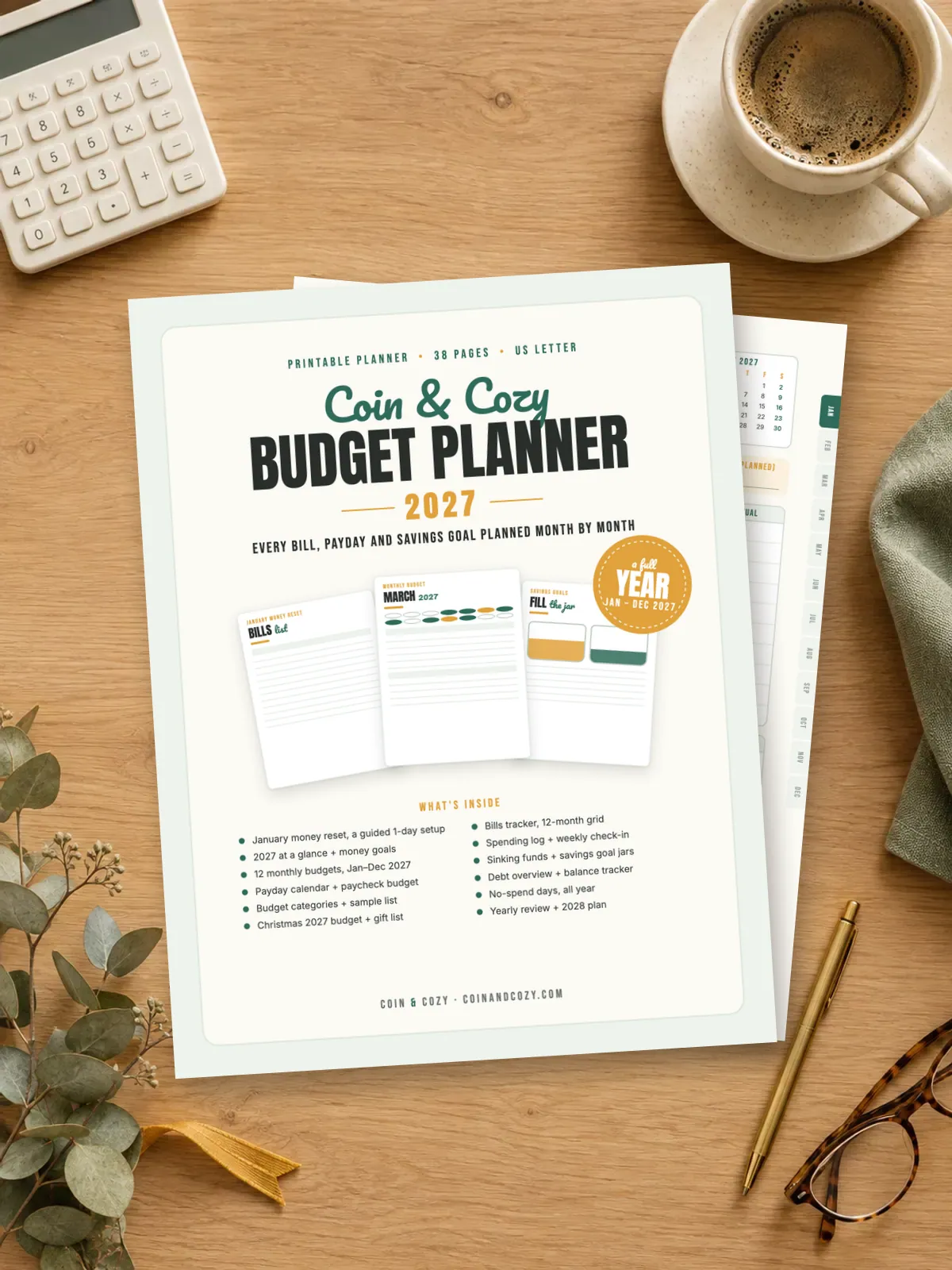
The Cozy Budget Planner 2027 has a guided January money reset, savings goal jars, a debt overview and monthly budget pages, so every goal on this list has a place to live.
Goals that stick
- A dollar amount and a deadline
- A per-paycheck number you can automate
- Written where you'll see it weekly
- Three goals at a time
Goals that fade
- "Save more" with no number
- Ten goals started on January 1
- Saving whatever is left at month's end
- Never checking progress
A small goal you finish does more for you than a big one you quit.
Helpful, not required
-
Clear glass savings jars with lids
Typically $8 to $20
A see-through jar for one cash goal keeps it in view.
Check price on Amazon for Clear glass savings jars with lids -
Undated monthly planner
Typically $10 to $20
Write each goal's deadline and payday checks on the calendar pages.
Check price on Amazon for Undated monthly planner -
Colored pencils set
Typically $6 to $15
For coloring in savings charts and goal trackers.
Check price on Amazon for Colored pencils set
Want the planner, the savings challenge charts and the Christmas planner together? The Cozy Money Binder bundles all three with a weekly money check-in page.
Frequently asked questions
What are good financial goals to set?
Specific ones you can schedule: a $500 starter emergency fund, paying off your smallest debt, cutting groceries by $50 a month or paying for Christmas in cash. Each needs an amount, a deadline and a per-paycheck number.
How many financial goals should I have at once?
Three is a good start: one 30-day goal, one 90-day goal and one year-long goal. When one finishes, add the next.
How do I figure out how much to save per paycheck?
Divide the goal by the number of paychecks before the deadline. $600 by December with 26 biweekly paychecks is $23.08 a paycheck. These are example numbers, not financial advice.
What is a good first financial goal?
Tracking your spending for 30 days or saving a $100 to $500 starter cushion. Both are quick, and they make every later goal easier to plan.
Should I save or pay off debt first?
Many people build a small starter fund first, then put extra money toward high-interest debt. Your situation may differ; this is general information, not financial advice.
Save it for later
Pin this to your Budgeting Basics board so it's there when you need it.
Save to Pinterest