Safety first: This is general money education, not personalised financial advice. Please read our financial disclaimer before you start.
Key takeaways
- A monthly budget shows this month. A yearly planner shows which months run tight, so you can save for them in advance.
- Six steps take about 2 hours 20 minutes (our estimate): review 2026, map the months, split yearly costs, mark paydays, set a base budget and set review dates.
- Divide each yearly cost by 12. A $600 Christmas fund is $50 a month.
- If you are paid every 2 weeks, two months in 2027 get three paychecks. Decide what those extra checks do before they land.
- A notebook or free spreadsheet works fine. A printable only saves the layout work.
In this post10 sections
- Why a Yearly Budget Planner Beats Twelve Separate Monthly Budgets
- Step 1: Review 2026 First (30 minutes)
- Step 2: Map the 12 Months and Mark the Costly Ones (25 minutes)
- Step 3: Turn Yearly Costs Into a Monthly Amount (25 minutes)
- Step 4: Mark Paydays and the Extra Paycheck Months (15 minutes)
- Step 5: Set Your Base Monthly Budget (25 minutes)
- Step 6: Fill In the Yearly Overview and Set Review Dates (20 minutes)
- Free Yearly Budget Planner or a Printable? How to Choose
- Your Next Step: Put the 12 Months on Paper
- FAQ
Quick note: product links go to Amazon search results or our own shop, and we may earn a small commission if you buy, at no extra cost to you. Dollar amounts are labelled examples, not advice about your money, and prices change by store and week. This is general information, not financial advice.
Why a Yearly Budget Planner Beats Twelve Separate Monthly Budgets
A monthly budget answers one question: what do I do with this month's money? A yearly budget planner answers a bigger one: which months will run tight, and what can I set aside now to cover them? Most money surprises are not random. Car registration, insurance renewals, birthdays, back-to-school and December all arrive on a calendar you can read today.
Pinterest is full of blank yearly grids to download. What most of them skip is the map: which of the 12 months cost extra for you, and how much to save each month to cover them. That is what the six steps below build. They pair with our one evening January budget reset, which sets the caps for a normal month, while this guide plans the whole year around it.

| Step | What you do | Time |
|---|---|---|
| 1 | Review 2026: income, big irregular costs, tight months | 30 minutes |
| 2 | Map the 12 months of 2027 and mark the costly ones | 25 minutes |
| 3 | Turn yearly costs into a monthly sinking fund amount | 25 minutes |
| 4 | Mark paydays and find any three paycheck months | 15 minutes |
| 5 | Set your base monthly budget | 25 minutes |
| 6 | Fill in the yearly overview and set review dates | 20 minutes |
Step 1: Review 2026 First (30 minutes)
A plan for 2027 starts with what actually happened in 2026. Open your statements for January through October. For November and December, use last year's numbers as a guess and label them as estimates.

What to pull from 2026
Write the answers on one page. These notes are the raw material for the next five steps. If a number is a guess, put a question mark next to it and fix it when the statement arrives.
Step 2: Map the 12 Months and Mark the Costly Ones (25 minutes)
Draw 12 boxes, one for each month of 2027. In each box, write the dates and costs you already know are coming: renewals, birthdays, trips, school fees and taxes. Use your 2026 review to find the months that felt tight. The table below lists common US calendar dates for 2027 to jog your memory, so swap in your own.
| Month | Dates and costs to check |
|---|---|
| January | Annual renewals you set for the new year, card bills from December shopping |
| February | Valentine's Day (Sunday, February 14), tax forms arriving, any paid tax prep |
| March | Spring trips or school breaks, birthdays you know about |
| April | US federal tax filing is usually due April 15 (a Thursday in 2027), possible tax bill or refund |
| May | Mother's Day (Sunday, May 9), graduations |
| June | Father's Day (Sunday, June 20), summer camp and childcare sign-ups |
| July | Summer travel, higher cooling bills in warm areas |
| August | Back-to-school supplies and fees |
| September | Fall activities, school costs, Labor Day weekend (Monday, September 6) |
| October | Halloween, early holiday shopping, any insurance renewal |
| November | Thanksgiving (Thursday, November 25), Black Friday (November 26), travel |
| December | Christmas (Saturday, December 25): gifts, food, cards, travel and a little buffer |

December is the month most households already know about, so give it its own box and its own fund. If you would like to start early, our Christmas savings plan shows how a January start spreads the cost over 12 months.
Step 3: Turn Yearly Costs Into a Monthly Amount (25 minutes)
List every cost that does not arrive monthly, then divide the yearly total by 12. The result is the amount you move into a sinking fund each month, so the bill is paid before it arrives. Our sinking funds guide has more category ideas.

| Cost | Yearly total | Per month (divide by 12) |
|---|---|---|
| Car registration and insurance renewals | $900 | $75 |
| Christmas | $600 | $50 |
| Vacation | $720 | $60 |
| Birthdays and gifts | $360 | $30 |
| Yearly subscriptions | $120 | $10 |
| Car repairs | $480 | $40 |
| Total | $3,180 | $265 |
In this example, $3,180 a year becomes $265 a month. If a bill is due in 3 months, divide by 3 instead of 12 for now, then drop to the normal amount after it is paid. If $265 is too much, fund the soonest bills first and add the rest as your income grows.
Step 4: Mark Paydays and the Extra Paycheck Months (15 minutes)
Write every payday in the boxes. Paid monthly, you get 12 paychecks in a year. Paid every 2 weeks, you get 26, which means two months in the year have three paychecks.

Here is an example. If your first 2027 payday is Friday, January 8, and you are paid every 14 days after that, April has three paydays (April 2, 16 and 30) and so does October (October 1, 15 and 29). Your dates will differ, so count yours on a calendar.
The money is worth planning. If each paycheck is $1,600, a normal month brings in $3,200 and a three paycheck month brings in $4,800. Over a year that is 26 paychecks, or $41,600, against $38,400 for 12 months of two. Budget your normal months on $3,200, and send the two extra $1,600 paychecks (April and October in this example) to a goal instead of spending them.
Good homes for an extra paycheck are a sinking fund that is behind, a starter emergency fund or a debt balance. Our biweekly budget guide explains paycheck-by-paycheck budgets, and the one paycheck ahead plan shows how to use an extra check to get a month ahead.
Step 5: Set Your Base Monthly Budget (25 minutes)
Now set the budget a normal month runs on. If you did our one evening reset, reuse its three caps (housing and bills, food, everything else). If you have not, start with last year's average for each. The new piece here is a sinking fund line from Step 3, taken out before the rest.

| Line | Monthly amount | Share of income |
|---|---|---|
| Housing and bills | $1,760 | 55% |
| Food | $480 | 15% |
| Everything else | $480 | 15% |
| Sinking funds (from Step 3) | $265 | 8% |
| Emergency fund or debt extra | $215 | 7% |
| Total | $3,200 | 100% |
In this example the sinking funds and the extra line come out of the $480 that would otherwise be general savings (265 plus 215 equals 480). If your bills already take more than half of your income, start the sinking fund smaller and raise it when a bill ends. Our low income budget guide has options when the numbers feel tight.
Step 6: Fill In the Yearly Overview and Set Review Dates (20 minutes)
Put it all on one page. For each of the 12 months, write the income you expect (counting paychecks), the base budget, the big costs due that month and the amount you move into sinking funds. Then circle the months where a cost is larger than the sinking fund can cover, and decide now how you will fill the gap.
Your yearly overview checklist

At each quarterly review, which takes about 15 minutes, compare what you planned with what happened, adjust the next three months and move any leftover to your goals. Between reviews, a short weekly check-in keeps the plan alive, and our financial goals for 2027 guide can help you choose what the extra money is for.
Free Yearly Budget Planner or a Printable? How to Choose
You do not need to buy anything to use these six steps. A notebook or a spreadsheet works. A printable only saves the layout work, so pick by how you like to plan.

| Option | Cost | Setup | Best if you |
|---|---|---|---|
| Notebook or hand-ruled grid | $0 | One evening to rule the pages | Like pen and paper and want full control |
| Free spreadsheet | $0 | One evening to build, or a free template to adapt | Like automatic totals and edit often |
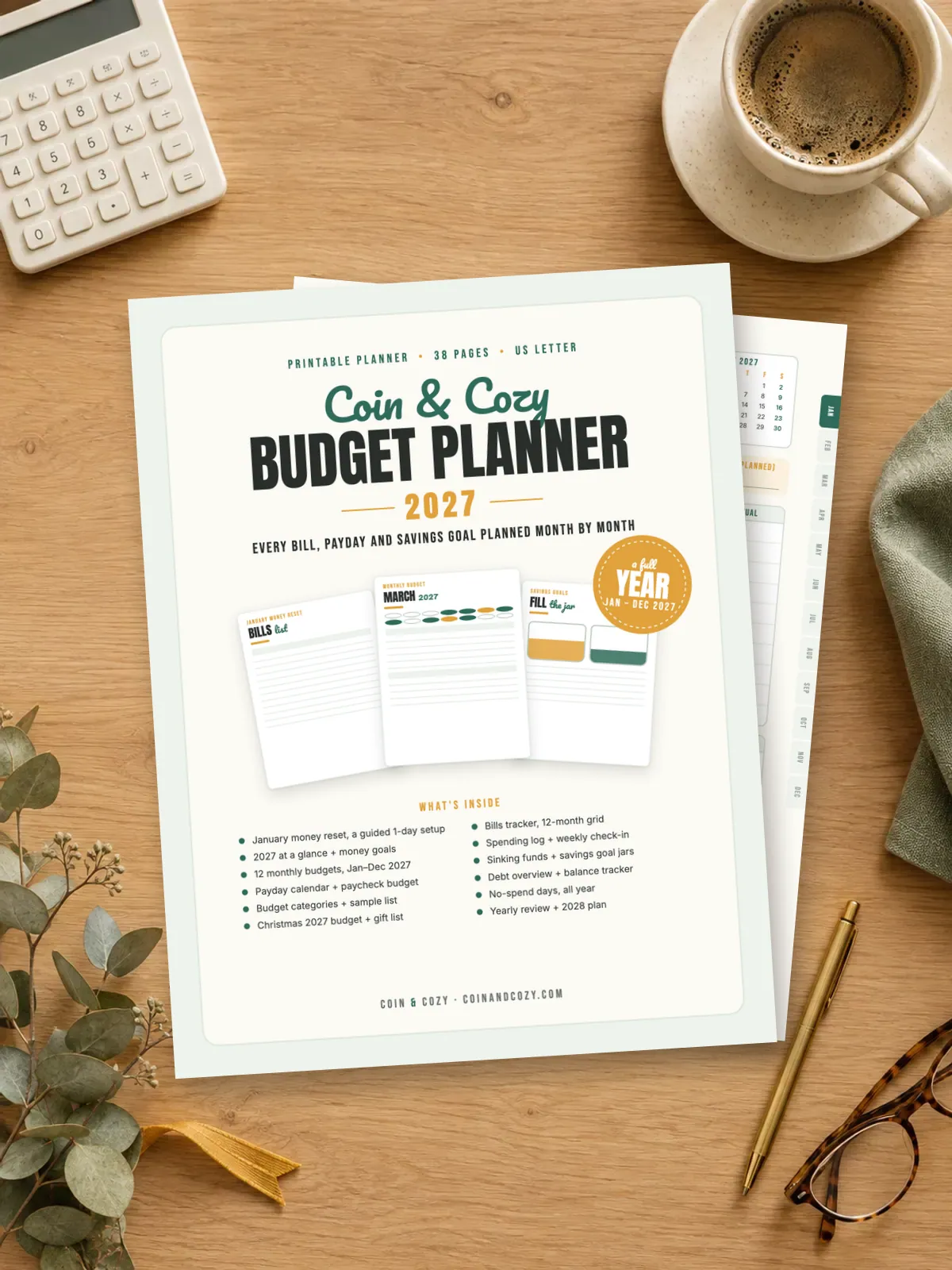
| Printable planner | $12 (Cozy Budget Planner 2027) | Print and fill in, layout done | Want ready-made monthly pages, a payday calendar and a yearly review |
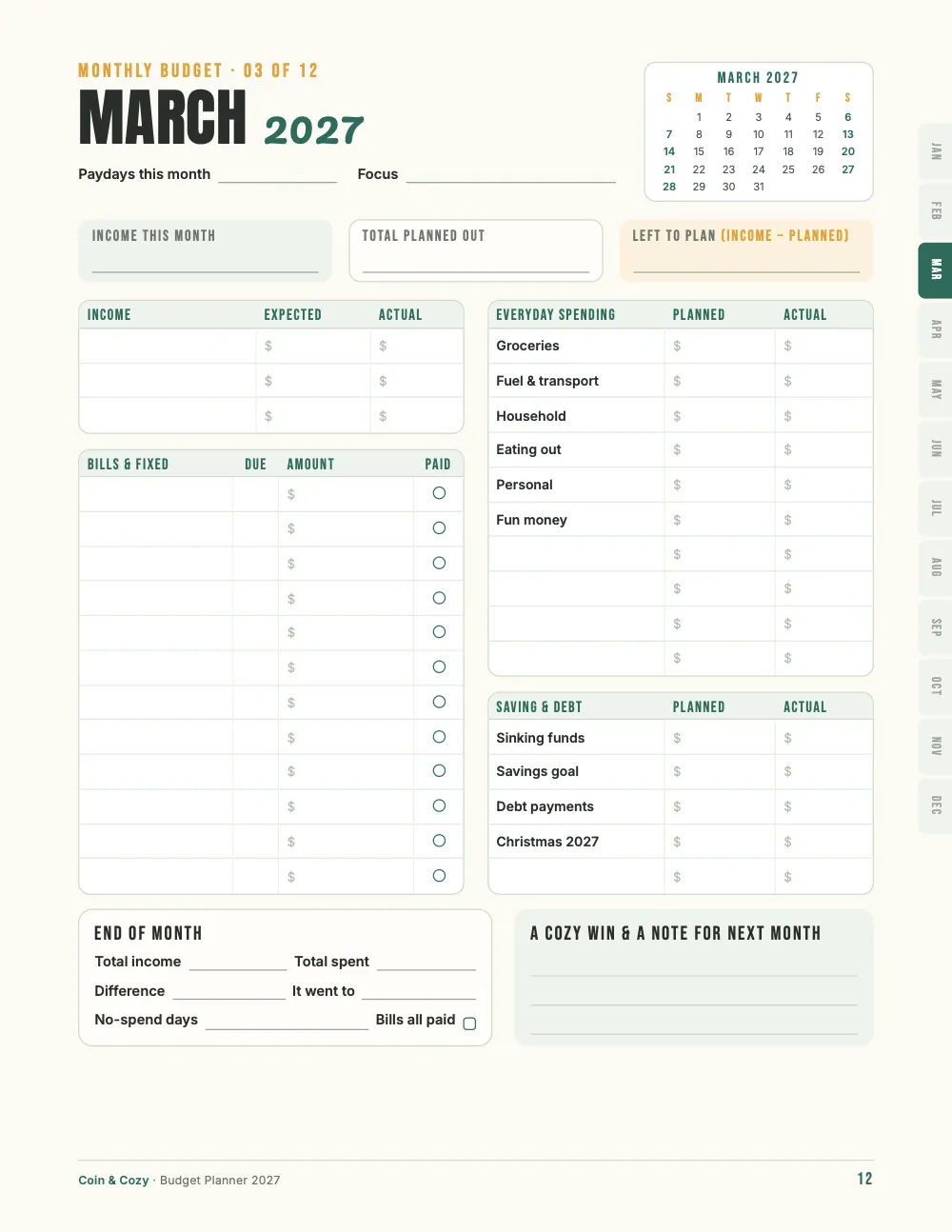
The Cozy Budget Planner 2027 is 38 pages on US Letter. It opens with a five step January money reset, then gives each month of 2027 its own dated page with a mini calendar, income, bills with paid checkboxes, saving and debt lines and an end-of-month check. It also has a 2027 payday calendar, a 12-month bills grid, a sinking funds plan, a debt overview, a whole-year no-spend grid, a Christmas 2027 page and a two page yearly review. It is a personal organizing tool, not financial advice.
If you want more ideas for what to put in a planner, see our 2027 planner pages ideas, our budget planner for beginners and the free budget printables we already have.
Your Next Step: Put the 12 Months on Paper
If you want these six steps on pages that are already laid out, the Cozy Budget Planner 2027 ($12) has the 12 dated monthly pages, the payday calendar, the bills grid and the yearly review in one printable. Print only the pages you need, as many times as you like for your own household. Or start tonight with a notebook and Step 1, and come back to the printable if you want the layout.
Frequently asked questions
What is a yearly budget planner?
A yearly budget planner is a set of pages or a spreadsheet that shows all 12 months of the year together. It lists your income, bills, goals and the months that cost extra, so you can save for them ahead of time.
How do I make a yearly budget?
Review last year, map the 12 months and mark the costly ones, turn yearly costs into monthly sinking fund amounts, mark your paydays, set a base monthly budget and fill in a one-page yearly overview. This guide walks through each step in about 2 hours 20 minutes (our estimate).
Is there a free yearly budget planner?
Yes. A notebook or a free spreadsheet works with the six steps above, so you do not have to buy anything. A printable planner saves the layout work if you would rather fill in ready-made pages.
Which months cost the most?
It depends on your household. For many US families December stands out, and so do months with birthdays, trips, school fees or annual bills. Check your own 2026 statements, because we do not have a verified national month-by-month figure to give you.
What is a three paycheck month?
If you are paid every 2 weeks, you get 26 paychecks in a year, so two months get three. In the example above, April and October have three paydays. Check your own calendar, and plan what the extra check will do before it arrives.
How often should I review a yearly budget?
A short weekly check-in plus a 15 minute review every three months is enough for most people. Use the review to adjust the next quarter and move any leftover money to a goal.
Save it for later
Pin this to your Budgeting Basics board so it's there when you need it.
Save to Pinterest