Safety first: This is general money education, not personalised financial advice. Please read our financial disclaimer before you start.
Key takeaways
- Plan every month as if it will be your lowest one, not your average one.
- Budget the lowest month down to $0, with a small savings line.
- Split every dollar above it into float, goals and debt, and fun.
- A float equal to one month of your floor makes slow months far less stressful.
- Recheck your lowest month every few months.
In this post12 sections
- What You Need Before You Start
- Why Budgeting From Your Average Month Backfires
- Irregular Income Budget Example: Six Months of Take-Home Pay
- Step 1: Find Your Lowest Month
- Step 2: Budget the Floor Down to $0
- Step 3: Split Every Dollar Above the Floor Into Three Buckets
- Step 4: Check In Each Month and Reset the Floor
- Free Irregular Income Budget Pages
- Irregular Income Budget Mistakes to Skip
- Variations: Seasonal Work, Commission and Gig Pay
- Keep Your Floor Budget and Buckets on Paper
- FAQ
This page is budgeting education with example numbers. It is not personalized financial advice, and your taxes, bills and income are your own.
What You Need Before You Start
Gather these first (about 45 minutes)

Why Budgeting From Your Average Month Backfires
The usual advice is to add up your months and divide. In our example, six months of take-home pay add up to $17,450, which averages $2,908 a month. But one of those months was only $2,100, so a budget built on the average runs about $808 short in the slow month.
The lowest-month method flips that. You plan every month as if it will be your slowest one, and anything above that number is a bonus with a job. A slow month then stops being an emergency, because the plan already fits it.
Irregular Income Budget Example: Six Months of Take-Home Pay
Here is the example we use below: someone with freelance and seasonal work, paid a different amount each month. These are made-up numbers to show the math.
| Month | Take-home | Above the $2,100 floor |
|---|---|---|
| June | $2,650 | $550 |
| July | $3,400 | $1,300 |
| August | $2,100 | $0 (lowest month) |
| September | $3,050 | $950 |
| October | $2,350 | $250 |
| November | $3,900 | $1,800 |
| Total | $17,450 | $4,850 |
Notice that the total above the floor is $4,850. That is the money the method puts to work, and it is the part that a plain average would have spent on a month that did not need it.
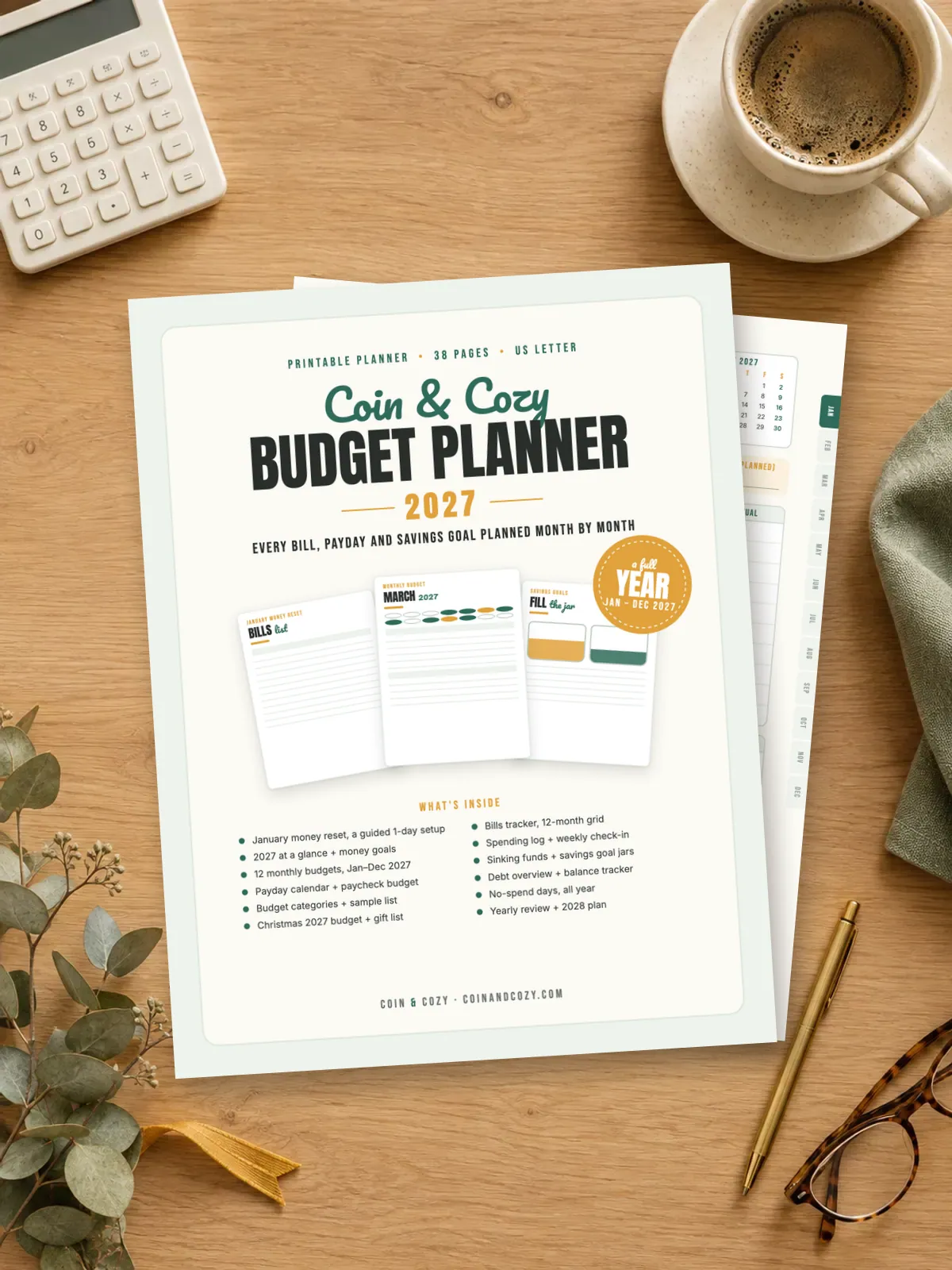
Your pay changes every month, so every month needs its own page where you write what actually came in, cover the floor bills first, and record where the extra went. The Cozy Budget Planner 2027 ($12, 38 printable pages) has a dated budget page for each month of 2027 with income, bills with paid boxes, a saving line and an end-of-month check, plus savings goal jars where your float can live.
Step 1: Find Your Lowest Month
Look at your last 6 to 12 months and write each month's take-home pay in a column. Circle the smallest one. That circled number is your floor, and in the example it is $2,100.

If you are self-employed, count what is left after business costs and after you set aside money for taxes. How much to set aside depends on your situation, so ask a tax professional. If one month was a true one-off, like a month off sick, you can use the next-lowest month, but write down that you chose to.
Step 2: Budget the Floor Down to $0
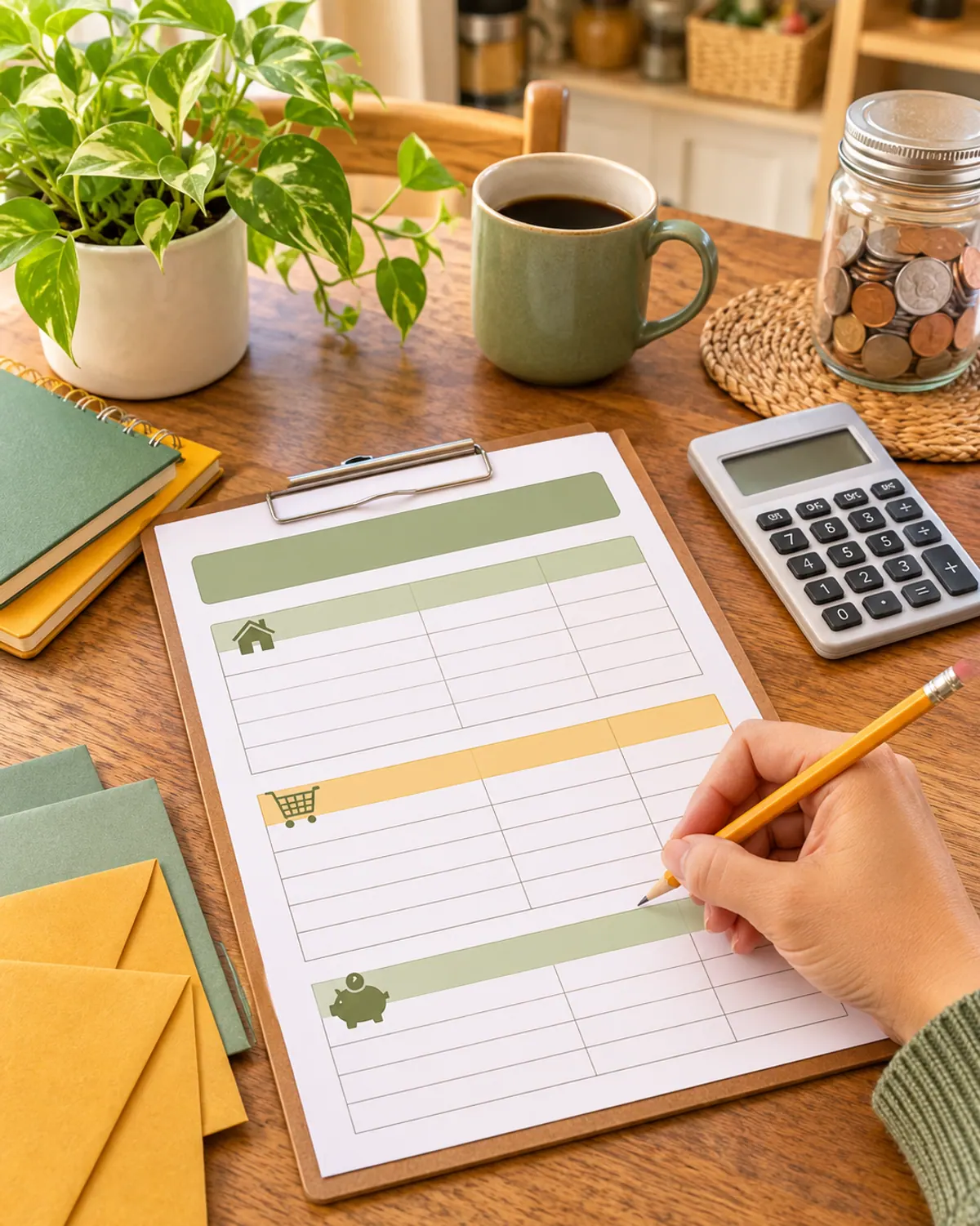
Now give every dollar of the floor a job, starting with the must-pays: housing, utilities, food, transport, phone and insurance, and minimum debt payments. Savings come last but still get a line, even a small one. This is the same idea as a zero-based budget, just run on your lowest number.
| Line | Amount |
|---|---|
| Rent | $950 |
| Utilities | $160 |
| Groceries | $450 |
| Transport | $220 |
| Phone and insurance | $180 |
| Minimum debt payment | $90 |
| Savings | $50 |
| Total | $2,100 |
When the line items add up to the floor, you are done. If they add up to more than your floor, that is useful to know before a slow month shows up: trim a line, or look at ways to make a low-income budget work. A bills tracker helps you see which bills are due before money arrives.
Step 3: Split Every Dollar Above the Floor Into Three Buckets
When a month comes in above the floor, the extra does not go to the first thing that looks good. It goes into three buckets, with the shares you choose. The example uses 50% float, 30% goals and debt, 20% fun, which is not the same as the 50/30/20 rule; change the shares to fit your life.
Float: a cushion in its own savings account that covers any future month below the floor.
Goals and debt: your emergency fund, sinking funds and extra debt payments.
Fun: money you can spend without guilt, because the bills and the cushion are already handled.

| Month | Extra above $2,100 | Float (50%) | Goals and debt (30%) | Fun (20%) |
|---|---|---|---|---|
| June | $550 | $275 | $165 | $110 |
| July | $1,300 | $650 | $390 | $260 |
| August | $0 | $0 | $0 | $0 |
| September | $950 | $475 | $285 | $190 |
| October | $250 | $125 | $75 | $50 |
| November | $1,800 | $900 | $540 | $360 |
| Total | $4,850 | $2,425 | $1,455 | $970 |
After six months in the example, the float holds $2,425, which is a little over one full month of the $2,100 floor. Goals and debt received $1,455, and $970 went to fun, all without touching the bills.

What if a month comes in below the floor? Take the gap from the float. If a month brought in $1,700, you are $400 short of $2,100. Moving $400 out of the $2,425 float leaves $2,025, and the bills are still paid.

Step 4: Check In Each Month and Reset the Floor
At the end of each month, write what really came in, subtract the floor, and run the split. It takes about 15 minutes with a pencil. Every few months, look at your last 12 months again, because your lowest month can change.

A simple rule you can try: once the float equals at least one full month of the floor (here $2,100), you can start raising the floor in small steps, like $100 at a time, only if the float stays above that line. Another option is to pay yourself the floor on a fixed day each month and leave the rest in the bucket accounts. Both are examples to adapt, not advice.
Free Irregular Income Budget Pages
These two free pages work with the method. They are general budget pages, not made only for irregular pay, so here is how to use them.
The free zero-based budget template (PDF) has a page for assigning every dollar down to $0, a two-paycheck page and a When the Month Changes page for moving money when income comes in lower. Use it for Step 2 and for the days a month falls short. No sign-up is needed.
The free monthly budget sheet (PDF) has Planned and Actual columns. Write the floor budget in Planned, then write what really happened in Actual, and the totals row shows what is left to split into buckets.

Irregular Income Budget Mistakes to Skip
Do this
- Plan from your lowest month
- Fund the float first when extra money arrives
- Keep the float in its own account
- Recheck your lowest month every few months
Skip this
- Budgeting on your average month
- Spending a high month before the buckets are filled
- Leaving the float in checking
- Treating a slow month as a failure of the plan
Variations: Seasonal Work, Commission and Gig Pay
Seasonal work: use your slowest month of the year as the floor, and let the busy months fill the float so it can carry you through the slow season.
One steady and one variable income: build the floor from the steady paycheck and the variable one's lowest month, and send everything above it to the buckets.
Paid every week or per job: add up the deposits at month end, then run the same split. If you are paid every two weeks on a steady amount, our biweekly budget guide fits better.
A slow month is not a surprise when your budget is already built to fit it.
Keep Your Floor Budget and Buckets on Paper
If your pay changes every month, the printable pages keep each month's income, bills and buckets in one place. The Cozy Budget Planner 2027 ($12) gives each month its own budget page and an end-of-month check, so you can write the floor on top and record the split below it.
Want the savings, cash envelope, debt, grocery and Christmas pages next to it? The Cozy Money Binder ($21, 181 pages) includes the planner and five more printables that would cost $46 bought separately, plus a weekly 15-minute check-in page. The code COZY20 takes 20% off at checkout. Personal organizing tool, not financial advice.
Frequently asked questions
What is an irregular income budget?
It is a budget for money that changes from month to month, like freelance, seasonal, commission or gig pay. The lowest-month method sets your bills against your smallest recent month and sends anything extra to savings, goals and fun.
How do you budget when your income changes every month?
Find your lowest take-home month from the last 6 to 12 months, budget that amount down to $0, then split every dollar above it into buckets. A slow month is then already covered.
Should you budget from your average or your lowest month?
The lowest month is safer, because an average overstates what a slow month brings in. In our example the average is $2,908 but the lowest month is $2,100, so an average-based budget is about $808 short in the slow month.
What do I do with the extra money in a high month?
Split it into buckets. The example uses 50% float, 30% goals and debt and 20% fun, but you can change the shares. Move the money the day it arrives.
What if my lowest month does not cover my bills?
Then the plan is showing a gap early. Trim lines you can control, look at the order for cutting spending on the free template's When the Month Changes page, and build the float with any extra month. This is education, not personalized financial advice.
Save it for later
Pin this to your Budgeting Basics board so it's there when you need it.
Save to Pinterest