This post contains affiliate links. As an Amazon Associate we earn from qualifying purchases, at no extra cost to you. Read our disclosure.
Safety first: This is general money education, not personalised financial advice. Please read our financial disclaimer before you start.
Key takeaways
- A low buy year means you spend less on wants and still buy needs. A no buy year pauses almost all wants.
- Start with seven rules in one table and four spending lanes, each with a yearly cap.
- In our example, a cap one third below last year's spending in every lane keeps $1,380 over the year (our arithmetic, example numbers).
- An urge log with a 30-day wait does most of the work, so write wants down instead of arguing with yourself.
- Give gifts and holidays their own lane so December does not break the year.
In this post13 sections
- Low Buy Year Rules: The Table First
- What a Low Buy Year Is (and What It Is Not)
- Low Buy vs No Buy Year
- Set Four Spending Lanes With Yearly Caps
- A Worked Example Year With the Math
- Keep an Urge Log With a 30-Day Wait
- Start Your Low Buy Year on January 1
- Gifts and Holidays Inside a Low Buy Year
- Use Up What You Own First
- Keep the Rules, Lanes and Ledger on Paper
- Low Buy Year Supplies
- Related Reading
- FAQ
Quick note: product links go to Amazon search results or our own shop, and we may earn a small commission if you buy, at no extra cost to you. Every dollar figure here is a labelled example, not advice about your money. This is general information, not financial advice.
Low Buy Year Rules: The Table First
Here are seven rules you can copy on January 1. Change any number to fit your household. The right column shows what each rule looks like on an ordinary day.
| Rule | What it means | What it looks like |
|---|---|---|
| Needs list | Write down what is always allowed: groceries, bills, medicine and work clothes you truly need | Shampoo you run out of is allowed; a fourth candle is a want |
| Four lanes | Every want belongs to one lane, and each lane has its own yearly cap | Things, Fun and food out, Gifts and holidays, Hobbies and subscriptions |
| Wait 30 days | A want goes on the urge log and waits 30 days before you decide | A $48 jacket logged on March 3 is decided on April 2 |
| Use up first | Finish, wear out or use up what you own before you buy the next one | Finish the open bottle before a new one comes home |
| One in, one out | When a new item arrives in a category, an old one leaves the house | A new sweater arrives and an old one goes to donation |
| Borrow, repair, buy used | Try the library, a repair or a used listing before buying new | Sew the button; borrow the book |
| Review monthly | Spend 10 minutes at month end comparing each lane to its cap | Fun lane at $63 of $80, so you know what is left |
These seven rules fit on one page. The lanes and caps are the part most guides skip, so the next sections show how to build them.
What a Low Buy Year Is (and What It Is Not)
A low buy year is a year of buying fewer non-essentials on purpose. You still buy food, bills, medicine and things you truly need. What changes is the pile of small extras: clothes, decor, beauty items, gadgets, impulse buys and subscriptions. The point is not to feel deprived. It is to spend on what you chose ahead of time.
It suits you if you want to cut back and keep a normal routine, rather than live on a strict rule for 12 months. The one-month version is in low spend month rules that make it doable, and the January version is the no spend challenge for January.
Low Buy vs No Buy Year
The main difference is how much you allow. A low buy year caps your wants. A no buy year pauses most of them for the whole stretch.
| Question | Low buy year | No buy year |
|---|---|---|
| What you can buy | Needs plus wants inside lane caps | Needs only, plus a short allowed list |
| Hardest part | Staying under a cap when each want is small | Saying no to almost everything for a long time |
| Best for | Cutting back without a full stop | A hard reset, such as when a bill needs paying down |
| Rules to write | Seven rules, four lanes, yearly caps | A short allowed list and an exception rule |
| Easiest way to fail | No lane for gifts or holidays | One slip feels like the end of the attempt |
If you want a pause rather than a cap, try a shorter run first, such as no spend November, and move to a low buy year once you know which wants are hardest for you.

Set Four Spending Lanes With Yearly Caps
A lane is a group of wants with one cap. Four lanes cover most households, and four are easier to track than ten categories.
| Lane | What goes in | Example yearly cap | Per month |
|---|---|---|---|
| Things | Clothes, shoes, decor, beauty items, gadgets | $720 | $60 |
| Fun and food out | Coffee shops, takeout, movies, outings | $960 | $80 |
| Gifts and holidays | Birthdays, Christmas, hosting | $600 | $50 |
| Hobbies and subscriptions | Craft supplies, apps, streaming, books | $480 | $40 |
| Total | $2,760 | $230 |
To set your own caps, take the last three months of card and bank statements, add up what went to each lane and divide by 3. Then lower each lane by a step you can live with. In our example every lane is one third lower, which is a starting point and not a target for everyone.

A Worked Example Year With the Math
This example household is made up to show the arithmetic. It is not a real person and not a result to expect. Before the year, the household spent about $4,140 on the four lanes. The yearly caps are one third lower in every lane.
| Lane | Before (per year) | Cap (per year) | Difference |
|---|---|---|---|
| Things | $1,080 | $720 | $360 |
| Fun and food out | $1,440 | $960 | $480 |
| Gifts and holidays | $900 | $600 | $300 |
| Hobbies and subscriptions | $720 | $480 | $240 |
| Total | $4,140 | $2,760 | $1,380 |
The $1,380 difference is $115 a month if it is set aside evenly ($1,380 divided by 12). Decide before January 1 where it goes, such as a starter emergency fund, a debt payment or a Christmas 2027 fund.
Spending does not arrive evenly, so the next table spreads the caps across the four quarters. Gifts are heavy in the fourth quarter.
| Quarter | Things | Fun and food out | Gifts and holidays | Hobbies and subscriptions | Quarter total |
|---|---|---|---|---|---|
| Q1 (Jan to Mar) | $180 | $240 | $60 | $120 | $600 |
| Q2 (Apr to Jun) | $180 | $240 | $120 | $120 | $660 |
| Q3 (Jul to Sep) | $180 | $240 | $90 | $120 | $630 |
| Q4 (Oct to Dec) | $180 | $240 | $330 | $120 | $870 |
| Year | $720 | $960 | $600 | $480 | $2,760 |
In the example, the $330 gifts cap in the fourth quarter is 55% of the yearly gifts lane ($330 divided by $600). That is on purpose, because most gift spending lands in November and December.

Keep an Urge Log With a 30-Day Wait
An urge log is a list of wants with a date and a price. You write the want down, then wait 30 days before you decide. Many wants fade in that time, and the ones that stay are the ones worth the money. Here are four made-up entries.
| Date | Want | Price | Lane | Decision after the wait |
|---|---|---|---|---|
| Mar 3 | Jacket on sale | $48 | Things | Skipped, the winter coat still works |
| Mar 9 | Paint set | $22 | Hobbies and subscriptions | Skipped, finished the old set first |
| Mar 14 | Pair of boots | $60 | Things | Bought on Apr 13, the old pair had a hole |
| Mar 21 | Concert tickets with a friend | $45 | Fun and food out | Bought on Apr 20, planned in the lane |
Two of the four wants were skipped, which kept $70 in the lanes ($48 plus $22). The other two were bought on purpose, and both fit inside their caps. The log is not a list of shame. It shows which wants pass the wait.

Start Your Low Buy Year on January 1
-
Step 1: Write your needs list
List what is always allowed: groceries, bills, medicine, transport to work and clothes you truly need. This takes about 10 minutes and keeps you from arguing with yourself later.
-
Step 2: Add up three months by lane
Use card and bank statements from the last three months. Put each want into one of the four lanes, add up each lane and divide by 3 to find your monthly average.
-
Step 3: Set a yearly cap for each lane
Lower each lane by a step you can live with. The example in this guide uses one third, but 10% or 20% is still a low buy year.
-
Step 4: Start the urge log
Use a notebook or the notes app. Write the date, the want, the price and the lane, then write the date 30 days away.
-
Step 5: Book the monthly review
Put a 10-minute review on the calendar for the last day of each month. Compare each lane to its monthly share of the cap and carry on.
Gifts and Holidays Inside a Low Buy Year
The lane that breaks most low buy years is gifts and holidays, because the spending lands in a few weeks. Give it a real cap and plan it ahead. Christmas on a budget walks through one number for the whole season, and the Christmas budget calculator helps you set it. If you buy for friends and coworkers, cheap gifts under $10 keeps a long list inside a short cap.

Use Up What You Own First
The use-up rule is the cheapest part of a low buy year, because it costs nothing. Start with a short list and add to it as you find things.
Use-it-up starter list

Keep the Rules, Lanes and Ledger on Paper
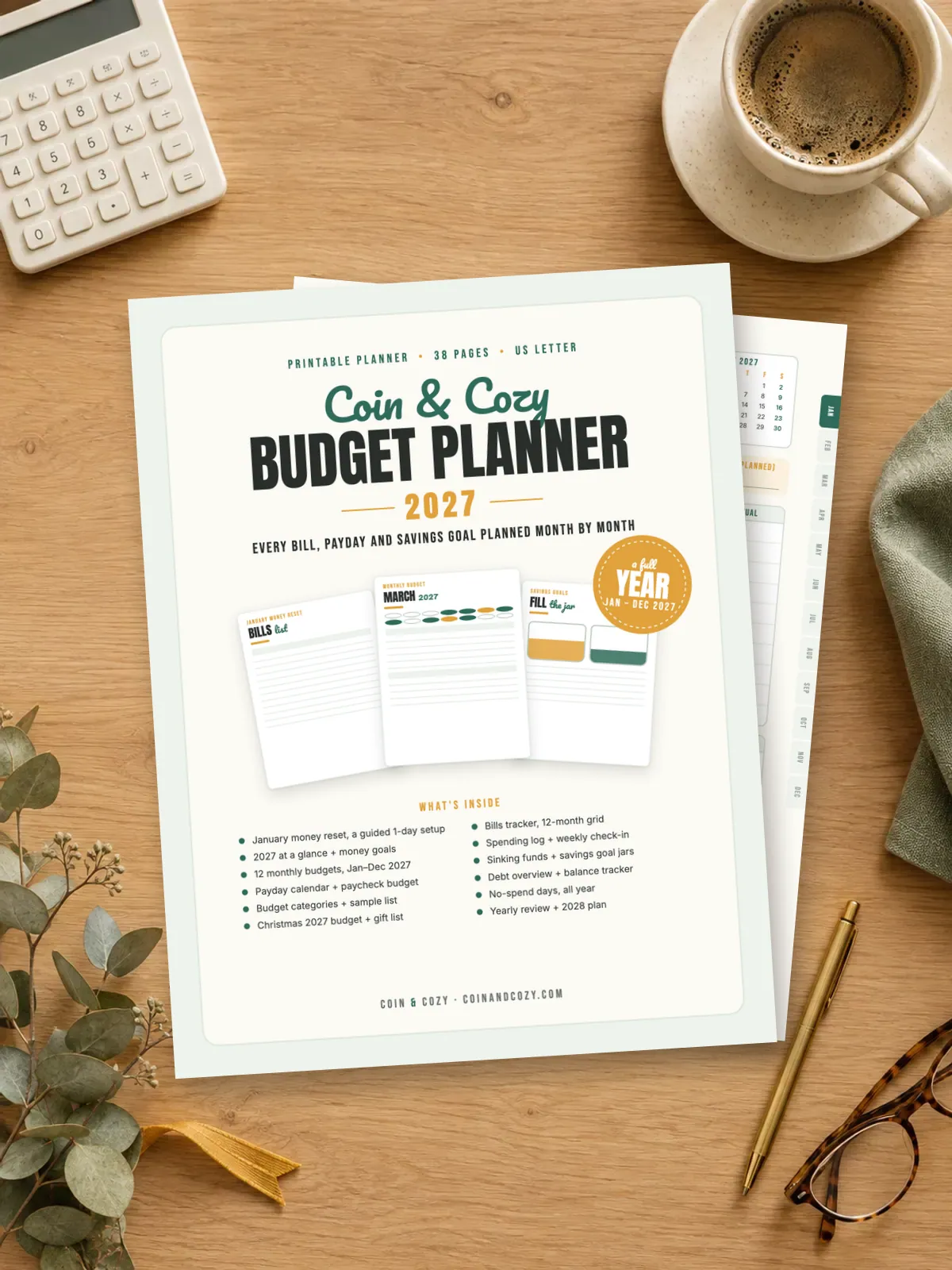
The Cozy Budget Planner 2027 has a whole-year no-spend days grid to color in, 12 dated monthly budget pages with an end-of-month check, and a Christmas 2027 budget and gift list, so the rules table, the lane caps and the gifts lane each have a page to live on.

Low Buy Year Supplies
You can run a low buy year with a notebook you already own. If you want a few things, these are cheap.
Low buy year supplies
-
Lined A5 notebook
Typically $5 to $12
Holds the rules, the lane caps and the urge log in one place.
Check price on Amazon for Lined A5 notebook -
Cash envelope set with a zipper wallet
Typically $8 to $15
Gives each lane a physical home if you like to spend cash.
Check price on Amazon for Cash envelope set with a zipper wallet -
Paper wall calendar
Typically $5 to $12
Mark the day each want can be decided, 30 days out.
Check price on Amazon for Paper wall calendar
Related Reading
If you want a short trial first, start with low spend month rules that make it doable. To plan the money you keep, see the new year budget plan you can reset in one evening and small, doable financial goals for 2027.
Frequently asked questions
What are good low buy year rules?
Start with seven: a needs list, four spending lanes with yearly caps, a 30-day wait, use up first, one in one out, borrow or repair first and a monthly review. Change the numbers to fit your household.
What is the difference between a low buy year and a no buy year?
A low buy year caps your wants in lanes and still lets you buy inside the caps. A no buy year pauses most wants for the whole stretch and allows only needs and a short list.
Can I buy gifts during a low buy year?
Yes. Give gifts and holidays their own lane with a yearly cap and plan it before November. In our example the lane is $600 for the year, with $330 of it in the fourth quarter.
How much can a low buy year save?
It depends on what you spend now. In our made-up example, a cap one third lower in four lanes keeps $1,380 over a year (example numbers, our arithmetic). Add up your own last three months to find your number. This is not financial advice.
What if I slip during a low buy year?
Write the purchase in the log under its lane, check the lane total at month end and carry on. One slip does not end a low buy year.
Is a low buy year the same as a no spend challenge?
No. A no spend challenge is usually a short stretch with a strict allowed list. A low buy year is longer and uses lane caps, so it is easier to keep up.
Save it for later
Pin this to your No-Spend Challenges board so it's there when you need it.
Save to Pinterest