This post contains affiliate links. As an Amazon Associate we earn from qualifying purchases, at no extra cost to you. Read our disclosure.
Safety first: This is general money education, not personalised financial advice. Please read our financial disclaimer before you start.
Key takeaways
- Three plans: $200 ($5 a day plus three $15 boosts), $500 (save the date plus a $4 finish) and $1,000 ($32 a day plus an $8 finish).
- January 2027 starts on a Friday, so a weekly payer has 5 paydays and the $500 plan is $100 each.
- Missed a day? Write owed, pay it back within 7 days, or shrink the goal. Never restart.
- The plan tables are free to copy; the $7 printable bundle is optional.
In this post10 sections
- January Savings Challenge: Three 31-Day Plans at a Glance
- Pick Your January Savings Challenge by Pay Schedule
- How to Run the January Savings Challenge in 4 Steps
- The $200 Plan: $5 a Day Plus Three Payday Boosts
- The $500 Plan: Save the Date, Count Up From $1
- The $1,000 Plan: $32 a Day With an $8 Finish
- What to Do When You Miss a Day
- Make the January Savings Challenge Easier to Keep
- Where January's Savings Can Go Next
- FAQ
January Savings Challenge: Three 31-Day Plans at a Glance
January 2027 has 31 days and starts on a Friday, so the month is four full weeks plus three days. Each plan below is built on that calendar, and each one adds up to its total exactly (we checked every sum by adding all 31 days).
| Plan | The daily rule | Jan 1 | Jan 31 | Average per day | Total |
|---|---|---|---|---|---|
| $200 plan | $5 a day, plus three $15 payday boosts | $20 | $5 | $6.45 | $200 |
| $500 plan | Save the date: $1 on Jan 1 up to $31 on Jan 31, plus a $4 finish | $1 | $35 | $16.13 | $500 |
| $1,000 plan | $32 a day, plus an $8 finish on the last day | $32 | $40 | $32.26 | $1,000 |

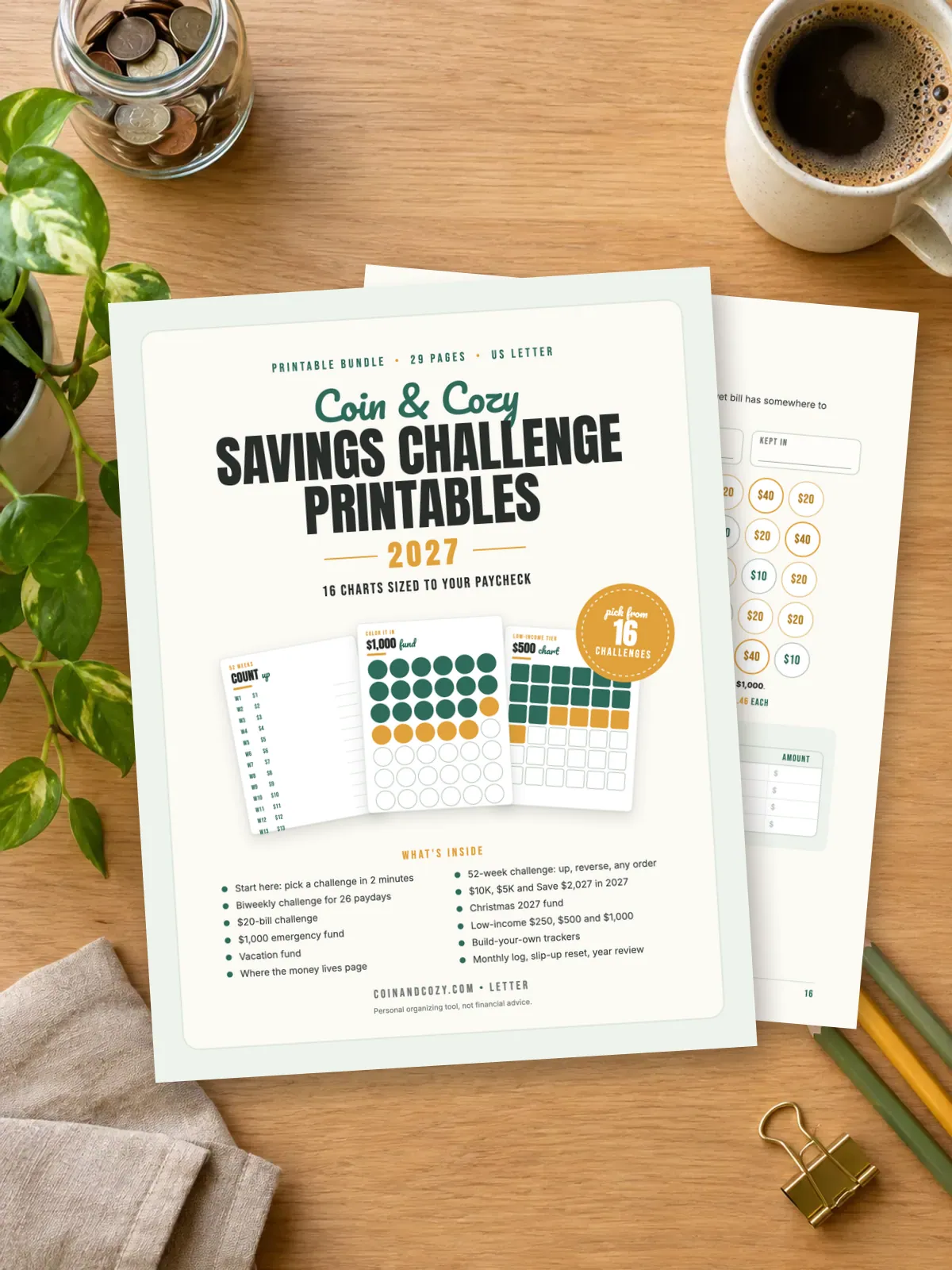
The next step after choosing a plan is a place to color it in. The Savings Challenge Printables 2027 ($7, 29 pages) start with a two-minute chooser page where you write what you can set aside each payday and it points to the charts that fit, with the total and rough per-paycheck amount for each. It also has $250, $500 and $1,000 charts with small boxes and a reset page for slip-ups. The January plans on this page are free to copy into a notebook, and the pages in the bundle are not set to January dates, so use them if you want color-in charts for the rest of the year.
Pick Your January Savings Challenge by Pay Schedule
The same plan feels different depending on how often you are paid. A $500 month is a small deposit when you get paid every Friday and a big one when you are paid once. Count your paydays first, then read your row.
| Pay schedule | Paydays in January 2027 | $200 plan | $500 plan | $1,000 plan |
|---|---|---|---|---|
| Every Friday | 5 (Jan 1, 8, 15, 22, 29) | $40.00 | $100.00 | $200.00 |
| Every other Friday | 3 (Jan 1, 15, 29) or 2 (Jan 8, 22) | $66.67 or $100.00 | $166.67 or $250.00 | $333.33 or $500.00 |
| Twice a month | 2 | $100.00 | $250.00 | $500.00 |
| Once a month | 1 | $200.00 | $500.00 | $1,000.00 |

A payday is not the same as a take-home amount, so use this table only to see the size of each deposit. If your pay date lands on a weekend or holiday it can shift. Not sure which plan fits? Use the tightest-month test: look at the month last year when the least was left after bills and groceries, and pick the plan whose per-payday amount is below that number. Our 2027 savings challenge guide walks through that test with twelve full-year challenges.
How to Run the January Savings Challenge in 4 Steps
-
Step 1: Pick one plan and write it down
Choose $200, $500 or $1,000 and write the total and the start date at the top of a notebook page or printed chart. One plan at a time is plenty for a first month.
-
Step 2: Copy the days onto a calendar
Draw 31 boxes and write the amount in each one, using the week tables below. Mark your paydays so you know which boxes you can fill the same day.
-
Step 3: Choose where the money goes
Use a spot you will not spend from by accident, such as a labeled envelope or a separate savings account. Move the money when you tick the box, not at the end of the month.
-
Step 4: Tick a box, then check once a week
Tick each day when the money moves. Once a week, compare your running total with the cumulative column in your plan table.

Prefer to save once a week instead of every day? Add up the week row in your plan and move that amount on payday. The week tables below show both the weekly total and the running total, and they are the same numbers whichever way you do it.
The $200 Plan: $5 a Day Plus Three Payday Boosts
This is the gentlest plan. You save $5 every day, which is $155 over 31 days, and add three $15 boosts on paydays for $45 more. The example puts the boosts on January 1, 15 and 29, which are the three paydays of an every-other-Friday schedule. If you are paid on other dates, put the boosts on any three paydays you like.
| Days | Saved that week | Running total | How it adds up |
|---|---|---|---|
| Jan 1 to 7 | $50 | $50 | 7 x $5 = $35, plus a $15 boost |
| Jan 8 to 14 | $35 | $85 | 7 x $5 = $35 |
| Jan 15 to 21 | $50 | $135 | 7 x $5 = $35, plus a $15 boost |
| Jan 22 to 28 | $35 | $170 | 7 x $5 = $35 |
| Jan 29 to 31 | $30 | $200 | 3 x $5 = $15, plus a $15 boost |
This plan is the easiest to fit into a tight month. If $5 a day is still too much, cut the daily amount to $3 and keep the boosts, which comes to $93 plus $45, or $138. Smaller is fine: a plan you finish beats a bigger one you drop in week two.

The $500 Plan: Save the Date, Count Up From $1
The classic 31-day count-up: on January 1 you save $1, on January 2 you save $2, and so on to $31 on January 31. All 31 days add up to $496, so the plan adds a $4 finish on the last day to make a round $500, and January 31 becomes a $35 day.
| Days | Saved that week | Running total | How it adds up |
|---|---|---|---|
| Jan 1 to 7 | $28 | $28 | $1 + $2 + ... + $7 = $28 |
| Jan 8 to 14 | $77 | $105 | $8 + ... + $14 = $77 |
| Jan 15 to 21 | $126 | $231 | $15 + ... + $21 = $126 |
| Jan 22 to 28 | $175 | $406 | $22 + ... + $28 = $175 |
| Jan 29 to 31 | $94 | $500 | $29 + $30 + $31 = $90, plus the $4 finish |
The shape is easy to remember and the start is gentle, but the last week asks for $94, which is the heaviest. Only $105 is saved by the end of January 14. If you want the big days to land earlier, count down instead: start at $31 on January 1 and finish at $1, then add the $4 on the last day so the total is still $500.

The $1,000 Plan: $32 a Day With an $8 Finish
Thirty-two dollars a day for 31 days is $992, and an $8 finish on January 31 makes it $1,000. That is about $224 a week, so check that number against your pay before you commit. It is a good fit if you have a bonus, a tax-season cushion, a second income or a few things to sell, and a hard fit if your January is already tight.
| Days | Saved that week | Running total | How it adds up |
|---|---|---|---|
| Jan 1 to 7 | $224 | $224 | 7 x $32 = $224 |
| Jan 8 to 14 | $224 | $448 | 7 x $32 = $224 |
| Jan 15 to 21 | $224 | $672 | 7 x $32 = $224 |
| Jan 22 to 28 | $224 | $896 | 7 x $32 = $224 |
| Jan 29 to 31 | $104 | $1,000 | 3 x $32 = $96, plus the $8 finish |
Most people will not have $224 a week left over from regular pay. One way to reach a bigger number is to pair a smaller daily amount with one-time money: selling things you no longer use, a refund, or cash from a no-spend week. Our money saving plan for $1,000 in 30 days shows where that extra money can come from.
What we like
- A round number, often used as a starter emergency fund goal
- The same $32 every day, so there is no math to do
- Steady pace: $448 saved after the first two weeks
Keep in mind
- Needs about $224 a week of spare money
- One missed week is a $224 hole
- Hard to run alongside a no-spend challenge with other goals
What to Do When You Miss a Day
You will miss a day, and that is the point of having a rule ahead of time. The challenge does not restart; the missed amount just becomes a small debt to yourself that you pay back or let go of, in this order:
-
Step 1: Write "owed" in the box
Do not leave it blank and do not erase it. A box marked owed is a number you can see.
-
Step 2: Pay it back within 7 days if you can
Add the owed amount to your next payday deposit, or to any day when you have extra. Never double up the same day if it will leave you short for groceries.
-
Step 3: After 7 days, shrink the goal
If you still cannot pay it, cross the box out and subtract it from your total. The goal gets smaller; it does not start over.
Here is the math on a real example. In the $500 plan, if you miss January 12 and January 13, you owe $12 plus $13, which is $25. Pay it back and you still finish at $500. Let it go and your goal becomes $475, which is still $475 saved. The bundle also has a slip-up reset page if you would rather work it out on paper.

Make the January Savings Challenge Easier to Keep
January is a good month to start because the holiday spending is over and a calendar page is a natural reset. It is also a month when bills from December land, so a plan has to be small enough to survive them. Two ideas help.
First, find the money before you save it. Our no spend January rules give you a list of what to pause, and every dollar you skip can go into this challenge. Second, plan the spending side too: the new year budget plan sets up a simple budget in one evening, and the 30-day financial reset is a good companion for the first month.
January savings challenge starter checklist
Simple supplies for a savings challenge
-
Cash envelopes (reusable, labeled)
Typically $8 to $15 for a set
One labeled envelope keeps January's savings apart from everyday cash.
Check price on Amazon for Cash envelopes (reusable, labeled) -
Mini jars with lids
Typically $10 to $18 for a set
A jar you can see filling up helps you keep going.
Check price on Amazon for Mini jars with lids -
Colored pencils or highlighters
Typically $5 to $12
Color in each box when the money moves.
Check price on Amazon for Colored pencils or highlighters
Where January's Savings Can Go Next
When the month ends, move the money to its job: a starter emergency fund, a Christmas 2027 fund or the first payment on a debt. Our guide to how much your emergency fund should be can help you pick, and the Christmas savings plan shows how to start a holiday fund in January.

The numbers on this page are examples to help you plan, not promises, and no plan replaces a budget you can sustain. Pick the smallest deposit you can repeat, start on January 1 and let the tables do the math. This is general information, not financial advice; see our financial disclaimer.
If you want the charts printed, the Savings Challenge Printables 2027 ($7) are the next step, with the chooser page, the $250, $500 and $1,000 charts and a reset page for the days that go sideways. If you also want the budget, cash envelopes, debt and grocery pages in one binder, the Cozy Money Binder ($21) includes the savings printables, and the code COZY20 takes 20% off at checkout.
Frequently asked questions
What is the January savings challenge?
It is a 31-day plan that has you set aside a set amount each day of January. In our examples, $5 a day plus three $15 boosts saves $200, adding the date's number each day plus a $4 finish saves $500, and $32 a day plus an $8 finish saves $1,000. These are examples, not financial advice.
How much can I save in 31 days?
It depends on what you can set aside. The three plans here save $200, $500 or $1,000, which is about $6.45, $16.13 or $32.26 a day on average. Choose the one whose deposit is smaller than what was left in your tightest month.
Is there a free January savings challenge printable?
The three plan tables on this page are free to copy onto a calendar or into a notebook. Our free Cozy Savings Challenge Pack has a 100-envelope chart, a 50-envelope chart and a 30-day no-spend tracker you can use in the same month.
What if I miss a day of the savings challenge?
Write owed in the box and pay it back within 7 days if you can. After that, cross it out and subtract it from your goal. In the $500 plan, missing January 12 and 13 means $25 owed, so the goal becomes $475 if you do not pay it back.
How do I split the January savings challenge by paycheck?
Divide the plan total by the number of paydays in January. In 2027 a weekly payer has 5 Fridays, so the $500 plan is $100 a payday, and a twice-a-month payer has 2 paydays, so it is $250 each.

Save it for later
Pin this to your Savings Challenges board so it's there when you need it.
Save to Pinterest