This post contains affiliate links. As an Amazon Associate we earn from qualifying purchases, at no extra cost to you. Read our disclosure.
Safety first: This is general money education, not personalised financial advice. Please read our financial disclaimer before you start.
Key takeaways
- Pick the deposit first: the challenge that fits your tightest month is the one you will finish.
- The 52-week challenge saves $1,378, but counting up asks $202 in the four weeks from December 3.
- 2027 starts and ends on a Friday, so it has 53 Fridays; every-other-Friday pay is 26 or 27 paychecks.
- Add deposits, not totals, when you stack two goals: $1,000 plus $600 is about $61.54 a paycheck over 26 paychecks.
In this post10 sections
- 2027 Savings Challenge Compared: Totals, Weekly and Per Paycheck
- Pick Your 2027 Savings Challenge by Pay Schedule
- The 2027 Friday Savings Challenge: 53 Fridays to Plan For
- 52-Week Savings Challenge 2027: Count Up, Count Down or Color Any Box
- Small Paycheck Choices: $5 a Week, $250 and $500
- Bigger Goals: Save $2,027 in 2027, $5,000 or $10,000
- Stack Two Challenges Without Doubling the Pain
- How to Choose: The Tightest-Month Test
- Keep It Going After the First Month
- FAQ
2027 Savings Challenge Compared: Totals, Weekly and Per Paycheck
Most pages sell one challenge. Here are twelve in one table, so you can read across from the yearly total to what it asks of you each week and each payday. Weekly means the total divided by 52, and the paycheck columns divide by 26 (every two weeks) and 24 (twice a month).
| Challenge | Total | Weekly average (52) | Per paycheck, every 2 weeks (26) | Per paycheck, twice a month (24) |
|---|---|---|---|---|
| $250 low-budget chart | $250 | $4.81 | $9.62 | $10.42 |
| Steady $5 a week | $260 | $5.00 | $10.00 | $10.83 |
| $500 low-budget chart | $500 | $9.62 | $19.23 | $20.83 |
| Christmas 2027 fund | $600 | $11.54 | $23.08 | $25.00 |
| $1,000 emergency fund | $1,000 | $19.23 | $38.46 | $41.67 |
| 52-week challenge (also paydays, track A) | $1,378 | $26.50 | $53.00 | $57.42 |
| Vacation fund | $1,500 | $28.85 | $57.69 | $62.50 |
| $20-bill challenge (100 bills) | $2,000 | $38.46 | $76.92 | $83.33 |
| Save $2,027 in 2027 | $2,027 | $38.98 | $77.96 | $84.46 |
| Biweekly track B ($10 more each payday) | $3,510 | $67.50 | $135.00 | $146.25 |
| $5,000 challenge | $5,000 | $96.15 | $192.31 | $208.33 |
| $10,000 challenge | $10,000 | $192.31 | $384.62 | $416.67 |
For a chart that grows, such as the 52-week challenge, these are averages. The real deposits start small and finish large, which the 52-week section below shows week by week.

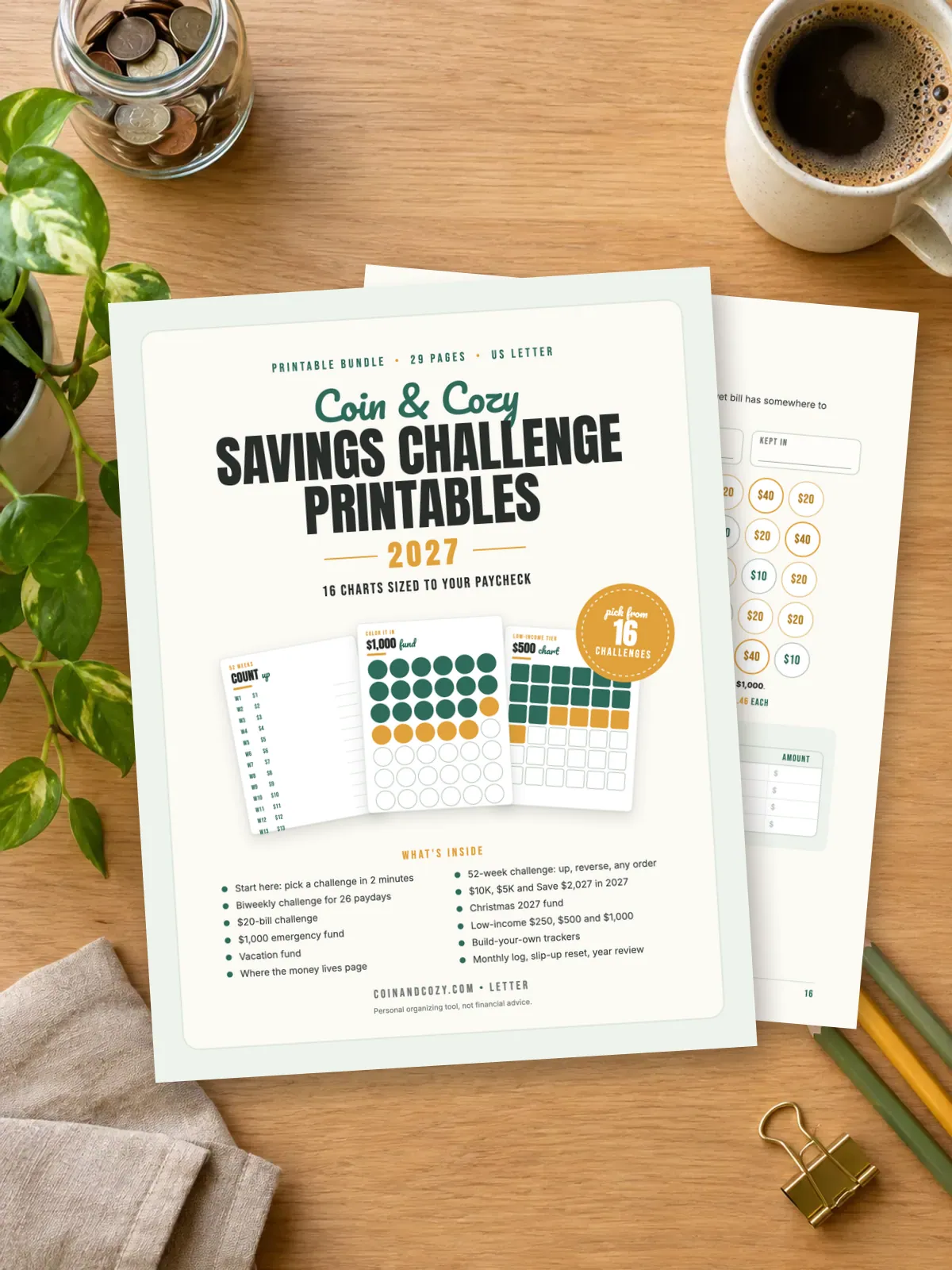
If you would rather print these than draw them, the Savings Challenge Printables 2027 are $7 and carry 16 charts in 29 pages. Page 2 is a two-minute chooser: you write what you can set aside each payday, find your row and it points to the charts that fit, with the total and rough per-paycheck amount next to each. You can try the steady weekly, Save $2,027 in 2027 and $250 pages first in the free sample PDF.
Pick Your 2027 Savings Challenge by Pay Schedule
The same goal feels different depending on how often you are paid. A $1,000 goal is a small deposit on 52 weekly paychecks and a bigger one once a month. Count your own schedule first, then read the row for your goal.
| Pay schedule | Deposits in 2027 | Save $1,000 | Save $2,027 |
|---|---|---|---|
| Weekly | 52 | $19.23 | $38.98 |
| Every two weeks | 26 | $38.46 | $77.96 |
| Twice a month | 24 | $41.67 | $84.46 |
| Monthly | 12 | $83.33 | $168.92 |

Paid every other Friday? The calendar matters in 2027. The year starts and ends on a Friday, so it has 365 days, which is 52 weeks plus one day, and 53 Fridays. If one of your paydays is Friday, January 1, you get 27 paychecks, and the three-paycheck months are January, July and December. If your first payday is Friday, January 8, you get 26 paychecks, and the three-paycheck months are April and October.
With 27 paychecks the same $2,027 goal comes to about $75.07 each instead of $77.96. Count the paydays on your own calendar before you divide, because pay dates that fall on weekends or holidays can shift.
The 2027 Friday Savings Challenge: 53 Fridays to Plan For
A Friday challenge is easy to follow: you move money once a week on the same day. In 2027 the first Friday is January 1 and the 52nd is December 24, the week of Christmas Eve, so a classic 52-week chart asks for $52 right then. The 53rd Friday is December 31, which makes a tidy free box for any amount you choose.

Prefer Saturdays? There are 52 of them, from January 2 to December 25, so a Saturday saver lands its biggest box on Christmas Day. If that feels wrong, start in week 2 or run the chart in reverse.
52-Week Savings Challenge 2027: Count Up, Count Down or Color Any Box
The classic chart saves $1 in week 1, $2 in week 2 and so on, up to $52, for $1,378 across the year. It is the most pinned chart for a reason, but where you start changes how it feels.
| Version | First 4 weeks | Last 4 weeks | After 26 weeks | Best if |
|---|---|---|---|---|
| Count up ($1 first) | $10 | $202 | $351 | you want a gentle start and can handle a heavy December |
| Count down ($52 first) | $202 | $10 | $1,027 | January feels easy and December is your tightest month |
| Color any box | your pick | your pick | your pick | your income changes a lot from week to week |
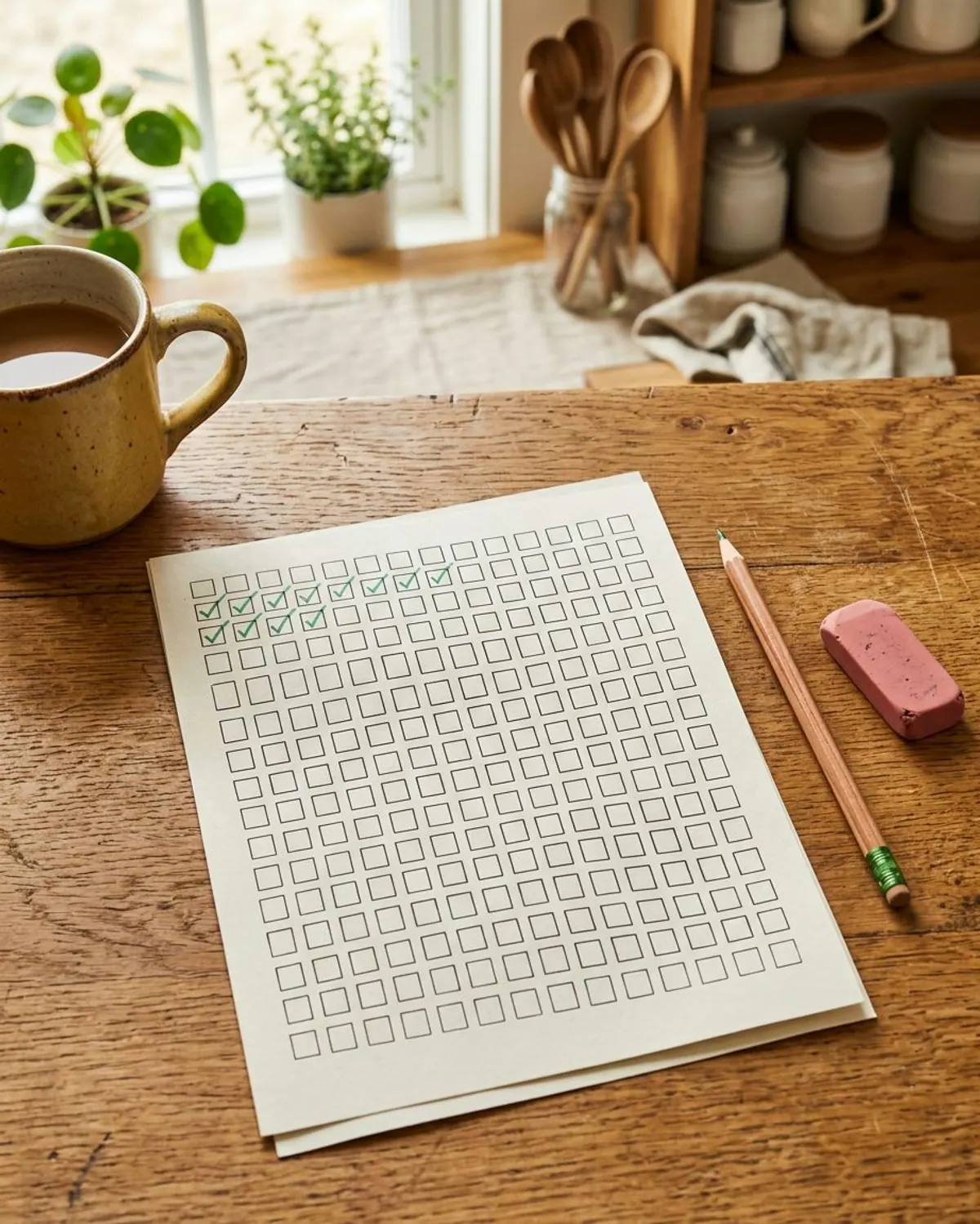
Counting up puts $202 into the four weeks that start December 3, 10, 17 and 24. Counting down saves $1,027 by the end of week 26, so you are ahead before the holiday spending starts. Our ways to do the 52 week savings challenge covers the step-down and same-amount-every-week versions in more detail.
What we like
- Starts at $1, so week 1 costs almost nothing
- One simple rule, easy to explain to a partner
- Works with any pay schedule if you group two weeks per payday
Keep in mind
- Counting up asks $202 in December, the month many budgets are already full
- Only $351 is saved by the end of June (after 26 weeks)
- A missed week can feel like failure unless you decide the catch-up rule in advance
Paid every two weeks? Combine two weeks per payday: $1 plus $2 is $3, then $3 plus $4 is $7, and so on. That makes 26 paydays that add up to the same $1,378, and the last payday is $103.
Small Paycheck Choices: $5 a Week, $250 and $500
If a $26 week is too much, you do not need a smaller version of the same idea. A steady $5 a week is $260 in a year, which is $10.00 on a 26-paycheck schedule. The $250 chart is about $9.62 a paycheck. The $500 chart is $19.23.

The best low-income savings challenge is the one you can repeat in your tightest month. Our list of money saving challenges for low income budgets has more ideas under $5 a day, and the free bi weekly savings challenge charts include a $5 and $10 plan.
Bigger Goals: Save $2,027 in 2027, $5,000 or $10,000
The Save $2,027 in 2027 chart works out to about $5.55 a day over 365 days, or $38.98 a week. In our version it has 81 boxes: 30 of $10, 30 of $20, 16 of $50, 4 of $75 and one $27 box, and they add up to $2,027. Because the boxes are different sizes you can color the small ones in a lean week and the $75 ones when money is easier.

The $5,000 challenge is about $192.31 a paycheck and the $10,000 challenge about $384.62. Those are big deposits, so check them against your budget first. Our 10K savings challenge guide shows how that goal looks at different pay schedules.
Stack Two Challenges Without Doubling the Pain
Run two goals at once by adding the deposits, not the totals. Say you start a $1,000 emergency fund and a $600 Christmas fund in January. Together that is $1,600, or about $61.54 each paycheck on a 26-paycheck schedule and $30.77 a week.

The Christmas fund alone is $23.08 a paycheck over 26 paychecks, or $25.00 over 24, and finishes before December if you start on the first payday of January. Our Christmas savings plan shows how to build one for the holidays, and the bundle has a plan page for running up to three challenges side by side.

How to Choose: The Tightest-Month Test
This method comes before the chart, not after it. Pick the deposit by your hardest month, then match it to the table.
-
Step 1: Find your tightest month
Look at the last 12 months and find the one with the least money left after bills and groceries. Write down what was left, even if it was only $20.
-
Step 2: Set the deposit below it
Pick a per-paycheck amount smaller than that number, rounded down to the nearest $5. If your tightest month left $60 over two paychecks, a $25 deposit leaves room.
-
Step 3: Match it to a row
Use the tier table below to see which charts fit that deposit, then choose one.
-
Step 4: Name where the money lives
Choose one envelope, jar or account before day one so the savings are not mixed with spending money.
-
Step 5: Write the rule for a missed week
Decide now whether you skip the box, add it to the end or color a smaller one. A rule made in advance keeps one slip from ending the chart.
| Deposit each paycheck | Challenges that fit |
|---|---|
| Up to $20 a paycheck | $250 low-budget chart ($9.62); Steady $5 a week ($10.00); $500 low-budget chart ($19.23) |
| $20 to $60 a paycheck | Christmas 2027 fund ($23.08); $1,000 emergency fund ($38.46); 52-week challenge ($53.00); Vacation fund ($57.69) |
| $60 to $150 a paycheck | $20-bill challenge ($76.92); Save $2,027 in 2027 ($77.96); Biweekly track B ($135.00) |
| More than $150 a paycheck | $5,000 challenge ($192.31); $10,000 challenge ($384.62) |

Not sure what to do with the other half of the budget? Our new year budget plan sets up the spending side in one evening. If you want to find the money first, try the no spend January rules and send what you skip to your chart.
2027 savings challenge starter checklist
Keep It Going After the First Month
The first three weeks are easy and week 6 is where charts stall. Put the chart on the fridge, tick the box the same day you move the money, and check your running total once a month. If you already use a planner, our biweekly budget template shows how to place the deposit before bills.
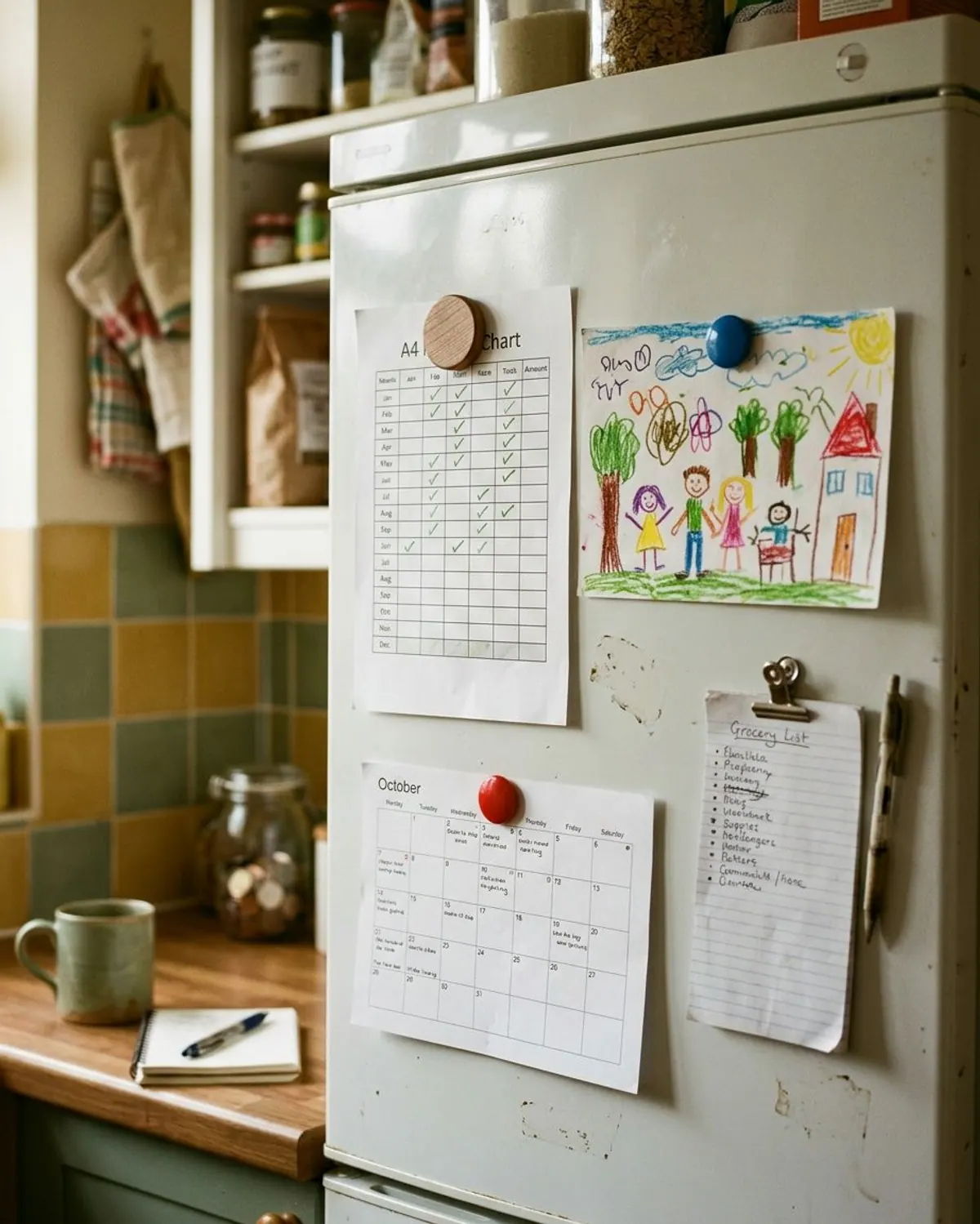
The bundle also has a reset page for slip-ups, so a missed week does not mean a restart. If you want one binder for every chart, plan, tracker and envelope, the Cozy Money Binder bundles those with the budget kits, though most readers only need the $7 chart pack to start.
Simple supplies for a savings challenge
-
Cash envelopes (reusable, labeled)
Typically $8 to $15 for a set
One labeled envelope per challenge keeps each goal separate.
Check price on Amazon for Cash envelopes (reusable, labeled) -
A6 binder with zip pouches
Typically $10 to $20
A small binder holds an A6 chart and the cash for it in one place.
Check price on Amazon for A6 binder with zip pouches -
Colored pencils or highlighters
Typically $5 to $12
Coloring each box as you save makes progress visible.
Check price on Amazon for Colored pencils or highlighters
The charts are examples and the amounts are yours to change. Pick the smallest deposit you can repeat, start on your next payday and let the table do the rest. This is general information, not financial advice; see our financial disclaimer.
Frequently asked questions
What is the best savings challenge for 2027?
The best one is the chart whose deposit you could still make in your tightest month. A steady $5 a week saves $260, the 52-week challenge saves $1,378 and the Save $2,027 in 2027 chart saves $2,027. These are examples, not financial advice.
How much do you save with the 52-week challenge in 2027?
$1,378, from $1 in week 1 to $52 in week 52. That averages $26.50 a week, or $53.00 a paycheck over 26 paychecks.
How many Fridays are in 2027?
There are 53. The year starts on Friday, January 1, and ends on Friday, December 31, so a Friday savings challenge has 53 deposit days, one more than the 52-week chart needs.
How much per paycheck do I need to save $2,027 in 2027?
On 26 paychecks it is about $77.96 each. On 24 it is $84.46, on 27 it is about $75.07, and monthly it is $168.92. Divide by your own number of paydays.
Can I do two savings challenges at once?
Yes, if you add the deposits, not the totals. A $1,000 fund and a $600 fund total $1,600, about $61.54 a paycheck over 26 paychecks. Start with a smaller second goal if that feels tight.
What if I miss a week?
Decide the rule before you start: skip the box, add it to the end or color a smaller one. Most charts have room to catch up, and a missed week is not a reason to restart.
Save it for later
Pin this to your Savings Challenges board so it's there when you need it.
Save to Pinterest