This post contains affiliate links. As an Amazon Associate we earn from qualifying purchases, at no extra cost to you. Read our disclosure.
Safety first: This is general money education, not personalised financial advice. Please read our financial disclaimer before you start.
Key takeaways
- The free couples budget template is a 4-page PDF: a one-page sheet for two incomes, a 20 minute money date agenda with a worked example, and a look at the 2027 planner.
- A fair split by income divides the shared bills in the same proportion as your take-home pay: $3,200 and $2,000 of pay means paying 61.5% and 38.5% of $2,600 in shared bills, $1,600 and $1,000.
- After a fair split each partner keeps the same share of their own pay, which is half in the example. An equal split of $1,300 each leaves $1,900 and $700.
- The money date has five timed steps: 3, 5, 5, 4 and 3 minutes, which add up to 20. Hold the first one this weekend and the next before January.
- Agree on an amount each of you spends without asking. Examples only, not financial advice: your own income, bills and debts come first.
In this post11 sections
- What Is on the Free Couples Budget Template
- How to Fill In the Sheet in Four Steps
- How to Split Bills Fairly When You Have Two Incomes
- Yours, Mine and Ours: What Each of You Keeps
- The 20 Minute Money Date Agenda
- Joint, Separate or Both: Where the Shared Money Lives
- Set a Christmas Total Together This Week
- Plan Your First Three Money Dates Before January
- New to Budgeting? Start Here
- Your Next Step After the Free Sheet
- FAQ
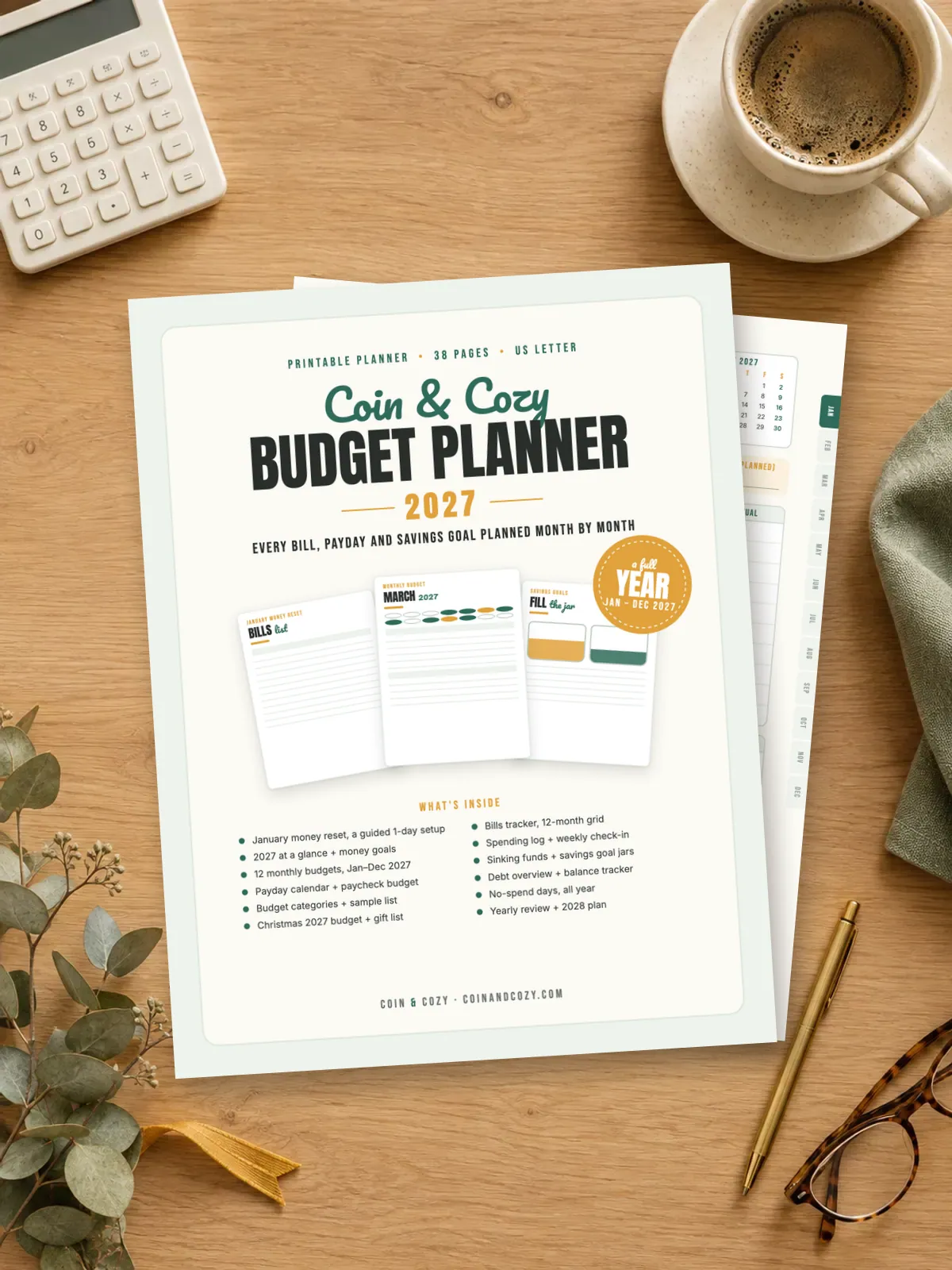
The free sheet plans one month for two people. If the two of you want every month of 2027 planned the same way, with a payday calendar and a bills tracker so shared bills never surprise either of you, the Budget Planner 2027 ($12) is the next step.
Some links on this page are Amazon affiliate links. If you buy through one, we may earn a small commission at no extra cost to you.
What Is on the Free Couples Budget Template
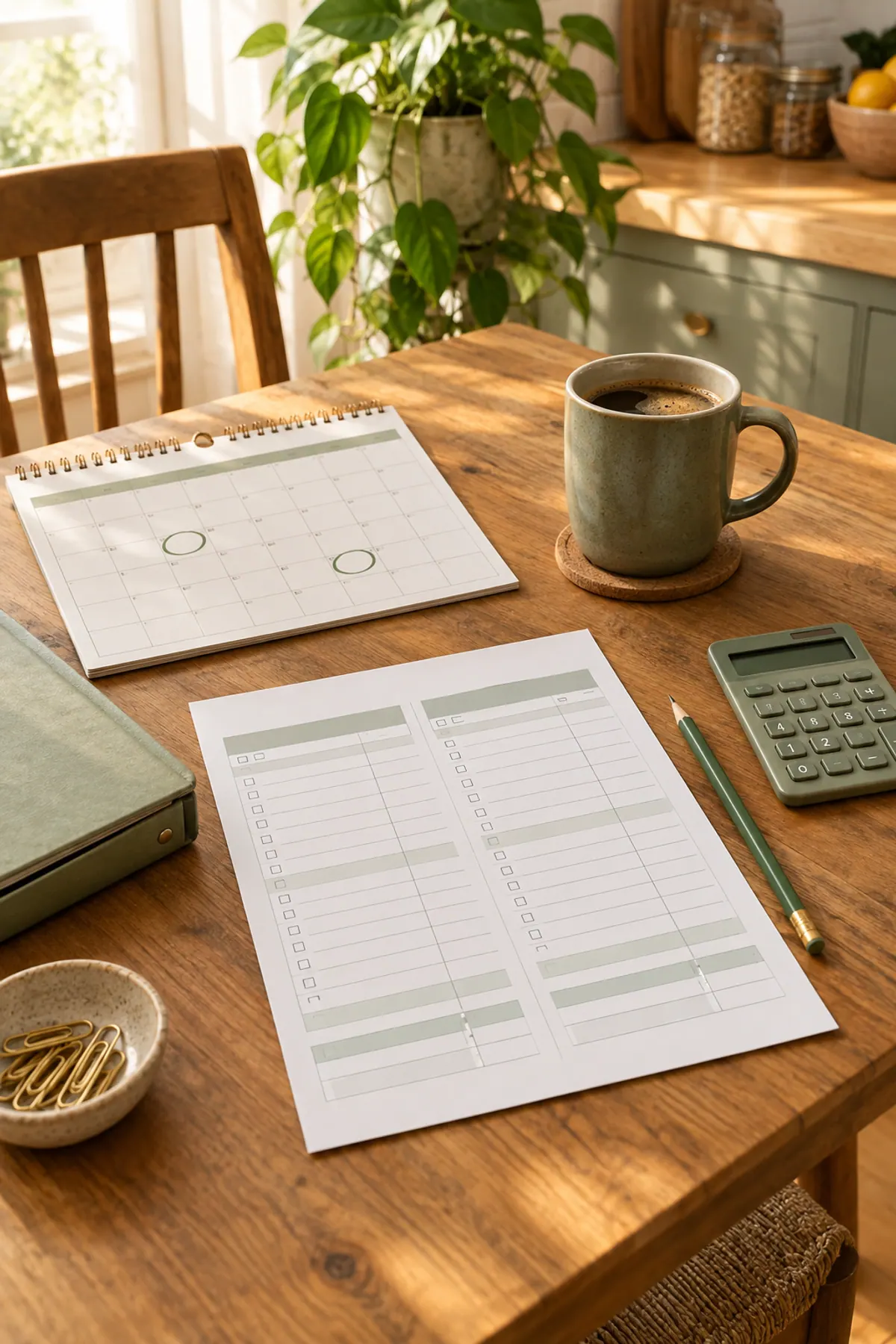
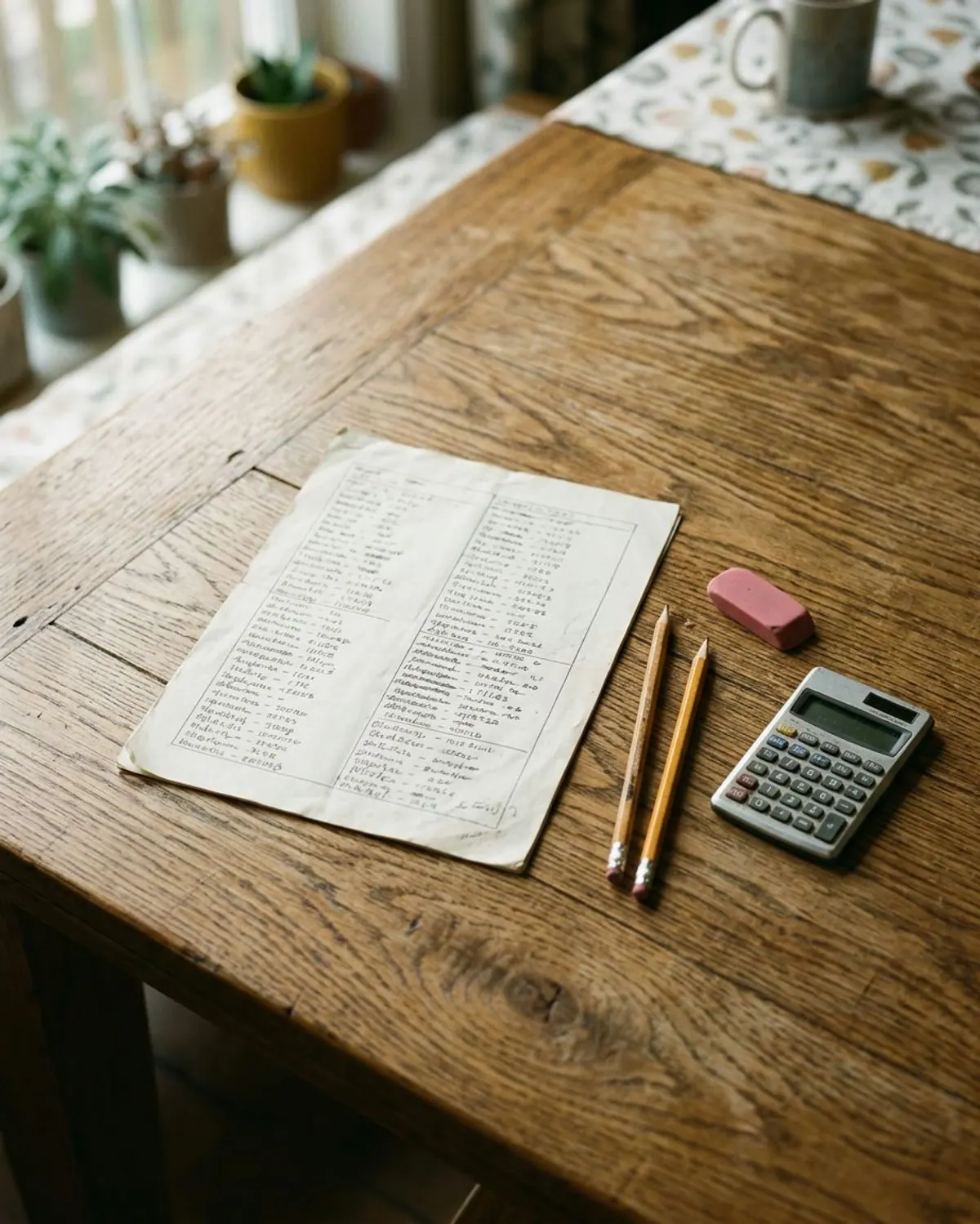
The download is a 4-page PDF in US Letter size. Page 1 is the cover. Page 2 is the one-page sheet, in four short steps: Money coming in for both take-home pays, Our shared bills, Who pays what and What is left: yours, mine and ours.
Page 3 is the money date: five timed steps that add up to 20 minutes, a short list of ground rules and a We decided box so nothing said out loud is forgotten. It also holds a worked example of the fair-split math with made-up amounts. Page 4 shows what the 2027 planner adds, so you can see it without any pressure to buy.
How to Fill In the Sheet in Four Steps
Sit side by side so you can both see the page. Use pencil, since a bill or a pay amount will change. Start with the month and the date of your money date at the top.
-
Step 1: Write both take-home pays
Put each person's pay after tax on its own row, then add them on the Together line. If pay changes from month to month, use a low or average month and note it, so the plan holds in a short month.
-
Step 2: List the bills you share
Write each shared bill with the day it is due and the amount: rent or mortgage, utilities, groceries, internet, insurance you share. Leave out each person's own phone, subscriptions and debts for now.
-
Step 3: Decide who pays what
Work out each person's share of the total from the pay rows, then multiply it by the shared bills total. Or split the total in half. Tick which way you chose, since both are on the page.
-
Step 4: Write what is left for each of you
Take each person's pay, subtract their share of the shared bills and the amount each of you adds to a shared goal. What remains is yours and mine, spent without asking.

How to Split Bills Fairly When You Have Two Incomes
There is no single right way to split shared bills, and the best one is the one you both agree on. Two methods cover most couples. An equal split is simple and easy to track. A split by income keeps the share each of you pays in line with what each of you earns, so the person with less pay is not left with much less to spend.
| Partner A | Partner B | Together | |
|---|---|---|---|
| Take-home pay | $3,200 | $2,000 | $5,200 |
| Share of the total pay | 61.5% | 38.5% | 100% |
| Pays by income | $1,600 | $1,000 | $2,600 |
| Left after shared bills (by income) | $1,600 | $1,000 | $2,600 |
| Pays if split equally | $1,300 | $1,300 | $2,600 |
| Left after shared bills (equal) | $1,900 | $700 | $2,600 |
The math is two steps. First each pay divided by the total: $3,200 divided by $5,200 is 61.5%, and $2,000 divided by $5,200 is 38.5%. Then each share times the shared bills: 61.5% of $2,600 is $1,600, and 38.5% is $1,000. After the split each person keeps half of their own pay, which is why many couples find it feels fair.
Under an equal split in the same example, one person keeps $1,900 and the other $700. Some couples are happy with that, and some are not, which is why it is worth talking about on purpose instead of letting it happen by default. Neither method is a rule: it is a starting point for a conversation, and your own numbers will differ.

| Method | How it works | Works well when | Watch out for |
|---|---|---|---|
| Equal split | Each pays half of the shared bills | Pay is close, or both want the simplest rule | The lower earner has far less left to spend |
| Split by income | Each pays the same share of the bills as their share of the total pay | Pay is different and you want similar breathing room | Needs a quick recalculation when either pay changes |
| One pays bills, the other saves or covers extras | Costs are divided by type, not by percentage | Both are happy with the trade and you review it often | Can drift into one person carrying the plan, so check it on every money date |
Yours, Mine and Ours: What Each of You Keeps
Step 4 on the sheet is the one couples tend to skip, and it matters most. Yours and mine is the money each of you can spend without checking with the other: a coffee, a hobby, a small gift. Ours is the shared goal you both add to, like a trip, a car repair fund or a Christmas fund.

Agree on these three amounts together
Write the amounts on the sheet and keep them for the month. If a number does not feel right by the next money date, change it then, not in the middle of the month when it can turn into an argument.

The 20 Minute Money Date Agenda
Pick one evening a month, put the phones face down and fill in page 2 together. A set time and a short list keep it friendly: you know when it ends, and so does your partner.
| Minutes | Step | What you do |
|---|---|---|
| 3 | Wins first | Name one thing that went well with money last month. Start friendly, then do the numbers |
| 5 | Last month against the plan | Tick off the shared bills that were paid. Where did you spend more or less than planned, and why? |
| 5 | Next month's money | Fill in both pays, list the shared bills and any big cost coming up, then work out the split |
| 4 | One goal | Pick one shared goal and one amount each of you adds this month. Small and steady beats big and skipped |
| 3 | Decide and close | Write who does what by when, set the next date and end on something nice |

Ground rules that keep a money date calm

Joint, Separate or Both: Where the Shared Money Lives
The sheet works with any setup, because it decides how much goes toward shared bills, not which bank holds it. Banks and their rules differ, so check with your own before changing accounts. This is general information, not financial advice.
| Setup | How it works | A good fit if |
|---|---|---|
| One joint account | Both pays go into one account, and bills and spending come out of it | You want one simple pot and one set of numbers |
| Separate accounts | Each keeps their own, and each sends an agreed amount for shared bills | You like your own account and a clear split |
| Joint plus separate | A joint account for shared bills and goals, and a personal account each for spending | You want shared bills handled and your own spending left alone |

Set a Christmas Total Together This Week
Christmas is 38 days away on Fri Dec 25 (checked Tue Nov 17, 2026), so the first money date is a good time to agree on one total for gifts, food and extras, before either of you shops. Write it on the Next month's money step, then divide it by the people on your list.
| Christmas total | Each partner adds | Per person on a list of 10 |
|---|---|---|
| $100 | $50 | $10 |
| $250 | $125 | $25 |
| $500 | $250 | $50 |

For the gift list itself, the Christmas budget planner and gift spending tracker shows how to track each gift against its cap. To pay for it from the paychecks you have left, see the free sinking funds printable, which divides what is still to save by the paychecks before Dec 25.
Plan Your First Three Money Dates Before January
Fri Jan 1, 2027 is 45 days away, which is enough time for three short money dates. Dates are suggestions: pick the evenings that suit both of you.
| Date | Days from Nov 17 | What to cover |
|---|---|---|
| Sat Nov 21 | 4 | Fill in the sheet for December: both pays, shared bills and your Christmas total |
| Sun Dec 13 | 26 | Check the Christmas total against what you have spent, then fix the split if a pay or a bill changed |
| Sun Dec 27 | 40 | Fill in the sheet for January and list the bills that restart, then pick one shared goal for 2027 |
For the January sheet, the free January budget template lists bills in the order they are due after Christmas. The 2027 financial goals guide helps you pick a shared goal that is small enough to keep. If you each get paid every 2 weeks, budgeting every paycheck shows how to match shared bills to payday.
New to Budgeting? Start Here
If neither of you has made a monthly budget before, how to build a monthly budget walks through it one step at a time, and the couples sheet above is the shared version of it. Start with the shared bills, since those are the ones you both feel when they are late.
Helpful, not required
-
Letter-size clipboard
Typically $6 to $15
Holds the sheet flat on the sofa or kitchen table during the money date.
Check price on Amazon for Letter-size clipboard -
Pencils with erasers
Typically $4 to $10
Pay and bills change, so write the sheet in pencil and keep one each.
Check price on Amazon for Pencils with erasers -
Basic desk calculator
Typically $6 to $14
Makes the fair-split math quick and keeps the date to 20 minutes.
Check price on Amazon for Basic desk calculator -
Pocket folders
Typically $5 to $12
One folder each for yours and mine, one for ours, if you like paper.
Check price on Amazon for Pocket folders
Your Next Step After the Free Sheet
Print the free sheet and hold your first money date this weekend. When one month feels easy and you want the shared bills, paydays and goals for all of 2027 on paper, the Budget Planner 2027 ($12) gives each month its own budget page, a payday calendar and a bills tracker. All amounts and dates here are examples for planning, not financial advice. Your own income, bills and debts come first.
Frequently asked questions
Is there a free couples budget template I can print?
Yes. The free 4-page PDF has a one-page couples budget sheet for two incomes, a 20 minute money date agenda and a worked example. Enter your email in the form on this page and the PDF is sent to you, then print page 2.
How do couples split bills when one earns more?
Many couples split shared bills by income. Divide each take-home pay by the combined total to get each share, then multiply by the shared bills. In the example, $3,200 and $2,000 of pay gives 61.5% and 38.5% of $2,600: $1,600 and $1,000. Others split equally. Pick the method you both agree on.
What is a money date?
A money date is a regular, short time when you look at money together. This one is 20 minutes once a month, in five timed steps: a win, last month, next month, one goal and a decision. Put the phones face down and write what you decide on the sheet.
Should we have a joint account or separate accounts?
Either can work with this sheet, because it sets how much goes toward shared bills, not where the money sits. Some couples use one joint account, some keep separate accounts and some use a joint account for shared bills plus a personal account each. Check your bank's rules. This is general information, not financial advice.
How much should each of us keep as spending money?
There is no set amount. Agree on one that feels fair to both of you, write it on step 4 of the sheet and keep it for the month. Change it at the next money date if it does not fit.
How often should we sit down and do this?
Once a month is enough for most couples, and 20 minutes is long enough for the sheet. Pick the same evening each month, such as the first Sunday, and write the next date on the sheet before you finish.
Save it for later
Pin this to your Budget Printables board so it's there when you need it.
Save to Pinterest